Your Travel Partner
SINCE 1989
Your Travel Partner
SINCE 1989
Mizoram sits in a part of India that, for most travellers – including many within India itself – remains genuinely unfamiliar territory. Tucked into the country's far northeast, bordered by Myanmar and Bangladesh, with a landscape of forested hills and a culture shaped as much by its tribal traditions and Christian missionary history as by anything most visitors would associate with "India" in a general sense, Mizoram offers an experience that's distinct from almost anywhere else covered on this list.
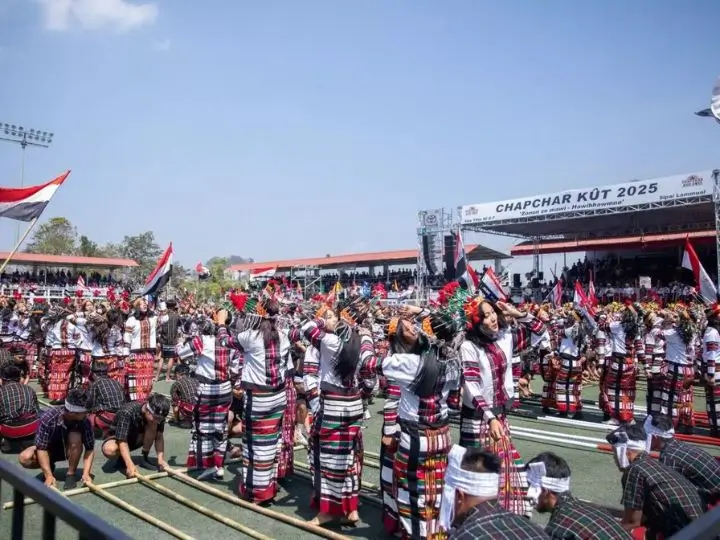
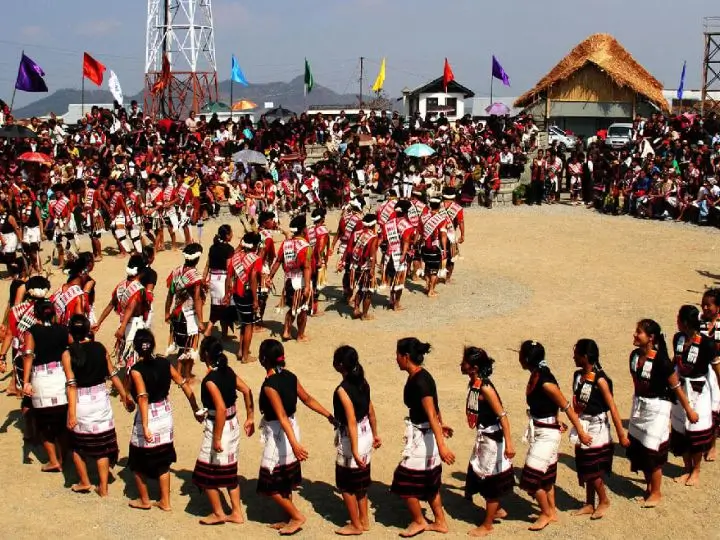
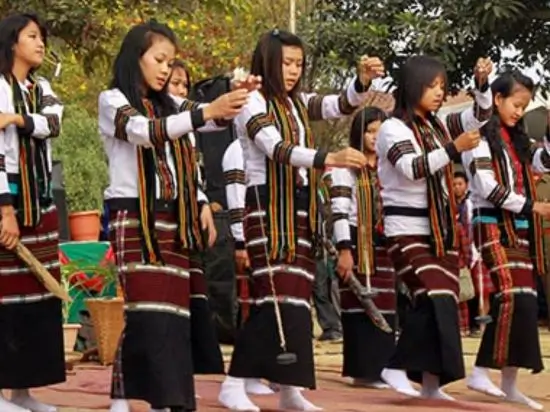
Chapchar Kut, the state's most prominent festival, is where this distinct culture is at its most visible – a spring festival celebrated with the kind of large-scale group dances that have become emblematic of Mizo identity, performed by thousands of participants in coordinated traditional dress.
Chapchar Kut traces its origins to the agricultural cycle of jhum (shifting) cultivation, traditionally practised by Mizo communities. The festival marks a period after jungle clearing (chapchar) has been completed and before the next phase of cultivation begins – a brief window of rest and celebration between stages of agricultural labour, when communities would come together for festivities before the work of planting resumed.
In its modern form, Chapchar Kut has become less directly tied to the agricultural calendar in practice – most participants today aren't engaged in jhum cultivation in the way earlier generations were – but the festival retains its identity as a spring celebration, marking a seasonal transition with dance, music, and community gathering.
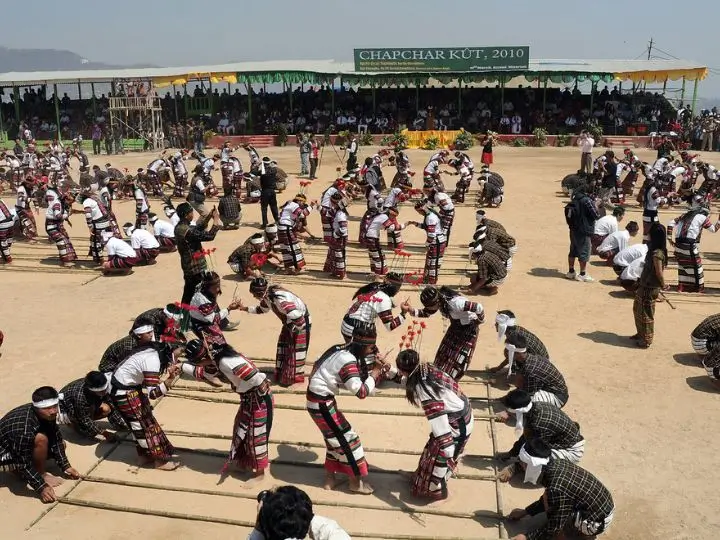
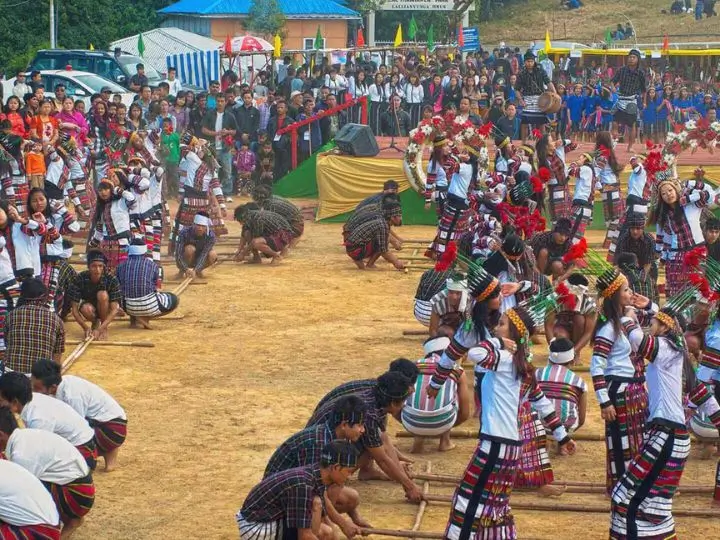
The festival's most recognisable element is Cheraw, often called the bamboo dance – a dance performed using long bamboo poles, held horizontally and rhythmically opened and closed by pairs of performers seated or kneeling on the ground, while dancers step in and out of the gaps between the poles in time with the music, their feet needing to move precisely as the poles open and close around them.
Cheraw is performed by large groups, often involving dozens or even hundreds of dancers and pole-holders simultaneously, dressed in traditional Mizo attire – woven shawls and skirts in distinctive patterns, with colours and designs that vary depending on the specific tradition or community. The visual effect of a large-scale Cheraw performance – the synchronised movement of poles and dancers across a wide space – is one of the festival's defining images, and for many visitors, the dance that Chapchar Kut is most associated with.
Alongside Cheraw, Chapchar Kut features a range of other traditional Mizo dances, each with its own movements, music, and significance – Khuallam, a dance traditionally performed to welcome guests, and various other group dances that showcase different aspects of Mizo cultural tradition. Traditional Mizo music, including instruments specific to the region, accompanies these performances, and the overall programme during the festival's main celebrations in Aizawl typically spans an extended period, with multiple groups and communities participating.
The scale of participation is part of what makes Chapchar Kut distinctive – this isn't a festival watched primarily by spectators with a small number of designated performers, but one in which large portions of the community, across different groups and villages, take part directly in the dancing and processions.
Aizawl, Mizoram's capital, is built across a series of ridges, giving the city a distinctive vertical character – roads wind along hillsides, and views across the city often take in multiple ridgelines covered in buildings that seem to follow the contours of the land rather than imposing a grid upon it.
Mizo culture more broadly reflects a history shaped significantly by 19th and early 20th century Christian missionary activity – the majority of Mizoram's population is Christian, and church attendance and community life organised around churches form a significant part of social structure in a way that's distinct from much of the rest of India. At the same time, traditional Mizo customs, language, and practices – including the dances central to Chapchar Kut – remain a strong part of cultural identity, creating a blend that's specific to this region and difficult to find an equivalent for elsewhere.
Mizo cuisine differs considerably from the food most travellers associate with India more broadly – rice forms a staple, often accompanied by vegetables, bamboo shoot preparations, and various meats prepared with comparatively less use of the spice combinations common in much of the rest of the country. For travellers, Mizo food offers a genuinely different culinary experience within an Indian itinerary, and Chapchar Kut, like many festivals, is accompanied by food specific to the occasion.
Hospitality in Mizoram is generally noted by visitors as warm and welcoming, with a sense of openness toward outside visitors that, given the region's relative unfamiliarity to most travellers, can come as something of a pleasant surprise to those arriving with limited expectations.
Mizoram's location – a part of India's northeast that requires specific permits for foreign nationals in some cases, and that's connected to the rest of the country primarily by air given the terrain – means visiting requires more planning than most destinations on this list. Flights connect Aizawl with Kolkata, Guwahati, and a limited number of other cities, and road travel within the region, while possible, involves navigating hilly terrain that can make journeys between destinations considerably longer than distances on a map might suggest.
For international visitors, checking current permit requirements well in advance of travel is essential, as requirements for India's northeastern states have varied over time and can differ depending on nationality.
Mizoram sits within a broader northeastern region that includes states like Assam, Meghalaya, Nagaland, and Manipur – each with its own distinct tribal cultures, landscapes, and, in several cases, its own significant festivals. For travellers with sufficient time, Chapchar Kut can form part of a broader Northeast India itinerary, though the logistics of moving between these states – given the terrain and limited transport infrastructure compared to much of the rest of India – mean such itineraries require considerably more advance planning than, for example, a Rajasthan circuit.
For travellers specifically drawn to Mizoram and Chapchar Kut, a more focused visit – centred on Aizawl and its surroundings, with the festival as the primary draw – offers a genuinely distinctive experience without requiring the broader logistical complexity of a multi-state northeastern itinerary.
Chapchar Kut sits, for most travellers to India, well outside the conventional festival circuit – it doesn't appear on most "top festivals in India" lists in the way Holi, Diwali, or even Pushkar do, and Mizoram itself remains, for the large majority of international visitors to India, somewhere they're unlikely to have considered. For travellers who've already experienced more of India's mainstream destinations and are looking for something that feels genuinely off the beaten path – not in the sense of a quiet corner of a well-known region, but an entirely different cultural and geographic context – Chapchar Kut and Mizoram offer exactly that.
The festival's emphasis on large-scale community participation, its connection to a culture that blends tribal tradition with a strong Christian identity, and its setting in a landscape of forested hills unlike anywhere else in India combine to make it a genuinely distinctive addition for travellers with the time and interest to make the journey.
If Chapchar Kut and Mizoram's distinct culture appeal to you, we can help plan a visit around the festival dates – covering Aizawl and its surroundings, with guidance on permits and logistics specific to travel in India's northeast. Share your interest and travel dates, and we'll discuss how a visit to this festival might be structured.
 4.83 Based on 430 reviews
My South India trip with friends was an unforgettable experience filled with vibrant culture, lush landscapes, and delicious food. We explored beautiful places like Coorg, Ooty, and Mysore, enjoying the serene beauty of the Western Ghats and the rich heritage of temples and palaces. Traveling with friends made it even more fun—late-night chats, spontaneous detours, and shared laughter added magic to the journey. The accommodations were comfortable and clean, especially the homestays that offered a warm, local touch. We booked a travel package that included transportation, guided tours, and daily breakfasts, which made everything hassle-free. The service throughout was excellent—friendly staff, prompt responses, and well-planned itineraries. This trip gave us not just memories but also a deeper appreciation for South India’s charm. I’d definitely go again!
...Read More
My trip to Rajasthan was an amazing experience, full of colorful markets, imposing forts, and a thriving culture. Every place captivated me, from the tranquil lakes of Udaipur to the imperial palaces of Jaipur. The tour was really made better by our guide, Mr. Manoj. His extensive historical knowledge, friendly demeanor, and narrative brought each monument to life. All of our inquiries were patiently addressed, and he recommended uncrowded local locations. Mukesh, our driver, was just as remarkable. We had a comfortable and secure trip thanks to his cool, competent driving through the congested cities and twisting desert roads. Mr. Manoj and Mukesh both contributed to the trip's ease, comfort, and enjoyment. I was able to enjoy Rajasthan's splendor worry-free because of them. I highly recommend Travel Plan for their services.
...Read More
Our Golden Triangle tour was planned by Travel Plan. It was a fantastic way to experience India's cultural core. We started in Delhi and saw busy markets and historic forts. Jaipur astonished us with its palaces and vibrant streets, while Agra's magnificent Taj Mahal left us in awe. What particularly impressed me was Travel Plan's outstanding service. With accuracy and consideration, they made all the arrangements, from cozy lodgings to knowledgeable local guides. The driver was kind and accommodating, and the car was spotless and consistently on time. The whole trip was well-planned, with every aspect contributing to a seamless and unforgettable experience. Their staff was helpful and always willing to help. If you want to book your Golden Triangle trip with a trustworthy and knowledgeable travel company.
...Read More
I visited Rajasthan with my friends last month. It was one of the unique experiences for as. As we stepped on the “land of kings” Rajasthan, we were amazed by the rich culture and hospitality. We explored the top attractions of the cities like Jaipur, Jodhpur, Udaipur and Jaisalmer. From exploring exquisite forts in Jaipur to spending one night in the desert of Jaisalmer, our trip was completely effortless. I appreciate our guide, Shankar, for guiding us throughout the trip and helping us to interact with locals and to learn about the culture of Rajasthan. Our driver, Shyam, was a skilled driver. Both of them gave their best to make our trip comfortable and cosy. I am glad that I chose Travel Plan as my travel partner. I highly recommend them for their services.
...Read More
I was very impressed with the services provided by Travel Plan for my short trip to Jaipur. They arranged a great guide (Mr. Kamlendra) and driver (Mr. Ajit) who took as to see the main sites and were flexible based on our interests. The car they provide is excellent and clean. The guide was knowledgeable and answered all of our many questions and, of course, knew the best places to take pictures for us! Travel Plan also booked the leopard safari for us - unfortunately we didn't see any leopards but that's all up to luck anyway. It was still a nice experience, showing the natural side of Jaipur. Make sure to bring warm clothing as it is in the early morning when it is cold. All in all, these guys are a top class tour operator and I would trust them for any travel arrangements in Rajasthan. They aren't expensive but also not cheap - you get a high level of service for a reasonable price. Do it!
...Read More
We had an amazing Rajasthan trip (Jaipur, Jodhpur, Jaisalmer) through Travelplan with our driver Mr.Ganesh Rao. It was a very informative, exciting and an eye-opening experience.
Our driver Mr Rao was especially very helpful, friendly and went above and beyond to accommodate us. He spoke English well, was quite interesting and made the long drive between the cities feel instant.
I highly recommend Travelplan if planning a Rajasthan trip.
...Read More
Having used Travel Plan on a previous occasion we contacted them again when planning our return visit to Jaipur. All our arrangements were honoured and as expected punctual. The cars were spotlessly clean with good safe drivers and of course AC. From meeting us at the airport to final drop off we were completely satisfied and can wholeheartedly recommend this company. We will be back!
...Read More
Very nice tour with travel plan. They provide good tour Guides, hotels and the car also. And Enjoy the food also at recommended restaurant.
...Read More
Thanks to Travel Plan India for arranging trip to Manwar Desert Camp including jeep & camel ride at dunes.They also arranged very nice cultural evening with folk dance & music.We enjoyed a lot.
...Read More
It was a great experience to travel by TRAVEL PLAN INDIA to down town, Jodhpur. They arranged a very good cycling tour for us through the narrow lanes of blue city with hustle & bustle in the colourful market in clock tower area, also had some street snacks & sweets with lassi.
...Read More
We all friends travelled through Travel Plan India to Ranakpur & had wonderful time as Travel Plan India booked us at nice beautiful Orchard which was away from city & no noise pollution with clean swimming pool.staff was very friendly,food quality & service was excellent.Orchard really worth for outing with friends & family
We will recommend Travel Plan India to our friends
Vinod was really nice with us, recommending good place to eat, explaining us the story of the place. He took us the all afternoon to visit the palaces. We totally recommend him.
...Read More
I booked my visit to udaipur and khumbhalgrah. All the services were very professional . I was also upgraded at both the hotels i stayed. Would highly recommend them for a memorable trip
...Read More
Travel Plan India has nice fleet of transport in Bikaner.
Our driver was very punctual and well behaved.
Guide was very knowledgeable and polite.
Many thanks to Travel Plan India for making our trip memorable.
Travel Plan India provided excellent services in Kolkata.
Enjoyed the tour of city. Guide was excellent and very good Driver.
Enjoyed a lot.
I was very impressed with the services provided by Travel Plan for my short trip to Jaipur. They arranged a great guide (Mr. Kamlendra) and driver (Mr. Ajit) who took as to see the main sites and were flexible based on our interests. The car they provide is excellent and clean. The guide was knowledgeable and answered all of our many questions and, of course, knew the best places to take pictures for us! Travel Plan also booked the leopard safari for us - unfortunately we didn't see any leopards but that's all up to luck anyway. It was still a nice experience, showing the natural side of Jaipur. Make sure to bring warm clothing as it is in the early morning when it is cold. All in all, these guys are a top class tour operator and I would trust them for any travel arrangements in Rajasthan. They aren't expensive but also not cheap - you get a high level of service for a reasonable price. Do it!
...Read More
Having used Travel Plan on a previous occasion we contacted them again when planning our return visit to Jaipur. All our arrangements were honoured and as expected punctual. The cars were spotlessly clean with good safe drivers and of course AC. From meeting us at the airport to final drop off we were completely satisfied and can wholeheartedly recommend this company. We will be back!
...Read More
Very nice tour with travel plan. They provide good tour Guides, hotels and the car also. And Enjoy the food also at recommended restaurant.
...Read More
We all friends travelled through Travel Plan India to Ranakpur & had wonderful time as Travel Plan India booked us at nice beautiful Orchard which was away from city & no noise pollution with clean swimming pool.staff was very friendly,food quality & service was excellent.Orchard really worth for outing with friends & family
We will recommend Travel Plan India to our friends
Vinod was really nice with us, recommending good place to eat, explaining us the story of the place. He took us the all afternoon to visit the palaces. We totally recommend him.
...Read More
Hi myself my wife and two teenage kids planned a trip to Jaipur through Travel Plan. We just let them know what we want and left everything on them and we were not disappointed. Their selection of guides, car,driver, monuments,restaurants and different activities like city tour and walking tour was exceptionally managed.
Thank you Travel Plan and their team.
we have enjoyed the view of the city from Nahargarh fort at Sunset by travel plan india.
wax museum is anazing.
Find the answers to all of our most frequently asked questions
Annually in early March, with the 2027 edition expected during this period, centred in Aizawl.
Originally a break in the jhum cultivation cycle after jungle clearing, now celebrated more broadly as a spring festival of community and tradition.
The bamboo dance, in which dancers step in and out of rhythmically opening and closing bamboo poles, performed by large groups in traditional Mizo dress.
Permit requirements for India's northeastern states have varied and depend on nationality, so checking current requirements well in advance is essential.
By flight from Kolkata, Guwahati, or a limited number of other cities, given the region's hilly terrain.
Rice-based, with bamboo shoot preparations and meats, generally using different flavour profiles from much of the rest of India.
Yes – the majority of Mizoram's population is Christian, reflecting the influence of 19th and early 20th century missionary activity, alongside strong traditional cultural practices.
Yes, though logistics between northeastern states require considerably more planning than itineraries elsewhere in India.
No – it remains well outside the conventional festival circuit, making it a genuinely off-the-beaten-path experience.
Khuallam, a traditional welcome dance, and various other group dances specific to Mizo communities.
It's built across hilly ridges, giving it a distinctive layout, though navigable with local transport.
Share your travel dates and interest, and guidance on logistics, permits, and an itinerary centred on Aizawl can be arranged.