Your Travel Partner
SINCE 1989
Your Travel Partner
SINCE 1989
Delhi – Mandawa – Bikaner – Jaisalmer – Sam Sand Dunes – Jodhpur – Narlai – Ranakpur – Kumbhalgarh – Udaipur – Chittorgarh – Bundi – Ranthambore – Jaipur – Abhaneri – Fatehpur Sikri – Agra – Delhi
A complete journey across Rajasthan needs enough time for its regions to change naturally rather than connecting famous cities through a series of hurried transfers. The Rajasthan Tour Package 24 Nights 25 Days follows a broad circuit from Shekhawati into the northern desert, across the Thar, through Marwar and the Aravalli hills, into Mewar and Hadoti, and finally through Ranthambore and Jaipur before reaching Agra.
The Rajasthan section begins with two nights in Mandawa, where painted havelis introduce the commercial history of Shekhawati. The architecture here was shaped as much by merchant prosperity as by royal patronage, providing a distinctive opening before the journey reaches the fortified desert cities.
Two nights in Bikaner allow more than a quick visit to Junagarh Fort. The additional time provides a better sense of the city's old quarters and desert-region identity before the route travels farther west.
Jaisalmer receives two nights for its living fort, Jain temples and carved merchant mansions. The following overnight at Sam Sand Dunes then moves the experience beyond the city's sandstone architecture and into the open Thar landscape.
From the desert, the itinerary reaches Jodhpur for two nights beneath Mehrangarh Fort. A subsequent overnight in Narlai changes the scale again, replacing a major royal capital with a smaller heritage settlement before the journey passes through Ranakpur.
Kumbhalgarh receives its own overnight, giving the great hill fortress a stronger role than a conventional en-route stop. Three nights in Udaipur then provide a substantial pause for the lakes, palaces, gardens and historic neighbourhoods of Mewar's capital.
The journey continues through an overnight at Chittorgarh and two nights in Bundi, allowing both destinations to be treated with greater depth. Chittorgarh represents the monumental fortified history of Mewar, whereas Bundi is known for its compact palace setting, stepwells and old-town character.
Two nights in Ranthambore introduce Rajasthan's natural heritage. A scheduled safari, when confirmed, operates according to official permits, allocated zones and park conditions. Bengal tigers live within the reserve, but tiger sightings are never guaranteed.
Three nights in Jaipur provide one of the longest stays of the itinerary, giving time for Amber Fort, City Palace, Jantar Mantar, the historic bazaars and a less hurried appreciation of Rajasthan's capital.
The final road section connects Abhaneri, Fatehpur Sikri and Agra. The geometric depth of Chand Baori and the imperial architecture of Fatehpur Sikri prepare the transition from Rajasthan's Rajput heritage to the Mughal world of Agra and the Taj Mahal.
For travellers searching for a 25 days complete Rajasthan tour, the strength of this itinerary lies in its balance. Shekhawati havelis, desert forts, dunes, smaller heritage settlements, Jain architecture, Mewar strongholds, lake landscapes, Hadoti heritage, wildlife and Mughal monuments all appear as separate stages rather than being compressed into a short sightseeing circuit.
Arrive in Delhi at the international airport, domestic terminal, railway station or another confirmed meeting point. Meet the representative or private driver and transfer to the selected hotel for the opening night of this twenty-five-day journey.
The arrival day remains deliberately adaptable because travellers may reach Delhi at very different times. Guests arriving after a long international flight can use the day to rest, while an earlier arrival allows a light introduction to the capital.
Where time permits, drive through selected sections of New Delhi to observe its broad avenues and prominent public architecture. The metropolitan scale provides a strong contrast with the merchant towns, desert cities and smaller heritage settlements that dominate much of the Rajasthan circuit.
A market, neighbourhood or selected landmark can be incorporated when sufficient time remains within the confirmed schedule. Extensive sightseeing is intentionally avoided so that the first day does not become unnecessarily demanding.
Return to the hotel and rest. The following morning leaves Delhi behind for Mandawa and the frescoed heritage of Shekhawati.
Overnight stay in Delhi.
After breakfast, check out and begin travelling towards Mandawa. Rather than entering Rajasthan through one of its large royal capitals, this itinerary starts with the smaller merchant towns of the Shekhawati region.
Arrive in Mandawa and check into the selected hotel or heritage property for a two-night stay. This extended allocation allows the destination to be explored as a complete historic town rather than merely used as a convenient overnight stop between Delhi and Bikaner.
Begin with a gentle walk through appropriate sections of the old town. Traditional streets reveal historic residences with carved entrances, balconies, internal courtyards and surviving painted façades.
The frescoed havelis of Mandawa reflect the wealth of merchant families whose trading connections influenced the development of Shekhawati. Their decorative programmes often combine traditional religious subjects with floral motifs and images influenced by a changing world.
Return to the accommodation after the introductory exploration. The following day remains entirely within Mandawa and the surrounding heritage environment, keeping the opening stage of the Rajasthan journey comfortably paced.
Overnight stay in Mandawa.
Begin the morning with a more detailed exploration of Mandawa's historic quarters. The appeal of Shekhawati is not centred on one enormous monument; instead, it emerges gradually through streets lined with former merchant residences and painted architectural surfaces.
Visit selected havelis according to current access conditions. Some historic buildings remain privately owned or have varying levels of conservation, so entry arrangements may differ, but their façades and accessible interiors reveal the region's distinctive residential architecture.
Look closely at the Shekhawati frescoes, where religious scenes, floral decoration, portraits and imagery reflecting social and technological change may appear side by side. The paintings make these buildings valuable records of both artistic taste and merchant aspirations.
Where the confirmed programme allows, additional nearby heritage areas may be incorporated. The second day provides enough time to appreciate smaller details rather than moving rapidly from one photographed façade to another.
Return to Mandawa for a relaxed evening. Two nights in Shekhawati establish the measured pace of this Complete Rajasthan Experience before the journey moves towards the desert city of Bikaner.
Overnight stay in Mandawa.
After breakfast, leave Mandawa and travel towards Bikaner. The route moves westward, and the surrounding landscape gradually becomes drier as the journey enters Rajasthan's northern desert region.
The architectural emphasis also changes. Shekhawati's heritage was strongly shaped by merchant residences, while Bikaner developed as an important princely capital with substantial royal fortifications and palace architecture.
Arrive in Bikaner and check into the selected hotel for a two-night stay. Because another full day is available, the arrival afternoon does not need to be overloaded with the complete city sightseeing programme.
Depending on arrival time, explore an appropriate section of the old city or a traditional market. Narrow streets and active commercial areas provide an introduction to Bikaner beyond its best-known royal monument.
Spend the evening at leisure. Junagarh Fort and a more detailed examination of Bikaner's architectural heritage are reserved for the following day.
Overnight stay in Bikaner.
Begin the morning at Junagarh Fort, Bikaner's principal royal monument. Unlike many Rajasthan fortresses positioned high above their cities, Junagarh stands on comparatively level terrain and creates its defensive presence through massive walls, gateways and carefully planned fortifications.
Enter the complex and explore the accessible courtyards, former royal apartments and ceremonial areas. Decorative interiors, carved balconies and ornamental surfaces reveal a refined palace environment concealed behind the imposing exterior.
Spend time observing how different sections of the complex reflect changing architectural tastes. The fort developed over an extended period, creating a layered collection of royal spaces rather than a single uniform structure.
Later, continue through selected Bikaner old-city areas or markets according to the confirmed programme. The second night makes it possible to see the destination as a functioning desert city instead of treating Junagarh as a quick stop before Jaisalmer.
Return to the hotel and enjoy the evening at leisure. The next stage travels deeper into the Thar towards the Golden City.
Overnight stay in Bikaner.
After breakfast, leave Bikaner and begin the longer drive towards Jaisalmer. This road sector takes the itinerary substantially farther west and deeper into the arid landscapes associated with the Thar Desert.
During the journey, vegetation becomes increasingly sparse and settlements are separated by broader areas of open terrain. The changing environment provides valuable context for understanding how geography shaped trade, architecture and settlement patterns across western Rajasthan.
Approaching Jaisalmer, golden-yellow sandstone begins to dominate the built environment. The elevated silhouette of Jaisalmer Fort gradually appears above the city and creates an immediate contrast with Bikaner's architectural character.
Arrive and check into the selected hotel for a two-night stay. The major fort and haveli sightseeing is kept for the following morning so that the arrival day remains comfortable after the longer road journey.
If daylight permits, enjoy a short orientation through an appropriate market or heritage street. The softer evening light enhances the warm tones of Jaisalmer's sandstone buildings.
Overnight stay in Jaisalmer.
Begin at Jaisalmer Fort, the historic heart of the Golden City. The fortress remains particularly distinctive because it continues to function as an inhabited settlement containing homes, temples, shops and active lanes.
Walk through the winding passages and explore accessible sections of the fort. Golden sandstone links defensive gateways, residential façades, balconies and religious structures into a remarkably consistent architectural landscape.
Visit the Jain temples within the fort according to current opening schedules and religious regulations. Their finely carved interiors demonstrate exceptional stone craftsmanship and provide a delicate contrast with the massive defensive walls outside.
Continue into the lower city and visit selected merchant havelis. Intricately carved façades, projecting balconies and stone screens reflect the prosperity of trading families who benefited from Jaisalmer's historical position on commercial routes across the desert.
Spend the later afternoon exploring the old city at a comfortable pace. This second night allows the urban heritage of Jaisalmer to be appreciated separately from the open desert experience planned for the following day.
Overnight stay in Jaisalmer.
Enjoy breakfast and use the first part of the day according to the confirmed Jaisalmer schedule before leaving the city for Sam Sand Dunes. The transfer is relatively short compared with many intercity journeys, but the character of the surroundings changes significantly.
As the dense sandstone city recedes, the wider Thar Desert landscape becomes the focus. Open horizons, sparse vegetation and areas of wind-shaped sand create a natural setting completely different from Jaisalmer's fort, temples and havelis.
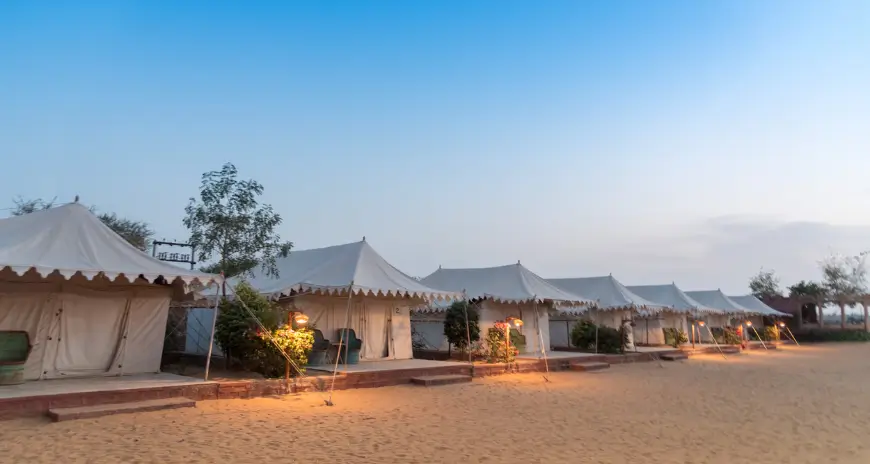
Arrive in the Sam area and check into the selected desert accommodation according to the confirmed category. Accommodation standards and styles vary, so the exact camp or property and included facilities should always follow the final booking confirmation.
A camel ride, jeep excursion, sunset visit or cultural programme may be arranged when specifically included in the confirmed package. Such activities depend on the selected arrangements, local operating conditions and season and should not be treated as automatically included.
As evening approaches, the changing light across the desert becomes the central experience of the day. Spend the night in the Sam area, completing the transition from Jaisalmer's built heritage to the open landscape of the Thar.
Overnight stay at Sam Sand Dunes.
Wake in the desert surroundings of Sam Sand Dunes and enjoy breakfast before beginning the journey towards Jodhpur. After the previous evening among open dunes and wide horizons, today's drive gradually reconnects the itinerary with Rajasthan's great fortified cities.
The route crosses western Rajasthan towards Jodhpur, historically one of the most important centres of Marwar. The changing scenery is part of the day's experience, with isolated desert stretches gradually giving way to increasingly settled landscapes as the Blue City approaches.
Arrive in Jodhpur and check into the selected hotel for a two-night stay. The major sightseeing programme is intentionally reserved for the following morning so that the arrival day remains comfortable after leaving the desert.
Later, head towards the Clock Tower and Sardar Market area. Its active lanes, spice shops, textiles, handicrafts and local businesses reveal a living commercial district beneath the imposing presence of Mehrangarh Fort.
Return to the hotel after the evening orientation. The following day is devoted to Jodhpur's royal architecture and the historic neighbourhoods associated with the Blue City.
Overnight stay in Jodhpur.
Begin at Mehrangarh Fort, which rises dramatically from a rocky escarpment above Jodhpur. Its immense walls and commanding position make it one of the most impressive fortified complexes encountered during the entire Rajasthan circuit.
Pass through the historic gateways and explore the accessible palace sections. Behind the defensive exterior are courtyards, balconies, intricately carved stone screens and former royal chambers that reveal the refined residential and ceremonial life of the Marwar court.
Continue towards the elevated viewpoints overlooking the Blue City. The dense historic neighbourhoods beneath the fortress provide an extraordinary panorama and illustrate the relationship between the royal stronghold and the settlement that developed around it.
Visit Jaswant Thada, the elegant marble memorial situated near Mehrangarh. Its pale stonework and quieter setting provide a visual contrast with the dark, monumental mass of the fortress.
Spend the later afternoon in the old city or traditional market areas. The second Jodhpur night allows the principal heritage sites to be explored without combining them with another intercity transfer.
Overnight stay in Jodhpur.
After breakfast, leave Jodhpur and travel towards Narlai. The itinerary now changes scale again, moving from a major royal capital into a smaller settlement surrounded by the landscapes of the Aravalli region.
Arrive and check into the selected heritage accommodation. Narlai provides a quieter setting where the character of the historic property and surrounding settlement can become an important part of the travel experience.
Depending on the confirmed programme, spend time exploring suitable areas of the village or its immediate surroundings. Traditional streets, local religious sites and the dramatic rocky landscape distinguish Narlai from the urban heritage of Jodhpur.
Any organised village experience, special dinner, countryside activity or local excursion should be considered included only when specifically confirmed in the final package. The day is intentionally kept flexible rather than filling the stay with unconfirmed activities.
Spend the evening at leisure in the heritage surroundings. Narlai acts as a natural transition between Marwar and the Jain and Mewar heritage encountered over the following days.
Overnight stay in Narlai.
After breakfast, leave Narlai and travel first towards Ranakpur. The route passes through the Aravalli region and introduces one of Rajasthan's most celebrated examples of Jain temple architecture.
Visit the Ranakpur Jain Temple according to current opening schedules and religious regulations. Its extensive marble construction, numerous carved pillars, domes and intricate ceilings demonstrate a form of craftsmanship completely different from the massive sandstone forts experienced earlier.
Walk through the permitted sections at a measured pace, observing the changing effects of natural light across the marble surfaces. As the complex remains an active religious site, current rules concerning footwear, clothing, photography and belongings must be respected.
After completing the Ranakpur visit, continue towards Kumbhalgarh. The journey moves deeper into the hills, where the landscape itself becomes increasingly important to understanding the defensive architecture of Mewar.
Arrive and check into the selected hotel. Depending on timing, enjoy an initial view of the surrounding fort landscape or relax after the day's journey.
Overnight stay in Kumbhalgarh.
Begin the morning with a detailed visit to Kumbhalgarh Fort according to official opening hours. Positioned among the Aravalli hills, the fortress represents one of the most imposing defensive landscapes associated with historic Mewar.
Enter through the fortified gateways and explore selected accessible sections. Defensive walls, temples, palace structures and elevated viewpoints demonstrate how extensively the natural terrain was incorporated into the fort's strategic design.
Take time to appreciate the surrounding hill landscape rather than focusing only on individual buildings. Kumbhalgarh's isolated position is central to its historical character and distinguishes it from urban forts such as Mehrangarh or Junagarh.
After sightseeing, continue towards Udaipur. Arrive in the City of Lakes and check into the selected hotel for a generous three-night stay, creating one of the most relaxed sections of the itinerary.
Spend the evening at leisure or take a gentle orientation around Lake Pichola according to arrival time. The main Udaipur sightseeing begins the following morning.
Overnight stay in Udaipur.
Begin at Udaipur City Palace, the extensive royal complex overlooking Lake Pichola. Built and expanded over generations, it contains a network of gateways, courtyards, balconies, terraces and former royal apartments.
Walk through the accessible palace sections and observe carved windows, decorative interiors and elevated viewpoints. Views across Lake Pichola and the surrounding hills demonstrate how strongly Udaipur's architecture was shaped by its natural setting.
Continue to Jagdish Temple, situated within the historic quarter close to City Palace. The temple remains an active place of worship, and visitors should follow all applicable requirements concerning footwear, photography and respectful behaviour.
Later, visit Saheliyon Ki Bari, whose fountains, garden spaces and pavilions provide a quieter contrast to the large royal complex visited earlier.
Spend the evening around the lakefront. Optional boating on Lake Pichola can be arranged separately according to weather, operating schedules and confirmed services.
Overnight stay in Udaipur.
The third Udaipur day allows the itinerary to slow considerably. After almost two weeks of continuous travel, the additional night gives travellers an opportunity to experience the city without another hotel change or lengthy road transfer.
Spend the morning exploring selected old-city neighbourhoods. Narrow lanes, temples, traditional shops, workshops and residential buildings reveal aspects of Udaipur that are easily missed when attention is concentrated only on City Palace.
Additional museums, gardens, viewpoints or heritage locations may be incorporated according to the confirmed programme. The schedule can therefore accommodate individual interests while avoiding repetition of the previous day's principal monuments.
The afternoon may remain free for handicraft shopping, photography, relaxation or an optional lake activity. Udaipur is particularly well suited to an unhurried day because its appeal comes from the combination of architecture, water and surrounding hills.
Enjoy a final evening in the City of Lakes before the route continues to Chittorgarh.
Overnight stay in Udaipur.
After breakfast, leave Udaipur and travel towards Chittorgarh. Although both destinations are central to the story of Mewar, their architectural personalities are dramatically different.
Arrive in Chittorgarh and check into the selected hotel. The overnight stay gives the enormous fort complex greater importance than itineraries that include it only as a brief stop between cities.
Proceed to Chittorgarh Fort, entering through its historic gateways and travelling onto the extensive elevated plateau. Palace remains, temples, towers, reservoirs and defensive structures are distributed across a remarkably large area.
Explore selected landmarks according to available time and current access conditions. The scale of the complex and the commanding views across the surrounding plains help explain the strategic significance of this fortified centre.
Return to the hotel after sightseeing. The journey continues into the Hadoti region the following morning, but Chittorgarh's dedicated overnight allows the Mewar section to end with appropriate depth.
Overnight stay in Chittorgarh.
Leave Chittorgarh after breakfast and travel towards Bundi. The route moves into the Hadoti region, where the architecture and scale of the historic towns differ considerably from the large royal centres visited earlier.
Arrive in Bundi and check into the selected hotel for a two-night stay. This longer allocation is especially valuable because Bundi is often reduced to a short en-route stop despite its distinctive palace, fort, stepwells and historic streets.
Begin with an introductory walk through appropriate sections of the old town. Compact streets, traditional houses and the palace rising above the settlement create an intimate architectural environment.
Depending on arrival time, visit a selected stepwell or heritage area. Bundi's historic water structures are among its most characteristic architectural features and demonstrate how practical water management could be transformed into elaborate design.
Return to the hotel and enjoy the evening at leisure. The principal palace and fort sightseeing is reserved for the following day.
Overnight stay in Bundi.
Begin with the principal Bundi palace and fort complex according to current opening and access conditions. Rising above the town, the architecture creates a dramatic backdrop while remaining more intimate than the enormous fortifications of Chittorgarh.
Explore the accessible palace sections, gateways and courtyards. Surviving decorative elements and elevated viewpoints provide insight into Bundi's distinctive regional style and its relationship with the compact settlement below.
Continue to one or more notable stepwells according to the confirmed sightseeing programme. Their descending geometry and functional relationship with water make them very different from the palaces and temples dominating much of the Rajasthan circuit.
Spend part of the afternoon walking through the old streets. Markets, residential façades and local religious structures help place the formal monuments within the living town around them.
Return to the hotel for the second night. The additional time in Bundi provides a deeper Hadoti experience before the itinerary turns towards Ranthambore's wildlife landscape.
Overnight stay in Bundi.
After breakfast, leave Bundi and travel towards Ranthambore. The architectural focus that has dominated the journey now gives way to forests, rocky ridges and natural habitat.
Arrive in the Ranthambore region and check into the selected wildlife resort or hotel for a two-night stay. The surrounding landscape feels markedly different from the dense historic towns experienced during the previous stages.
Use the remainder of the day to relax and prepare for the scheduled national park safari. Reporting times depend on the official safari session and the permit confirmed for the booking.
Safari vehicles, routes and zones are allocated according to applicable park procedures. Entry therefore remains subject to permit availability, zone allocation, park regulations and operational conditions.
Ranthambore is internationally associated with Bengal tigers, but tiger sightings are never guaranteed. Wildlife movement is entirely natural and depends on numerous environmental factors.
Overnight stay in Ranthambore.
Begin according to the reporting time shown on the confirmed Ranthambore wildlife safari permit. Enter the reserve in the authorised vehicle and travel only within the officially assigned zone and route.
The park contains dry deciduous forest, rocky hills, open areas and water bodies. Historic ruins visible in parts of the landscape create an unusual combination of Rajasthan's architectural past and its natural environment.
While Bengal tigers are the most famous residents, the ecosystem supports many other species. Depending on natural conditions, travellers may encounter deer, antelope, wild boar, monkeys, crocodiles and a wide variety of birds.
A tiger encounter is possible but can never be promised. Animal movement, vegetation, season, weather and the assigned safari zone all influence what may be seen during any particular drive.
Return to the accommodation after the safari and spend the remaining hours at leisure. Any additional safari requires separate permits and confirmation unless specifically included.
Overnight stay in Ranthambore.
After breakfast, leave Ranthambore and travel towards Jaipur. The itinerary now returns to a major urban centre after several days centred on Chittorgarh, Bundi and the national park.
Arrive in Jaipur and check into the selected hotel for a generous three-night stay. This extended allocation provides enough time to separate the major fort-and-palace programme from markets, additional heritage and leisure.
Begin with a relaxed introduction to the historic Pink City. See the exterior of Hawa Mahal and continue through selected old-city streets and traditional bazaars.
Jaipur's organised urban plan creates a noticeable contrast with the compact lanes of Bundi. Jewellery, gemstones, textiles, block printing and handicrafts remain important parts of the city's commercial identity.
Return to the hotel after the orientation. Amber Fort and the principal royal monuments are reserved for the following day.
Overnight stay in Jaipur.
Begin at Amber Fort, located among the hills outside central Jaipur. The fortified palace represents the earlier royal seat before the development of the planned Pink City.
Pass through the historic gateways and explore the accessible courtyards, ceremonial spaces and former royal apartments. The transition from powerful exterior defences to refined palace architecture is one of Amber's defining features.
Return towards Jaipur and pause near Jal Mahal for exterior views where stopping conditions permit. Continue into the historic centre for City Palace, which represents the political and residential heart of the later capital.
Visit nearby Jantar Mantar, where monumental astronomical instruments demonstrate the scientific interests associated with Maharaja Sawai Jai Singh II.
Complete the day around Hawa Mahal and the old markets if desired. With another full Jaipur day still available, there is no need to compress additional sightseeing into the evening.
Overnight stay in Jaipur.
The third Jaipur day is intentionally more flexible. After the previous day's concentrated monument programme, travellers can use the additional time to experience aspects of the city that are often missed on shorter tours.
The morning may include additional heritage sightseeing according to the confirmed programme and individual interests. Museums, gardens, craft areas or other appropriate locations can complement Amber Fort and City Palace without simply repeating the same type of experience.
Spend time in selected Jaipur bazaars and craft districts, where textiles, gemstones, jewellery, pottery and block-printed fabrics demonstrate the continuing importance of skilled artisanal traditions.
The afternoon can remain available for shopping, photography or personal exploration. This slower schedule is especially useful within a twenty-five-day itinerary, preventing every day from becoming a rigid sequence of monuments.
Return to the hotel for the final Rajasthan overnight in Jaipur. The next morning begins the journey towards Agra with important heritage stops at Abhaneri and Fatehpur Sikri.
Overnight stay in Jaipur.
After breakfast, leave Jaipur and travel first towards Abhaneri. Visit Chand Baori according to current access conditions, observing the extraordinary geometric arrangement of descending steps that makes the structure one of Rajasthan's most distinctive historic water monuments.
Continue towards Fatehpur Sikri, the former Mughal imperial capital. Its monumental gateways, courtyards and palace structures introduce a different architectural vocabulary from the Rajput forts and palaces that have dominated the journey.
Explore the accessible sections according to official timings. The planned complex provides an important historical bridge between Rajasthan and Agra, allowing the transition into Mughal architecture to develop gradually rather than abruptly.
Continue afterwards to Agra and check into the selected hotel. According to arrival time and the confirmed schedule, the Taj Mahal visit may take place during the most suitable available visiting period or the following morning before departure.
Spend the final overnight reflecting on a route that has crossed Shekhawati, the Thar, Marwar, Mewar, Hadoti and eastern Rajasthan before entering the Mughal landscape of Agra.
Overnight stay in Agra.
Begin according to the confirmed sightseeing schedule with a visit to the Taj Mahal if it was not completed on the previous day. Enter through the monumental gateway and proceed along the formal garden axis towards the white marble mausoleum.
Take time to observe the symmetry, marble inlay, calligraphic decoration and relationship between the principal mausoleum and its surrounding structures. After weeks of sandstone forts, frescoed havelis, Jain temples and regional palaces, the Taj Mahal provides a dramatically different architectural finale.
After completing the scheduled Agra sightseeing, begin the road journey towards Delhi. The final transfer closes a twenty-five-day circuit covering an unusually broad cross-section of Rajasthan.
From Mandawa's painted havelis and Bikaner's Junagarh Fort to Jaisalmer's golden architecture and Sam's open desert, the first stages established the state's northern and western character. Jodhpur, Narlai, Ranakpur and Kumbhalgarh then carried the route through Marwar and into the Aravallis.
Udaipur, Chittorgarh and Bundi revealed different dimensions of Mewar and Hadoti, while Ranthambore introduced forests and wildlife. Three nights in Jaipur provided a final extended Rajasthan stay before Abhaneri, Fatehpur Sikri and Agra completed the architectural progression. On arrival in Delhi, transfer to the confirmed airport, railway station, hotel or onward departure point.
03 Nights / 04 Days
Delhi - Jaipur - Ranthambore - Delhi
12 Nights / 13 Days
Delhi - Jaipur - Jodhpur - Jaisalmer - Udaipur - Delhi