Your Travel Partner
SINCE 1989
Your Travel Partner
SINCE 1989
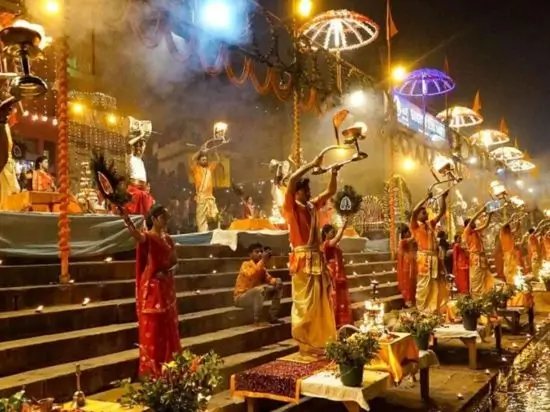
There is a particular hour in Varanasi, just as the sun drops behind the rooftops on the western bank of the Ganges, when the city seems to gather itself at the water's edge. Bells begin somewhere in the distance. Conch shells sound. And along the stone steps of Dashashwamedh Ghat, a line of young priests steps forward in matching saffron robes, each holding a tiered brass lamp that will, within minutes, be lit and swung in slow, practised arcs against the darkening sky.
This is the Ganga Aarti – an evening ritual of fire, sound, and devotion performed on the banks of the river that Hindus consider the holiest in the world. It happens every single evening, rain or no rain, festival or none, and for many travellers to Varanasi, it ends up being the single image they carry home most clearly.
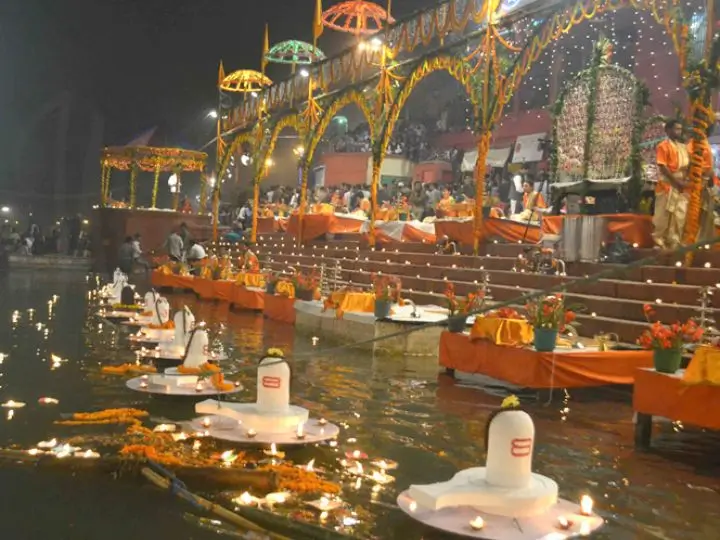
The aarti is, at its core, an offering – a ceremony in which fire, incense, flowers, and sound are presented to the river as an act of gratitude and reverence. At Dashashwamedh Ghat, the most prominent site for the ceremony, a row of priests perform the ritual in unison, moving through a sequence of gestures with lamps, conch shells, peacock-feather fans, and incense, all set to devotional chanting and music that builds steadily as the ceremony progresses.
The choreography is precise – each priest mirrors the others, turning, lifting, and lowering their lamps in coordinated waves, while the crowd watching from the ghat steps and from boats moored just offshore grows steadily as the ceremony nears its peak. By the time the largest lamps, heavy enough to require both hands, are being swung in wide circles, the steps are usually packed several rows deep, and the boats on the water form a loose crescent facing the ghat.
There are two broad ways to experience the aarti, and the choice matters more than first-time visitors often expect. Watching from the ghat steps themselves puts you close to the ceremony, among the crowd, with the sound of the chanting and the heat of the lamps close at hand – an immersive, slightly chaotic experience that many find genuinely moving.
Watching from a boat on the river offers something different – a slightly removed, wider view, with the lights of the ghat reflected on the water and the sound carrying across the surface in a way that feels, for many visitors, more atmospheric than being in the crowd itself. Boats can be hired individually or shared, and arriving early enough to find a good position on the water – not too close, not too far – is part of the experience for those who choose this route.
Neither approach is objectively better. Some travellers prefer the intensity of the crowd, the sense of being part of something rather than observing it from a distance. Others prefer the water, where the ceremony becomes more of a tableau, framed by the ghat's architecture and the darkening sky behind it.
The Ganga Aarti is, for many visitors, the anchor of a Varanasi visit, but the city around it rewards considerably more time than a single evening allows. Varanasi is one of the oldest continuously inhabited cities in the world, and its narrow lanes – too narrow in places for anything but foot traffic and the occasional motorbike – wind between temples, shops, and homes in a layout that seems to follow no logic beyond centuries of accumulated habit.
The morning hours offer a completely different version of the city. Many visitors take an early boat ride along the ghats at sunrise, when the river is calm, the light is soft, and the daily rhythms of the city – people bathing, washing clothes, performing morning rituals – are visible along the steps in a way that feels considerably quieter and more contemplative than the evening's ceremony.
Kashi Vishwanath Temple, one of the most significant Hindu temples dedicated to Shiva, sits close to the ghats and draws a steady stream of pilgrims throughout the day. Sarnath, a short distance outside the city, marks the place where the Buddha is said to have given his first sermon after attaining enlightenment, and offers a quieter, more reflective counterpoint to the intensity of the ghats.
Varanasi is also one of the few places in India where cremation takes place in full public view, on ghats specifically designated for this purpose – most notably Manikarnika Ghat, where fires burn continuously, day and night, every day of the year. For Hindus, dying in Varanasi and being cremated on its ghats is considered to bring liberation from the cycle of rebirth, and the cremation ghats are, for those who come here for this purpose, places of genuine sanctity rather than spectacle.
For travellers, this is an area that calls for particular care. Photography at the cremation ghats is generally considered inappropriate and, in some cases, actively discouraged, and visitors who do choose to walk past or near these areas – which is sometimes unavoidable given the layout of the ghats – are best served by doing so quietly and respectfully, without lingering or treating the area as a sight to be consumed. A knowledgeable local guide can help navigate this part of the city in a way that's both informative and appropriately respectful.
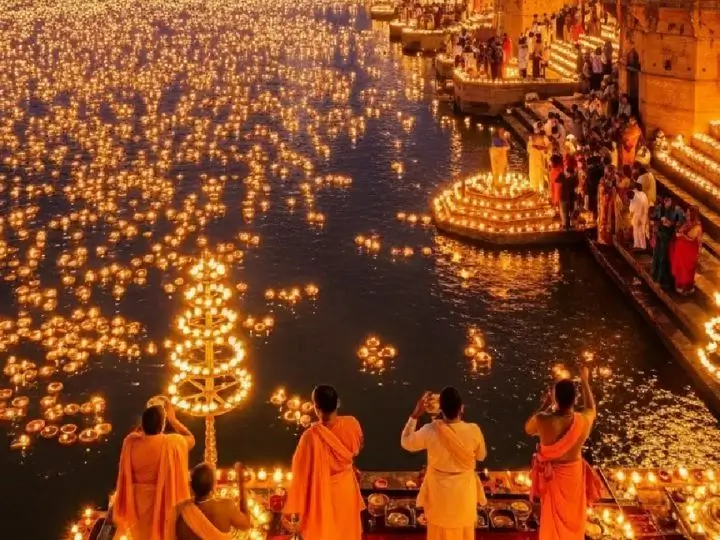
If the nightly Ganga Aarti is Varanasi's everyday spectacle, Dev Deepawali is its once-a-year amplification. Falling on the full moon night roughly two weeks after Diwali, Dev Deepawali – "the Diwali of the Gods" – sees every one of Varanasi's ghats, stretching for several kilometres along the river, lit with tens of thousands of oil lamps.
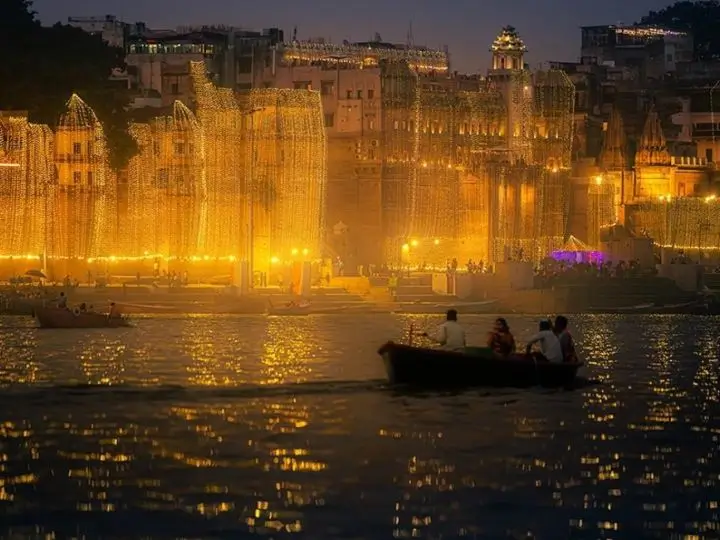
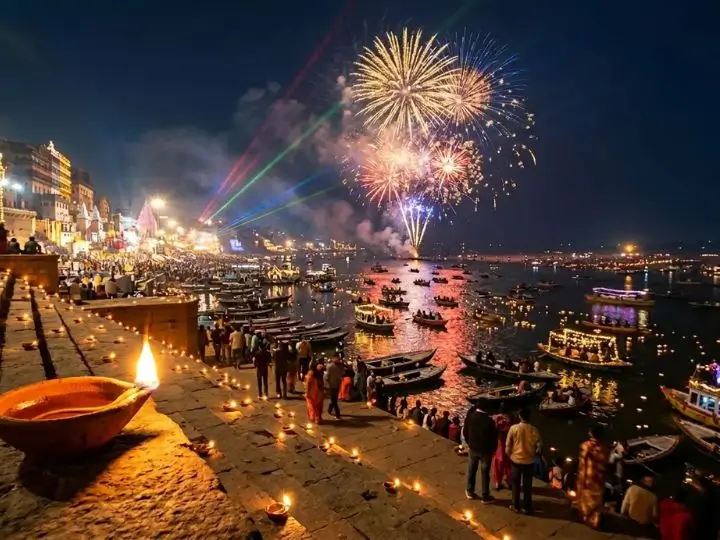
The scale is genuinely different from anything else on the Varanasi calendar. Where the nightly aarti is concentrated at Dashashwamedh Ghat, Dev Deepawali extends along the entire riverfront – ghat after ghat lit with rows of diyas, their reflections spreading across the water until the river itself seems to be glowing. The aarti ceremonies that evening are larger and more elaborate than usual, often performed simultaneously at multiple ghats, accompanied by classical music and dance performances that continue well into the night.
For travellers able to time a visit around Dev Deepawali specifically, the experience is considerably more crowded than an ordinary evening – boats fill the river in far greater numbers, and the ghats themselves become difficult to move through during the peak hours – but the visual impact, particularly viewed from the water with the entire riverfront illuminated, is something that's genuinely difficult to find an equivalent for elsewhere in India.
Because the Ganga Aarti happens every evening, there's no need to time a Varanasi visit around a specific date the way many of the festivals on this list require – any evening in Varanasi offers the chance to see it. That said, arriving with enough time to choose between the ghat and the boat, and to find a good position before the crowds build, makes a meaningful difference to the experience.
Varanasi works well as part of a wider North India itinerary – often combined with Bodh Gaya and Sarnath for travellers interested in Buddhist heritage, or as an extension from a Golden Triangle tour for those wanting to add a more spiritually focused destination to a Delhi-Agra-Jaipur circuit. Given Varanasi's distinct character – considerably less polished than Jaipur or Udaipur, and more intense in places – a guide familiar with the city's layout and customs adds genuine value, particularly around the ghats and narrow lanes of the old city.
Unlike most entries on this list, Varanasi isn't built around a single event – it's a city where ritual and daily life are continuously intertwined, and the aarti is simply the most visible, most accessible expression of something that's happening, in various forms, throughout the day and across the year. For travellers, this means Varanasi rewards a slightly different approach – less about timing a visit to coincide with a specific event, and more about allowing enough time to experience the city's rhythms across a full day, from the quiet of early morning on the water to the building intensity of the evening ceremony.
Dev Deepawali, for those who can time a visit around it, offers a genuine festival dimension on top of this everyday rhythm – but even without it, an evening at the Ganga Aarti in Varanasi tends to be remembered as one of the more striking experiences of an India trip, festival calendar or not.
If you'd like to include the Ganga Aarti – or time your visit around Dev Deepawali – as part of your India journey, we can build a private Varanasi itinerary that covers the ghats, a sunrise boat ride, Kashi Vishwanath Temple, and Sarnath, combined where useful with a wider North India circuit. Share your travel dates, and we'll put together a tour that gives this city the time it deserves.
Find the answers to all of our most frequently asked questions
It's held every evening at sunset, typically starting around 6:00 to 7:00 PM depending on the season, at Dashashwamedh Ghat
Both offer different experiences – the ghat puts you in the crowd close to the ceremony, while a boat offers a wider, more atmospheric view from the water.
Dev Deepawali falls on 24 November 2026, fifteen days after the main Diwali festival, on the Kartik Purnima full moon.
On Dev Deepawali, every ghat along the river is lit with thousands of oil lamps, and aarti ceremonies are performed on a far larger scale across multiple locations simultaneously.
Yes, at Dashashwamedh Ghat photography is generally welcome, though visitors should be more cautious and respectful near the cremation ghats.
It's possible to walk near Manikarnika Ghat, but visitors should do so quietly and respectfully, without photography, given its significance as an active cremation site
A sunrise boat ride along the ghats, Kashi Vishwanath Temple, the old city's narrow lanes, and nearby Sarnath are all popular additions.
Most visitors find two to three days sufficient to experience both the morning and evening rhythms of the ghats, plus time for Sarnath.
Yes, though its intensity – particularly around the ghats and narrow lanes – means a local guide is genuinely useful for orientation.
Yes – it's a common extension from Delhi, Agra, and Jaipur for travellers wanting a more spiritually focused addition to their itinerary.
A site a short distance from Varanasi where the Buddha is said to have given his first sermon, offering a quieter counterpoint to the ghats.
Share your travel dates, and we can build a Varanasi itinerary around the ghats, the aarti, and – if your dates align – Dev Deepawali itself.