Your Travel Partner
SINCE 1989
Your Travel Partner
SINCE 1989
Not every festival on this list involves colour, fire, or camels. Some of India’s most distinctive events are quieter affairs - and the Jaipur Literature Festival is one of them, even if “quiet” might be the wrong word for an event that, by some measures, has grown into the largest literary gathering of its kind anywhere in the world.
Held each January at Hotel Clarks Amer in Jaipur, the festival brings together writers, thinkers, journalists, politicians, and public figures from across the globe for five days of conversations, debates, readings, and discussions - almost all of it free to attend, which is part of what’s made it such a notable fixture on India’s cultural calendar.
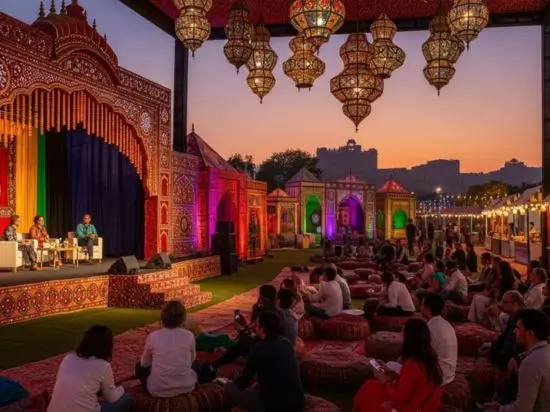
If you’re picturing a sedate literary event with small audiences in quiet rooms, the Jaipur Literature Festival will likely surprise you. The festival takes over multiple venues across the host property simultaneously, with sessions running throughout the day - sometimes five or six happening at once, covering everything from contemporary fiction and poetry to politics, history, science, and increasingly, topics like technology and artificial intelligence.
Crowds can be substantial, particularly for sessions featuring well-known authors or public figures, with queues forming well before doors open for the most anticipated talks. At the same time, there’s a genuinely relaxed atmosphere running through the event - people moving between sessions, browsing the festival’s book stalls, and gathering in courtyards and gardens between talks.
The audience at JLF is a genuinely mixed crowd - serious literary enthusiasts who’ve travelled specifically for the festival, students and academics from across India, journalists and publishing professionals using the event for networking, and a significant number of international visitors who’ve built their India trip around the festival dates.
For travellers without a particular literary background, this might raise a reasonable question: is it worth attending if you’re not deeply invested in books? The answer, for many visitors, turns out to be yes - not necessarily for the literary content specifically, but for the atmosphere, the calibre of conversation on display, and the simple experience of being part of a genuinely large-scale cultural event in one of India’s most visually striking cities.
Hotel Clarks Amer, the festival’s long-standing venue, provides a setting that’s part of the experience itself - gardens, courtyards, and open spaces that give the festival room to breathe, even with the considerable crowds it attracts. Between sessions, much of the festival’s social life happens in these outdoor spaces, with food stalls, music, and informal conversations forming as much a part of the experience as the scheduled programme.
The festival’s location in Jaipur also means that, for international visitors, JLF rarely exists in isolation - most attendees are also exploring the city’s forts, palaces, and markets either side of the festival days, making it naturally well-suited to combination with broader sightseeing.
While “literature festival” might suggest a narrow focus, the actual programme is considerably broader. Recent editions have included sessions on global politics, historical reassessments, scientific developments, and cultural commentary, alongside more traditional literary discussions - author readings, book launches, and conversations between writers about craft and inspiration.
The festival has also developed a reputation for hosting genuinely significant figures - past editions have featured Nobel laureates, internationally renowned authors, and prominent voices from journalism and public life, often in conversation formats that allow for more depth than a typical book tour event.
For travellers with even a passing interest in ideas and current affairs - not necessarily literature in the narrow sense - the festival’s breadth means there’s usually something relevant happening across its five days.
Because JLF falls in mid-January, it sits within one of Rajasthan’s most comfortable travel periods - cool mornings and evenings, pleasant daytime temperatures, and generally clear skies. This makes it a genuinely practical time to visit Jaipur regardless of the festival, and JLF simply adds an additional dimension to what’s already a good time to be in the city.
Most visitors attending JLF build it into a broader Rajasthan or Golden Triangle itinerary - arriving in Jaipur a day or two before the festival begins, attending sessions across some or all of the five days (attendance doesn’t require committing to every day), and continuing on to other destinations afterwards, whether that’s Delhi and Agra, or deeper into Rajasthan toward Udaipur or Jodhpur.
Because the festival is free to attend, it draws large numbers of visitors - including significant numbers of students and local attendees, alongside the international literary crowd. This means popular sessions can fill quickly, and arriving early for talks featuring well-known speakers is generally advisable if you have particular sessions in mind.
Accommodation in Jaipur during JLF week sees increased demand, given both the festival itself and the broader appeal of January as a travel month in Rajasthan. Booking ahead, particularly for properties near the festival venue, is sensible if JLF is a priority for your trip.
The festival’s scheduling - five days of overlapping sessions - means it’s worth thinking in advance about what genuinely interests you, since trying to attend everything isn’t realistic. Many visitors find that a flexible approach, dropping into sessions that catch their interest as the day unfolds rather than rigidly planning every hour, works well given the festival’s somewhat informal, drop-in atmosphere for most sessions.
Compared to most other entries on this list, JLF offers something distinctly different - not a religious festival, not a folk celebration, but a contemporary cultural event that happens to take place in one of India’s most historically rich cities. For travellers whose interests lean toward ideas, conversation, and contemporary culture alongside the more traditional sights of Rajasthan, JLF offers a way to engage with India’s intellectual and cultural life in a way that’s quite distinct from temple visits or palace tours.
It’s also worth noting that the festival’s free, open structure reflects something genuinely democratic about its character - there’s no sense of an exclusive, ticketed event for a narrow audience. Students sit alongside international academics, casual visitors alongside dedicated literary fans, all moving through the same spaces and queuing for the same sessions. For travellers interested in seeing a cross-section of contemporary India - not just its historical sights - this aspect of the festival is, in its own way, as interesting as anything on the formal programme.
Jaipur itself offers more than enough to fill the days around the festival - Amber Fort, City Palace, Hawa Mahal, and the city’s markets are all within easy reach, and many visitors structure their days around a mix of festival sessions and sightseeing, particularly given that JLF’s programme typically runs from mid-morning into the evening, leaving early mornings free for visits to sites that are best experienced before crowds build.
For travellers building a longer Rajasthan itinerary, JLF can function as the opening days of the trip, with the festival providing a distinctive start before moving on to explore the broader region.
If you’d like to attend the Jaipur Literature Festival as part of your India trip, we can build a private itinerary around the festival dates - combining JLF with Jaipur’s major sights and, if you’d like, onward travel to other parts of Rajasthan or a Golden Triangle circuit. Given the increased demand for accommodation during festival week, early planning is genuinely worthwhile. Share your travel dates, and we’ll design a tour around this event.
Find the answers to all of our most frequently asked questions
JLF 2027 runs from 14 to 18 January, marking the festival’s 20th edition.
Yes - the festival is free, which has contributed significantly to its scale and broad audience.
At Hotel Clarks Amer in Jaipur, with multiple simultaneous sessions across the venue’s gardens and indoor spaces.
No - many visitors attend only some days, dropping into sessions of particular interest rather than committing to the full schedule.
Not at all - the programme covers politics, history, science, and culture broadly, and the atmosphere appeals to a wide range of visitors.
Yes, particularly those featuring well-known authors or public figures - arriving early for specific sessions is advisable.
Yes - many visitors combine festival sessions (typically running mid-morning to evening) with early-morning visits to forts and palaces.
Yes - January is already a popular travel month in Rajasthan, and the festival adds further demand for accommodation in Jaipur.
Past editions have included Nobel laureates, internationally renowned authors, journalists, and prominent figures from politics and public life.
Yes - the breadth of topics and the overall atmosphere appeal to many visitors beyond dedicated literary audiences.
Yes - it works well as the opening days of a longer itinerary, with onward travel to other parts of Rajasthan or a Golden Triangle circuit afterwards.
Share your travel dates, and a private itinerary combining the festival with Jaipur sightseeing and onward travel can be arranged.