Your Travel Partner
SINCE 1989
Your Travel Partner
SINCE 1989
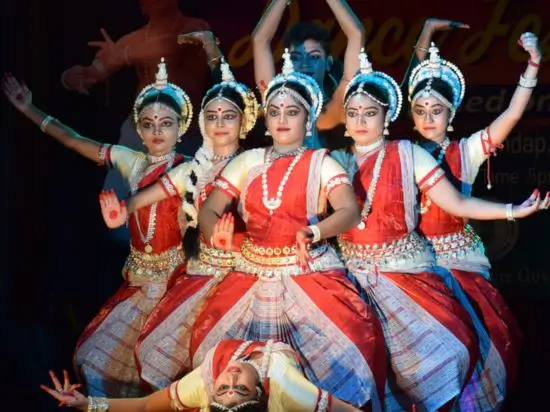
Khajuraho's temples are, for many travellers, primarily known for one thing – the intricate, often explicit carvings that cover their exteriors, depicting scenes of daily life, mythology, and human relationships with a frankness that's made the site both famous and, for some visitors arriving with certain expectations, slightly different from what they imagined. But the temples are also, simply, extraordinary examples of medieval Indian architecture and sculpture – and for one week each February, they become the setting for a festival that brings classical dance back into a space whose carvings often depict dancers and musicians in the first place.
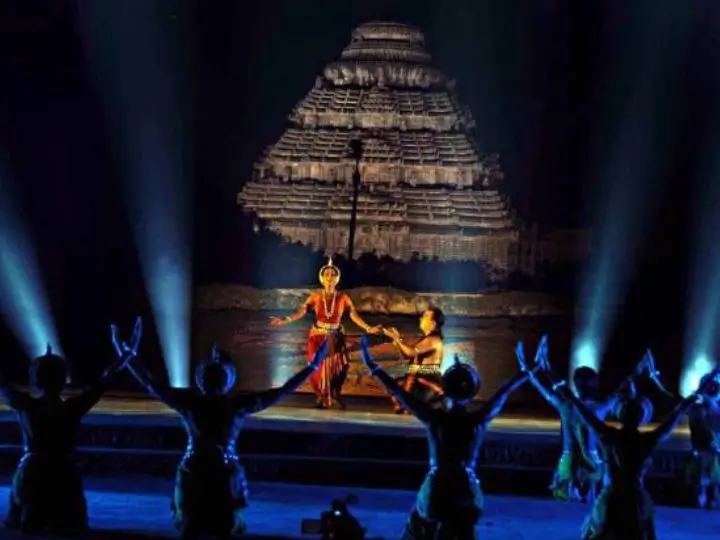
The Khajuraho Dance Festival sets performances of India's classical dance traditions against the floodlit backdrop of the Western Group of Temples – a combination of architecture and performance that, much like the Konark Dance Festival on India's east coast, creates a setting that feels integral to the performances themselves rather than incidental.
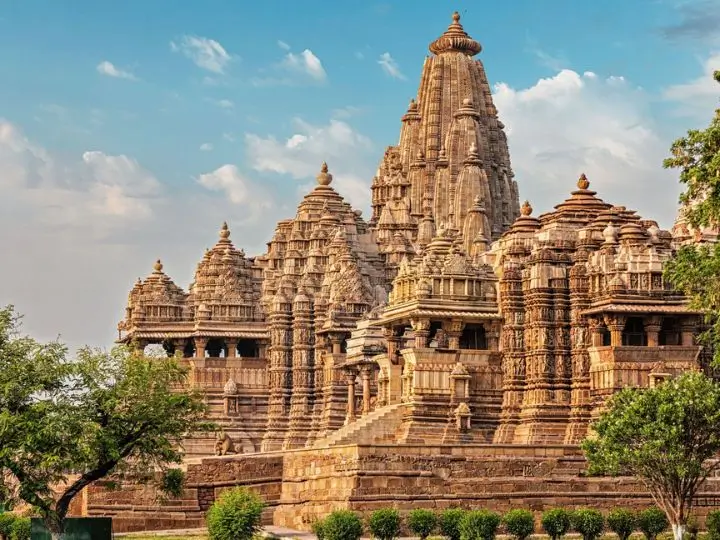
Built between roughly the 10th and 12th centuries by the Chandela dynasty, Khajuraho's temples – of which around twenty survive from an original group that may have numbered far more – are renowned for the density and quality of their stone carving. Every surface, in places, seems to carry some form of decoration – gods and goddesses, mythological scenes, musicians, dancers, and the famous figures in intimate poses that have given the site much of its popular fame.
These carvings are generally understood within a broader context of medieval Indian temple art, in which depictions of human life – including its more intimate dimensions – were considered part of a complete representation of existence, alongside religious and mythological themes, rather than separate from or in tension with them. For travellers, approaching the carvings with this context in mind – ideally with a knowledgeable guide – tends to lead to a considerably richer understanding than simply viewing them as a curiosity.
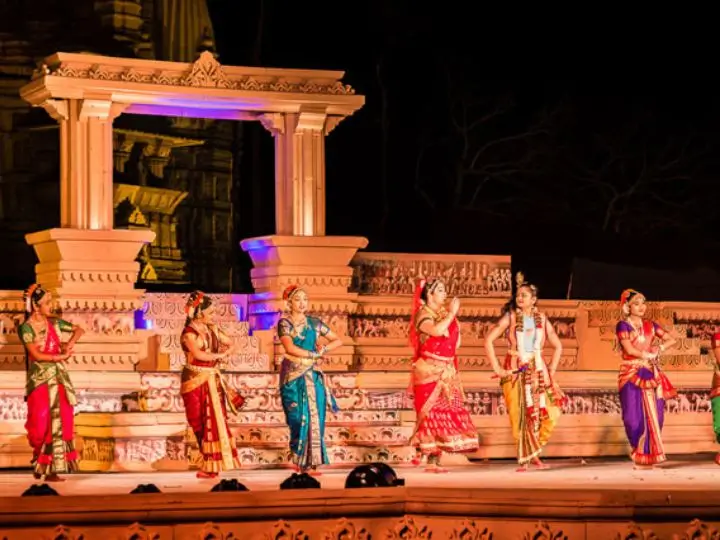
The Khajuraho Dance Festival takes place within the grounds of the Western Group of Temples – the most visited and best-preserved cluster at the site – with an open-air stage set up so that the temples themselves, illuminated for the evening performances, form the backdrop. As with Konark, the connection between setting and content is part of what makes the festival distinctive: many of the carvings on the temples behind the stage depict musicians and dancers, and watching live classical dance performed in front of these centuries-old representations of dance creates a kind of visual dialogue between past and present.
Performances take place over consecutive evenings, typically beginning as daylight fades, with the temples gradually becoming more prominent as the floodlighting takes over from natural light.
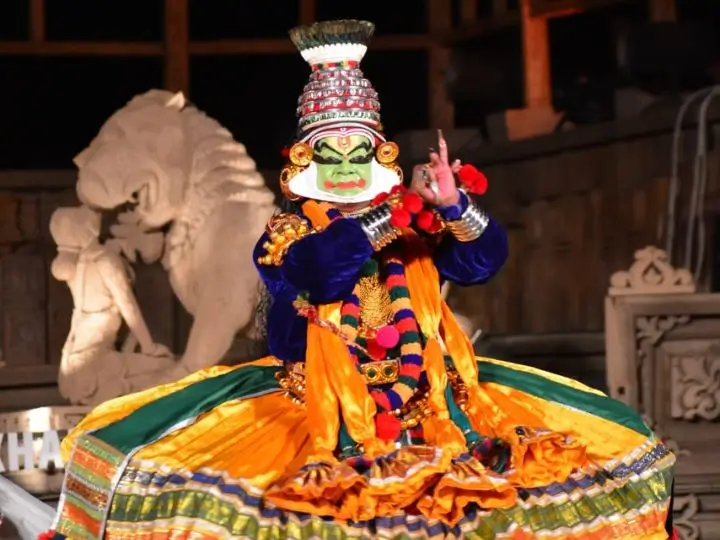
The festival showcases India's major classical dance traditions – Bharatanatyam, Kathak, Odissi, Kuchipudi, Manipuri, Mohiniyattam, and others – performed by leading dancers and companies from across the country. Each evening typically features multiple performances, often from different traditions, giving visitors across the festival's week a broad overview of classical Indian dance's diversity.
For visitors with limited prior exposure to these traditions, the festival offers a useful introduction – the different forms vary considerably in movement vocabulary, costume, and musical accompaniment, despite often being grouped together under the general heading of "classical Indian dance" by those less familiar with the distinctions between them.
Khajuraho itself is a relatively small town, and beyond the temples – divided into Western, Eastern, and Southern groups, with the Western Group being both the largest and most visited – there's relatively little in the way of additional major sights within the town itself. This makes Khajuraho somewhat unusual among India's significant heritage sites: a place where the temples themselves are very much the primary draw, rather than one element within a larger urban or regional context.
The Eastern and Southern groups of temples, while less visited than the Western Group, are worth at least a brief visit for travellers with time – generally quieter, and offering a sense of the broader scale of Khajuraho's original temple complex beyond the most famous cluster.
Khajuraho's relative remoteness – it's not on the most heavily travelled routes between major Indian cities – means access requires a degree of planning. Flights connect Khajuraho with Delhi and other major cities, though schedules can be limited, and road or rail journeys from nearby cities like Jhansi or Satna involve several hours of travel.
For travellers building a Khajuraho visit around the dance festival specifically, this relative remoteness is worth factoring into planning – Khajuraho works well as a dedicated stop within a broader Madhya Pradesh or Central India itinerary, rather than as an easy add-on to a more conventional North India circuit.
Madhya Pradesh, often overlooked in favour of more heavily promoted states, offers considerable depth for travellers willing to venture into central India. Orchha, with its own cluster of palaces and temples along the Betwa River, sits within a reasonable distance of Khajuraho and offers a quieter, less-visited counterpart with its own architectural interest.
For travellers interested in wildlife, Madhya Pradesh is also home to some of India's most significant tiger reserves – Bandhavgarh and Kanha among them – offering the possibility of combining Khajuraho's architectural and cultural interest with wildlife safaris, in a state that, for many international visitors, remains considerably less explored than its neighbours.
For travellers whose primary association with Khajuraho is its more widely circulated reputation – often reduced, in popular imagination, to the explicit carvings alone – visiting in person, ideally with a guide who can provide context, tends to shift that impression considerably. The carvings are one element within an enormous body of work depicting an extraordinarily wide range of subjects, and the temples' architectural sophistication – their proportions, their construction, their overall design – is, by most assessments, at least as significant as any individual category of carving.
The dance festival, in this sense, adds a further dimension – connecting the temples' carved depictions of performance to living traditions of classical dance, and offering a way to engage with Khajuraho that goes beyond simply viewing it as a site to photograph.
February offers comfortable weather in this part of Madhya Pradesh – mild temperatures, generally dry conditions, making it a practical time for both the festival and broader sightseeing in the region. Accommodation in Khajuraho is relatively limited compared to major tourist centres, and during the festival period, booking ahead is advisable.
Given the festival's evening timing within the temple grounds, and the temples' significance as both an archaeological site and, in some cases, still active places of worship, visitors should expect a degree of formality around access and conduct within the festival grounds, distinct from a standard daytime temple visit.
If the Khajuraho Dance Festival appeals to you, we can build a private itinerary around the festival dates – including time to explore the Western, Eastern, and Southern temple groups with a knowledgeable guide, the festival performances themselves, and, if you'd like, onward travel to Orchha or one of Madhya Pradesh's tiger reserves. Share your travel dates, and we'll design a tour around this event.
 4.83 Based on 430 reviews
My South India trip with friends was an unforgettable experience filled with vibrant culture, lush landscapes, and delicious food. We explored beautiful places like Coorg, Ooty, and Mysore, enjoying the serene beauty of the Western Ghats and the rich heritage of temples and palaces. Traveling with friends made it even more fun—late-night chats, spontaneous detours, and shared laughter added magic to the journey. The accommodations were comfortable and clean, especially the homestays that offered a warm, local touch. We booked a travel package that included transportation, guided tours, and daily breakfasts, which made everything hassle-free. The service throughout was excellent—friendly staff, prompt responses, and well-planned itineraries. This trip gave us not just memories but also a deeper appreciation for South India’s charm. I’d definitely go again!
...Read More
My trip to Rajasthan was an amazing experience, full of colorful markets, imposing forts, and a thriving culture. Every place captivated me, from the tranquil lakes of Udaipur to the imperial palaces of Jaipur. The tour was really made better by our guide, Mr. Manoj. His extensive historical knowledge, friendly demeanor, and narrative brought each monument to life. All of our inquiries were patiently addressed, and he recommended uncrowded local locations. Mukesh, our driver, was just as remarkable. We had a comfortable and secure trip thanks to his cool, competent driving through the congested cities and twisting desert roads. Mr. Manoj and Mukesh both contributed to the trip's ease, comfort, and enjoyment. I was able to enjoy Rajasthan's splendor worry-free because of them. I highly recommend Travel Plan for their services.
...Read More
Our Golden Triangle tour was planned by Travel Plan. It was a fantastic way to experience India's cultural core. We started in Delhi and saw busy markets and historic forts. Jaipur astonished us with its palaces and vibrant streets, while Agra's magnificent Taj Mahal left us in awe. What particularly impressed me was Travel Plan's outstanding service. With accuracy and consideration, they made all the arrangements, from cozy lodgings to knowledgeable local guides. The driver was kind and accommodating, and the car was spotless and consistently on time. The whole trip was well-planned, with every aspect contributing to a seamless and unforgettable experience. Their staff was helpful and always willing to help. If you want to book your Golden Triangle trip with a trustworthy and knowledgeable travel company.
...Read More
I visited Rajasthan with my friends last month. It was one of the unique experiences for as. As we stepped on the “land of kings” Rajasthan, we were amazed by the rich culture and hospitality. We explored the top attractions of the cities like Jaipur, Jodhpur, Udaipur and Jaisalmer. From exploring exquisite forts in Jaipur to spending one night in the desert of Jaisalmer, our trip was completely effortless. I appreciate our guide, Shankar, for guiding us throughout the trip and helping us to interact with locals and to learn about the culture of Rajasthan. Our driver, Shyam, was a skilled driver. Both of them gave their best to make our trip comfortable and cosy. I am glad that I chose Travel Plan as my travel partner. I highly recommend them for their services.
...Read More
I was very impressed with the services provided by Travel Plan for my short trip to Jaipur. They arranged a great guide (Mr. Kamlendra) and driver (Mr. Ajit) who took as to see the main sites and were flexible based on our interests. The car they provide is excellent and clean. The guide was knowledgeable and answered all of our many questions and, of course, knew the best places to take pictures for us! Travel Plan also booked the leopard safari for us - unfortunately we didn't see any leopards but that's all up to luck anyway. It was still a nice experience, showing the natural side of Jaipur. Make sure to bring warm clothing as it is in the early morning when it is cold. All in all, these guys are a top class tour operator and I would trust them for any travel arrangements in Rajasthan. They aren't expensive but also not cheap - you get a high level of service for a reasonable price. Do it!
...Read More
We had an amazing Rajasthan trip (Jaipur, Jodhpur, Jaisalmer) through Travelplan with our driver Mr.Ganesh Rao. It was a very informative, exciting and an eye-opening experience.
Our driver Mr Rao was especially very helpful, friendly and went above and beyond to accommodate us. He spoke English well, was quite interesting and made the long drive between the cities feel instant.
I highly recommend Travelplan if planning a Rajasthan trip.
...Read More
Having used Travel Plan on a previous occasion we contacted them again when planning our return visit to Jaipur. All our arrangements were honoured and as expected punctual. The cars were spotlessly clean with good safe drivers and of course AC. From meeting us at the airport to final drop off we were completely satisfied and can wholeheartedly recommend this company. We will be back!
...Read More
Very nice tour with travel plan. They provide good tour Guides, hotels and the car also. And Enjoy the food also at recommended restaurant.
...Read More
Thanks to Travel Plan India for arranging trip to Manwar Desert Camp including jeep & camel ride at dunes.They also arranged very nice cultural evening with folk dance & music.We enjoyed a lot.
...Read More
It was a great experience to travel by TRAVEL PLAN INDIA to down town, Jodhpur. They arranged a very good cycling tour for us through the narrow lanes of blue city with hustle & bustle in the colourful market in clock tower area, also had some street snacks & sweets with lassi.
...Read More
We all friends travelled through Travel Plan India to Ranakpur & had wonderful time as Travel Plan India booked us at nice beautiful Orchard which was away from city & no noise pollution with clean swimming pool.staff was very friendly,food quality & service was excellent.Orchard really worth for outing with friends & family
We will recommend Travel Plan India to our friends
Vinod was really nice with us, recommending good place to eat, explaining us the story of the place. He took us the all afternoon to visit the palaces. We totally recommend him.
...Read More
I booked my visit to udaipur and khumbhalgrah. All the services were very professional . I was also upgraded at both the hotels i stayed. Would highly recommend them for a memorable trip
...Read More
Travel Plan India has nice fleet of transport in Bikaner.
Our driver was very punctual and well behaved.
Guide was very knowledgeable and polite.
Many thanks to Travel Plan India for making our trip memorable.
Travel Plan India provided excellent services in Kolkata.
Enjoyed the tour of city. Guide was excellent and very good Driver.
Enjoyed a lot.
I was very impressed with the services provided by Travel Plan for my short trip to Jaipur. They arranged a great guide (Mr. Kamlendra) and driver (Mr. Ajit) who took as to see the main sites and were flexible based on our interests. The car they provide is excellent and clean. The guide was knowledgeable and answered all of our many questions and, of course, knew the best places to take pictures for us! Travel Plan also booked the leopard safari for us - unfortunately we didn't see any leopards but that's all up to luck anyway. It was still a nice experience, showing the natural side of Jaipur. Make sure to bring warm clothing as it is in the early morning when it is cold. All in all, these guys are a top class tour operator and I would trust them for any travel arrangements in Rajasthan. They aren't expensive but also not cheap - you get a high level of service for a reasonable price. Do it!
...Read More
Having used Travel Plan on a previous occasion we contacted them again when planning our return visit to Jaipur. All our arrangements were honoured and as expected punctual. The cars were spotlessly clean with good safe drivers and of course AC. From meeting us at the airport to final drop off we were completely satisfied and can wholeheartedly recommend this company. We will be back!
...Read More
Very nice tour with travel plan. They provide good tour Guides, hotels and the car also. And Enjoy the food also at recommended restaurant.
...Read More
We all friends travelled through Travel Plan India to Ranakpur & had wonderful time as Travel Plan India booked us at nice beautiful Orchard which was away from city & no noise pollution with clean swimming pool.staff was very friendly,food quality & service was excellent.Orchard really worth for outing with friends & family
We will recommend Travel Plan India to our friends
Vinod was really nice with us, recommending good place to eat, explaining us the story of the place. He took us the all afternoon to visit the palaces. We totally recommend him.
...Read More
Hi myself my wife and two teenage kids planned a trip to Jaipur through Travel Plan. We just let them know what we want and left everything on them and we were not disappointed. Their selection of guides, car,driver, monuments,restaurants and different activities like city tour and walking tour was exceptionally managed.
Thank you Travel Plan and their team.
we have enjoyed the view of the city from Nahargarh fort at Sunset by travel plan india.
wax museum is anazing.
Find the answers to all of our most frequently asked questions
It typically runs over seven days in late February, with the 2027 edition expected during this period.
Within the grounds of the Western Group of Temples, with performances set against the floodlit temples as a backdrop.
Major Indian classical traditions including Bharatanatyam, Kathak, Odissi, Kuchipudi, Manipuri, and Mohiniyattam.
No – while these carvings are well known, they're one element within a much broader body of sculpture depicting mythology, daily life, and architectural ornamentation.
Three – Western, Eastern, and Southern – with the Western Group being the largest, best-preserved, and most visited.
By flight from Delhi or other major cities (subject to limited schedules), or by road or rail from nearby cities such as Jhansi or Satna.
Orchha's palaces and temples, and Madhya Pradesh's tiger reserves such as Bandhavgarh or Kanha.
It's somewhat remote and works best as a dedicated stop within a broader Madhya Pradesh or Central India itinerary.
Yes – mild, dry weather makes it a practical time for both the festival and general sightseeing.
Yes – Khajuraho has relatively limited accommodation, and demand increases during the festival period.
Yes – a knowledgeable guide provides context for the carvings and architecture that significantly enriches the visit.
Share your travel dates, and an itinerary including the temple groups, the festival, and onward travel within Madhya Pradesh can be arranged.