Your Travel Partner
SINCE 1989
Your Travel Partner
SINCE 1989
Most of India's major festivals are, in some sense, things to watch – processions, ceremonies, performances that unfold in front of an audience. Navratri in Gujarat is different. For nine nights, across cities, towns, and villages throughout the state, the festival's central activity – Garba, a circular dance performed to devotional music – isn't a performance for spectators at all. It's something almost everyone present is expected to join.
For travellers, this makes Navratri in Gujarat one of the more genuinely participatory festival experiences available in India – less about observing a tradition from the outside, and more about, even briefly, becoming part of it.
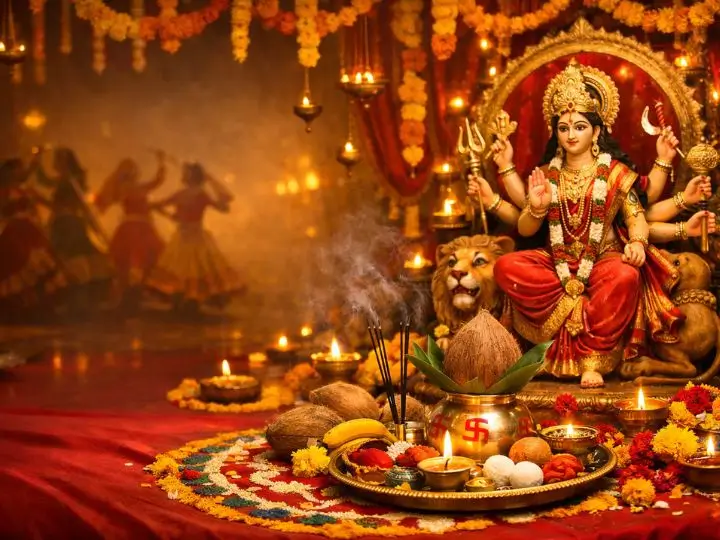
Navratri – literally "nine nights" – is dedicated to the goddess Durga in her various forms, with each of the nine nights traditionally associated with a different aspect or manifestation of the goddess. The festival culminates in Dussehra, which marks the goddess's victory over evil and, in northern India, is also associated with the story of Rama's victory over Ravana – the same underlying theme of good triumphing over evil that runs through many of India's major festivals, told through different regional traditions.
While Navratri is celebrated across India in various forms – including as the lead-up to Durga Puja in Bengal – Gujarat's version, centred on Garba and its related dance form Dandiya Raas, has developed its own distinct character, becoming as much a cultural and social event as a religious one.
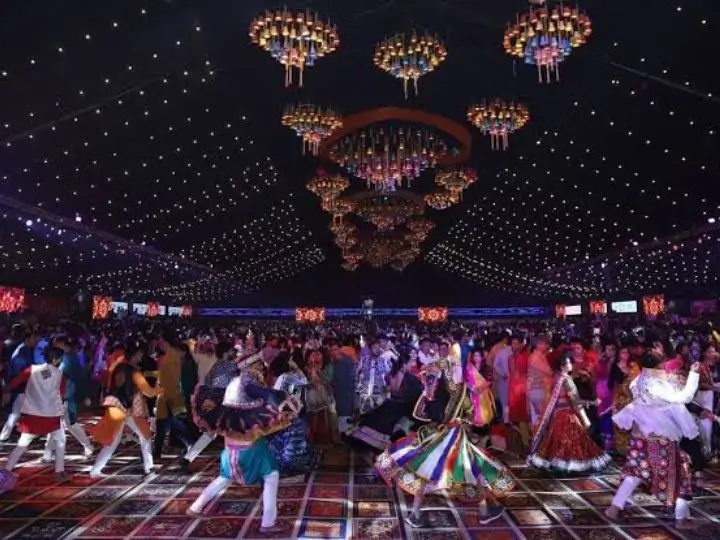
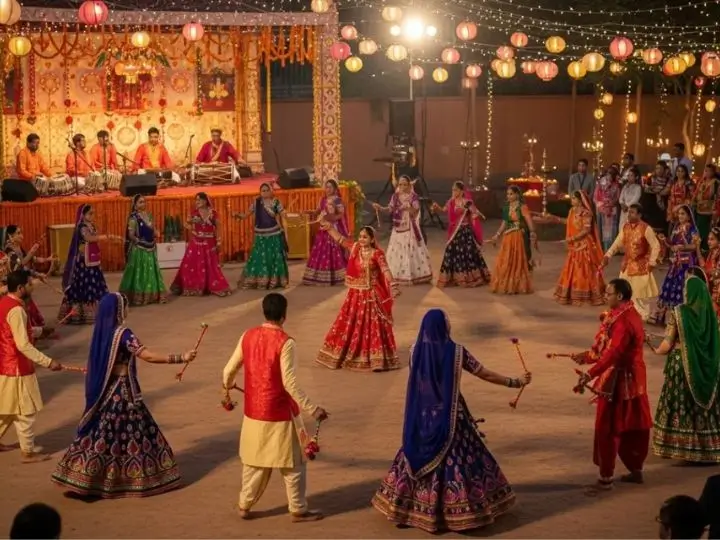
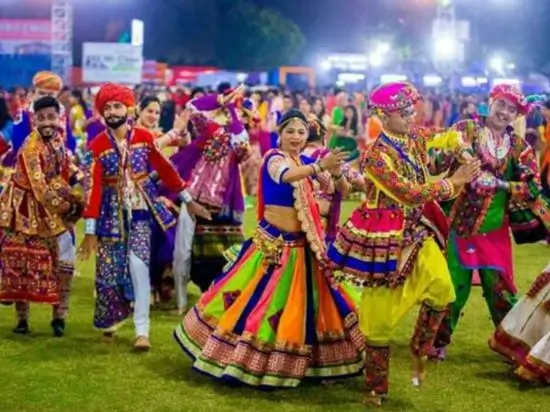
Garba is performed in concentric circles, with dancers moving in coordinated steps around a central shrine or lamp, accompanied by traditional Gujarati folk music and devotional songs. The movements range from relatively simple steps that newcomers can pick up within minutes, to more elaborate, faster sequences performed by experienced dancers, often in traditional Gujarati dress – chaniya choli for women, with elaborately embroidered skirts and mirrors, and kediyu for men.
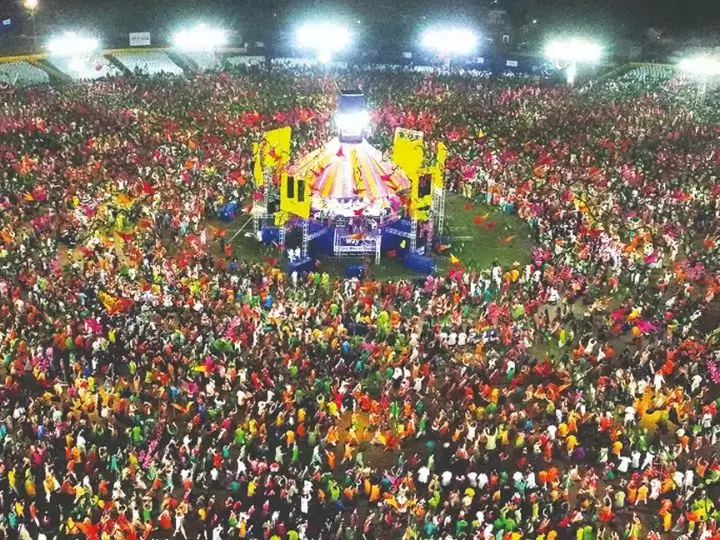
What makes Garba distinctive is its scale and inclusivity – large public Garba events, particularly in cities like Ahmedabad and Vadodara, can involve thousands of participants moving in synchronised circles, with the dance continuing for hours each night across all nine nights of the festival. Unlike many festival activities, there's no real barrier to participation – visitors are generally welcomed to join, and the circular, repetitive nature of the basic steps means it's genuinely possible to pick up the rhythm within a single evening.
Alongside Garba, Dandiya Raas – a dance performed with short decorated sticks, struck rhythmically against a partner's sticks in time with the music – adds another dimension to Navratri evenings. The two dancers strike their sticks together in a pattern that becomes increasingly intricate as the music speeds up, and large Dandiya events can involve hundreds of pairs moving through the same choreographed sequences simultaneously.
Both Garba and Dandiya Raas are accompanied by live or recorded music that's become, in its own right, a significant part of Gujarati popular culture – specific Garba and Dandiya songs are released and become popular each year in the lead-up to Navratri, much as festival-specific music does around other major celebrations elsewhere in the world.
Ahmedabad, Gujarat's largest city, hosts some of the state's largest Navratri events – organised Garba grounds, often run by clubs or community organisations, can draw thousands of participants each night, with some of the most prominent events becoming significant social occasions in their own right. Vadodara is also known for large-scale Navratri celebrations, with the United Way of Baroda Garba event often cited as one of the largest organised Garba gatherings anywhere.
Beyond the major cities, Navratri is celebrated in towns and villages across Gujarat, often with a more local, community character – smaller gatherings, sometimes centred around a temple or community space, where the atmosphere is less about scale and more about a genuinely local celebration that visitors might encounter more by chance than by seeking out a specific named event.
For travellers wondering whether it's appropriate to join Garba or Dandiya as a non-participant outsider, the general answer is a clear yes – these are inclusive, community events, and visible enthusiasm to learn the steps is generally met with encouragement rather than reluctance. Many organised Garba events, particularly larger ones aimed partly at tourism, are specifically welcoming to visitors, sometimes with informal demonstrations of basic steps before the dancing begins in earnest.
Appropriate dress – while not strictly required for visitors, wearing traditional Gujarati clothing if available adds to the experience and is often appreciated – and a willingness to follow the lead of more experienced dancers nearby tends to be all that's needed to participate comfortably.
Navratri's timing, in October, falls within a comfortable period for travel in Gujarat more broadly – the monsoon has cleared, and temperatures are moderate before the cooler winter months. This makes it a good time to combine Navratri with wider Gujarat exploration – the state's heritage sites, including the step-wells and temples around Patan and Modhera, the wildlife of Gir National Park (home to Asiatic lions), and the white salt desert of the Rann of Kutch, whose Rann Utsav festival season often overlaps with, or follows shortly after, Navratri.
For travellers interested in textiles and craft, Gujarat's tradition of embroidery, block printing, and weaving – much of it on display in the very clothing worn for Garba – offers an additional dimension that connects directly to what's visible during the festival itself.
What distinguishes Navratri from festivals built around a single peak day is its sustained nature – nine consecutive nights of dancing means the atmosphere builds gradually, with energy typically increasing as the festival progresses toward its final nights before Dussehra. For travellers with the flexibility to spend several evenings in Gujarat during this period, experiencing Garba on more than one night – perhaps at different venues, from a smaller community gathering to a larger organised event – offers a sense of the festival's range that a single evening doesn't fully capture.
The late-night nature of Navratri – dancing often continues well past midnight – also shapes the rhythm of days during the festival, with many people in Gujarat adjusting their schedules around the late nights, something travellers may want to factor into their own planning during this period.
If you'd like to experience Navratri and Garba in Gujarat, we can build a private itinerary around the festival – including organised Garba events in Ahmedabad or Vadodara, opportunities to join the dancing, and time to explore Gujarat's heritage sites, craft traditions, and wildlife. Share your travel dates, and we'll design a tour around this festival.
 4.83 Based on 430 reviews
My South India trip with friends was an unforgettable experience filled with vibrant culture, lush landscapes, and delicious food. We explored beautiful places like Coorg, Ooty, and Mysore, enjoying the serene beauty of the Western Ghats and the rich heritage of temples and palaces. Traveling with friends made it even more fun—late-night chats, spontaneous detours, and shared laughter added magic to the journey. The accommodations were comfortable and clean, especially the homestays that offered a warm, local touch. We booked a travel package that included transportation, guided tours, and daily breakfasts, which made everything hassle-free. The service throughout was excellent—friendly staff, prompt responses, and well-planned itineraries. This trip gave us not just memories but also a deeper appreciation for South India’s charm. I’d definitely go again!
...Read More
My trip to Rajasthan was an amazing experience, full of colorful markets, imposing forts, and a thriving culture. Every place captivated me, from the tranquil lakes of Udaipur to the imperial palaces of Jaipur. The tour was really made better by our guide, Mr. Manoj. His extensive historical knowledge, friendly demeanor, and narrative brought each monument to life. All of our inquiries were patiently addressed, and he recommended uncrowded local locations. Mukesh, our driver, was just as remarkable. We had a comfortable and secure trip thanks to his cool, competent driving through the congested cities and twisting desert roads. Mr. Manoj and Mukesh both contributed to the trip's ease, comfort, and enjoyment. I was able to enjoy Rajasthan's splendor worry-free because of them. I highly recommend Travel Plan for their services.
...Read More
Our Golden Triangle tour was planned by Travel Plan. It was a fantastic way to experience India's cultural core. We started in Delhi and saw busy markets and historic forts. Jaipur astonished us with its palaces and vibrant streets, while Agra's magnificent Taj Mahal left us in awe. What particularly impressed me was Travel Plan's outstanding service. With accuracy and consideration, they made all the arrangements, from cozy lodgings to knowledgeable local guides. The driver was kind and accommodating, and the car was spotless and consistently on time. The whole trip was well-planned, with every aspect contributing to a seamless and unforgettable experience. Their staff was helpful and always willing to help. If you want to book your Golden Triangle trip with a trustworthy and knowledgeable travel company.
...Read More
I visited Rajasthan with my friends last month. It was one of the unique experiences for as. As we stepped on the “land of kings” Rajasthan, we were amazed by the rich culture and hospitality. We explored the top attractions of the cities like Jaipur, Jodhpur, Udaipur and Jaisalmer. From exploring exquisite forts in Jaipur to spending one night in the desert of Jaisalmer, our trip was completely effortless. I appreciate our guide, Shankar, for guiding us throughout the trip and helping us to interact with locals and to learn about the culture of Rajasthan. Our driver, Shyam, was a skilled driver. Both of them gave their best to make our trip comfortable and cosy. I am glad that I chose Travel Plan as my travel partner. I highly recommend them for their services.
...Read More
I was very impressed with the services provided by Travel Plan for my short trip to Jaipur. They arranged a great guide (Mr. Kamlendra) and driver (Mr. Ajit) who took as to see the main sites and were flexible based on our interests. The car they provide is excellent and clean. The guide was knowledgeable and answered all of our many questions and, of course, knew the best places to take pictures for us! Travel Plan also booked the leopard safari for us - unfortunately we didn't see any leopards but that's all up to luck anyway. It was still a nice experience, showing the natural side of Jaipur. Make sure to bring warm clothing as it is in the early morning when it is cold. All in all, these guys are a top class tour operator and I would trust them for any travel arrangements in Rajasthan. They aren't expensive but also not cheap - you get a high level of service for a reasonable price. Do it!
...Read More
We had an amazing Rajasthan trip (Jaipur, Jodhpur, Jaisalmer) through Travelplan with our driver Mr.Ganesh Rao. It was a very informative, exciting and an eye-opening experience.
Our driver Mr Rao was especially very helpful, friendly and went above and beyond to accommodate us. He spoke English well, was quite interesting and made the long drive between the cities feel instant.
I highly recommend Travelplan if planning a Rajasthan trip.
...Read More
Having used Travel Plan on a previous occasion we contacted them again when planning our return visit to Jaipur. All our arrangements were honoured and as expected punctual. The cars were spotlessly clean with good safe drivers and of course AC. From meeting us at the airport to final drop off we were completely satisfied and can wholeheartedly recommend this company. We will be back!
...Read More
Very nice tour with travel plan. They provide good tour Guides, hotels and the car also. And Enjoy the food also at recommended restaurant.
...Read More
Thanks to Travel Plan India for arranging trip to Manwar Desert Camp including jeep & camel ride at dunes.They also arranged very nice cultural evening with folk dance & music.We enjoyed a lot.
...Read More
It was a great experience to travel by TRAVEL PLAN INDIA to down town, Jodhpur. They arranged a very good cycling tour for us through the narrow lanes of blue city with hustle & bustle in the colourful market in clock tower area, also had some street snacks & sweets with lassi.
...Read More
We all friends travelled through Travel Plan India to Ranakpur & had wonderful time as Travel Plan India booked us at nice beautiful Orchard which was away from city & no noise pollution with clean swimming pool.staff was very friendly,food quality & service was excellent.Orchard really worth for outing with friends & family
We will recommend Travel Plan India to our friends
Vinod was really nice with us, recommending good place to eat, explaining us the story of the place. He took us the all afternoon to visit the palaces. We totally recommend him.
...Read More
I booked my visit to udaipur and khumbhalgrah. All the services were very professional . I was also upgraded at both the hotels i stayed. Would highly recommend them for a memorable trip
...Read More
Travel Plan India has nice fleet of transport in Bikaner.
Our driver was very punctual and well behaved.
Guide was very knowledgeable and polite.
Many thanks to Travel Plan India for making our trip memorable.
Travel Plan India provided excellent services in Kolkata.
Enjoyed the tour of city. Guide was excellent and very good Driver.
Enjoyed a lot.
I was very impressed with the services provided by Travel Plan for my short trip to Jaipur. They arranged a great guide (Mr. Kamlendra) and driver (Mr. Ajit) who took as to see the main sites and were flexible based on our interests. The car they provide is excellent and clean. The guide was knowledgeable and answered all of our many questions and, of course, knew the best places to take pictures for us! Travel Plan also booked the leopard safari for us - unfortunately we didn't see any leopards but that's all up to luck anyway. It was still a nice experience, showing the natural side of Jaipur. Make sure to bring warm clothing as it is in the early morning when it is cold. All in all, these guys are a top class tour operator and I would trust them for any travel arrangements in Rajasthan. They aren't expensive but also not cheap - you get a high level of service for a reasonable price. Do it!
...Read More
Having used Travel Plan on a previous occasion we contacted them again when planning our return visit to Jaipur. All our arrangements were honoured and as expected punctual. The cars were spotlessly clean with good safe drivers and of course AC. From meeting us at the airport to final drop off we were completely satisfied and can wholeheartedly recommend this company. We will be back!
...Read More
Very nice tour with travel plan. They provide good tour Guides, hotels and the car also. And Enjoy the food also at recommended restaurant.
...Read More
We all friends travelled through Travel Plan India to Ranakpur & had wonderful time as Travel Plan India booked us at nice beautiful Orchard which was away from city & no noise pollution with clean swimming pool.staff was very friendly,food quality & service was excellent.Orchard really worth for outing with friends & family
We will recommend Travel Plan India to our friends
Vinod was really nice with us, recommending good place to eat, explaining us the story of the place. He took us the all afternoon to visit the palaces. We totally recommend him.
...Read More
Hi myself my wife and two teenage kids planned a trip to Jaipur through Travel Plan. We just let them know what we want and left everything on them and we were not disappointed. Their selection of guides, car,driver, monuments,restaurants and different activities like city tour and walking tour was exceptionally managed.
Thank you Travel Plan and their team.
we have enjoyed the view of the city from Nahargarh fort at Sunset by travel plan india.
wax museum is anazing.
Find the answers to all of our most frequently asked questions
Navratri runs for nine nights leading up to Dussehra, approximately 11 to 20 October 2026.
A circular dance performed to devotional music during Navratri, with dancers moving in coordinated steps around a central shrine or lamp.
A dance performed with decorated sticks, struck rhythmically by pairs of dancers in time with the music, often alongside Garba.
Yes – Garba and Dandiya are inclusive community events, and visitors are generally welcomed and encouraged to join.
Traditional Gujarati clothing, such as chaniya choli or kediyu, adds to the experience, though it isn't strictly required for visitors.
Ahmedabad and Vadodara host some of Gujarat's largest organised Garba events, with thousands of participants each night.
Yes – it's dedicated to the goddess Durga and culminates in Dussehra, though Gujarat's celebrations have also become significant social and cultural events.
Often well past midnight, particularly on the festival's later nights as the celebrations build toward Dussehra.
Yes – heritage sites near Patan and Modhera, Gir National Park, and the Rann of Kutch can all be combined with a Navratri-focused trip.
No – while Navratri is observed nationwide, Gujarat's Garba-centred celebrations are distinct from, for example, Bengal's lead-up to Durga Puja.
Even one or two nights gives a strong sense of the festival, though staying longer allows for visits to different venues and styles of celebration.
Share your travel dates, and an itinerary including Garba events and wider Gujarat sightseeing can be arranged around the festival's nine nights.