Your Travel Partner
SINCE 1989
Your Travel Partner
SINCE 1989
Rajasthan's festivals tend to be associated with the desert, the dry season, and landscapes of sand and stone - but Teej is something different. Arriving with the monsoon, Teej is a festival of green – of swings hung from trees, women in vibrant clothing gathering in gardens and courtyards, and a general sense of relief and celebration that comes with the arrival of rain after months of heat.
For travellers, Teej offers a side of Rajasthan that's considerably less photographed than its forts and deserts – a festival rooted in the rhythms of the agricultural calendar and in traditions specifically associated with women, observed across the state but with a particularly notable public procession in Jaipur.
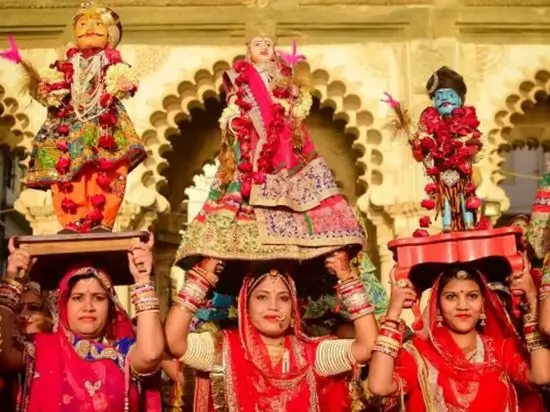
Teej marks the arrival of the monsoon and is dedicated to the goddess Parvati, commemorating her reunion with Shiva after a long period of penance and devotion. The festival is particularly associated with married and unmarried women, who observe fasts, dress in traditional green and red attire, apply mehndi (henna), and gather for celebrations that include singing, dancing, and the swinging on decorated swings that's become one of Teej's most recognisable images.
The colour green runs through much of Teej's symbolism – a direct reference to the monsoon's transformation of the landscape, and a contrast to the browns and golds that dominate Rajasthan for much of the rest of the year.
In towns and villages across Rajasthan, swings are hung from trees and within courtyards in the days leading up to Teej, and women gather to swing, sing traditional Teej songs, and socialise in a way that's specifically associated with this festival rather than occurring at other times of year. The songs themselves – often about longing, monsoon, and the relationships between women and their families – form a distinct musical tradition tied specifically to this period.
Mehndi application is also closely associated with Teej, with intricate henna designs applied to hands and feet as part of the festival's preparations – a tradition that, for travellers, offers one of the more accessible ways to engage with Teej's customs, with mehndi artists often available in markets and through hotels during the festival period.
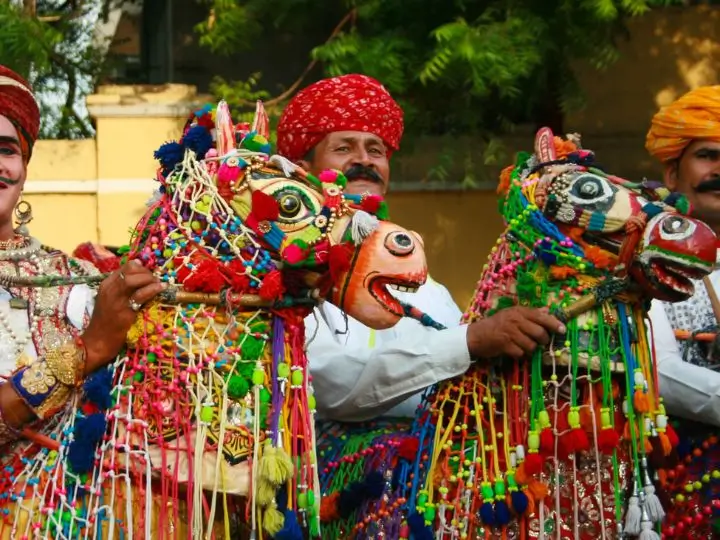
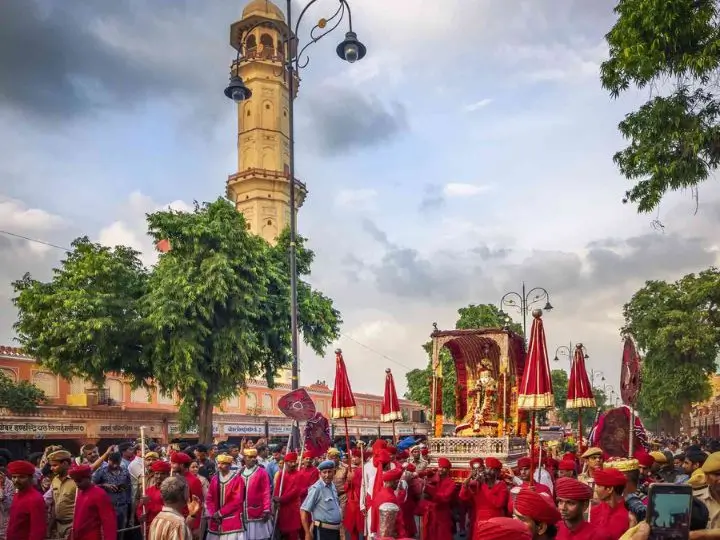
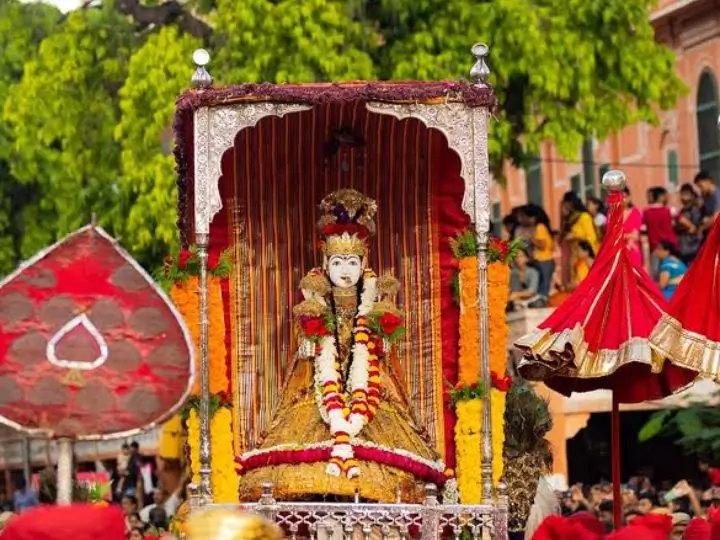
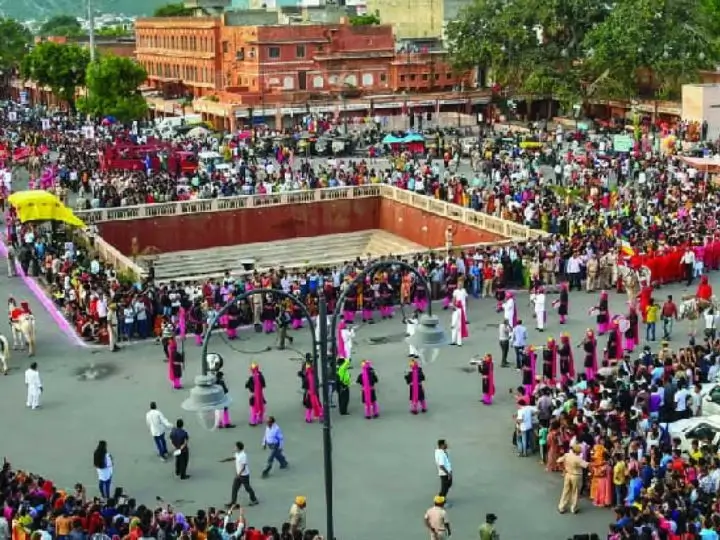
While Teej is celebrated across Rajasthan in homes and communities, Jaipur hosts a notable public procession that's become a significant event for visitors – an elaborately decorated idol of the goddess Teej is carried through the old city's streets on a palanquin, accompanied by elephants, camels, horses, traditional musicians, and dancers, drawing crowds along the route through Jaipur's historic bazaars.
The procession typically begins near the City Palace and moves through the old city's main streets, with the goddess's idol – dressed in elaborate jewellery and fine clothing – carried in a manner reminiscent of royal processions from Jaipur's past, when the city's rulers themselves would participate in or sponsor such events. For travellers, the Jaipur Teej procession offers a way to experience the festival's public, celebratory dimension, set against the backdrop of the city's pink-hued old town architecture.
Because Teej arrives with the monsoon, the festival's timing means visiting Rajasthan during this period involves a different kind of weather than the more commonly recommended winter months. Rain is genuinely possible – sometimes substantial – and the heat of the preceding summer months typically hasn't fully broken, meaning days can still be warm and humid even with rainfall.
For travellers, this means a Teej-timed visit to Rajasthan is, in some ways, a different proposition from the more popular winter season – fewer crowds at major sites, a noticeably greener landscape than the dry-season browns most images of Rajasthan depict, but also the practical realities of monsoon weather, including the possibility of heavy rain affecting outdoor plans on any given day.
While Jaipur's procession is the most visible public event associated with Teej, the festival's core observances – the swings, the songs, the mehndi, the fasting observed by many women – happen in homes and communities throughout Rajasthan, often in ways that aren't necessarily visible to passing travellers unless encountered through a local connection.
For visitors interested in this more domestic side of Teej, staying with a homestay family or visiting villages with a guide familiar with local customs can offer insight into how the festival is observed away from Jaipur's procession – though this requires a degree of local knowledge and connection that a standard sightseeing itinerary doesn't automatically provide.
Teej's timing in the monsoon season means it falls outside Rajasthan's most popular travel months, and itineraries built around this period look somewhat different from the winter-focused Golden Triangle and desert circuits that dominate much of Rajasthan tourism. Jaipur itself – with its forts, palaces, and bazaars – remains accessible and, with fewer crowds than peak season, can offer a more relaxed sightseeing experience around the festival days.
Travellers specifically drawn to Teej tend to be those with a particular interest in Rajasthani culture and tradition beyond the more conventional sightseeing circuit – the festival rewards an interest in the social and domestic dimensions of Rajasthani life, alongside its public spectacle in Jaipur.
What makes Teej distinctive among Rajasthan's festivals is, in part, simply its timing – arriving during the monsoon gives it a character that's genuinely different from the desert-festival associations that dominate much of Rajasthan's tourism identity. The colour green, the swings, the songs associated with rain and renewal – all of this offers a counterpoint to the golden forts and sand dunes that feature in most depictions of the state.
For travellers who've already experienced Rajasthan during its more popular winter season, or who are specifically interested in monsoon travel, Teej offers a way to see a familiar destination through a different seasonal lens – quieter, greener, and tied to a set of traditions that don't feature prominently in most standard itineraries.
If you'd like to experience Teej as part of your Rajasthan trip, we can build a private itinerary around the festival – including the Jaipur procession, time in the city's forts and bazaars during the quieter monsoon season, and, where possible, opportunities to engage with the festival's more domestic traditions through local connections. Share your travel dates, and we'll design a tour around this festival.
 4.83 Based on 430 reviews
My South India trip with friends was an unforgettable experience filled with vibrant culture, lush landscapes, and delicious food. We explored beautiful places like Coorg, Ooty, and Mysore, enjoying the serene beauty of the Western Ghats and the rich heritage of temples and palaces. Traveling with friends made it even more fun—late-night chats, spontaneous detours, and shared laughter added magic to the journey. The accommodations were comfortable and clean, especially the homestays that offered a warm, local touch. We booked a travel package that included transportation, guided tours, and daily breakfasts, which made everything hassle-free. The service throughout was excellent—friendly staff, prompt responses, and well-planned itineraries. This trip gave us not just memories but also a deeper appreciation for South India’s charm. I’d definitely go again!
...Read More
My trip to Rajasthan was an amazing experience, full of colorful markets, imposing forts, and a thriving culture. Every place captivated me, from the tranquil lakes of Udaipur to the imperial palaces of Jaipur. The tour was really made better by our guide, Mr. Manoj. His extensive historical knowledge, friendly demeanor, and narrative brought each monument to life. All of our inquiries were patiently addressed, and he recommended uncrowded local locations. Mukesh, our driver, was just as remarkable. We had a comfortable and secure trip thanks to his cool, competent driving through the congested cities and twisting desert roads. Mr. Manoj and Mukesh both contributed to the trip's ease, comfort, and enjoyment. I was able to enjoy Rajasthan's splendor worry-free because of them. I highly recommend Travel Plan for their services.
...Read More
Our Golden Triangle tour was planned by Travel Plan. It was a fantastic way to experience India's cultural core. We started in Delhi and saw busy markets and historic forts. Jaipur astonished us with its palaces and vibrant streets, while Agra's magnificent Taj Mahal left us in awe. What particularly impressed me was Travel Plan's outstanding service. With accuracy and consideration, they made all the arrangements, from cozy lodgings to knowledgeable local guides. The driver was kind and accommodating, and the car was spotless and consistently on time. The whole trip was well-planned, with every aspect contributing to a seamless and unforgettable experience. Their staff was helpful and always willing to help. If you want to book your Golden Triangle trip with a trustworthy and knowledgeable travel company.
...Read More
I visited Rajasthan with my friends last month. It was one of the unique experiences for as. As we stepped on the “land of kings” Rajasthan, we were amazed by the rich culture and hospitality. We explored the top attractions of the cities like Jaipur, Jodhpur, Udaipur and Jaisalmer. From exploring exquisite forts in Jaipur to spending one night in the desert of Jaisalmer, our trip was completely effortless. I appreciate our guide, Shankar, for guiding us throughout the trip and helping us to interact with locals and to learn about the culture of Rajasthan. Our driver, Shyam, was a skilled driver. Both of them gave their best to make our trip comfortable and cosy. I am glad that I chose Travel Plan as my travel partner. I highly recommend them for their services.
...Read More
I was very impressed with the services provided by Travel Plan for my short trip to Jaipur. They arranged a great guide (Mr. Kamlendra) and driver (Mr. Ajit) who took as to see the main sites and were flexible based on our interests. The car they provide is excellent and clean. The guide was knowledgeable and answered all of our many questions and, of course, knew the best places to take pictures for us! Travel Plan also booked the leopard safari for us - unfortunately we didn't see any leopards but that's all up to luck anyway. It was still a nice experience, showing the natural side of Jaipur. Make sure to bring warm clothing as it is in the early morning when it is cold. All in all, these guys are a top class tour operator and I would trust them for any travel arrangements in Rajasthan. They aren't expensive but also not cheap - you get a high level of service for a reasonable price. Do it!
...Read More
We had an amazing Rajasthan trip (Jaipur, Jodhpur, Jaisalmer) through Travelplan with our driver Mr.Ganesh Rao. It was a very informative, exciting and an eye-opening experience.
Our driver Mr Rao was especially very helpful, friendly and went above and beyond to accommodate us. He spoke English well, was quite interesting and made the long drive between the cities feel instant.
I highly recommend Travelplan if planning a Rajasthan trip.
...Read More
Having used Travel Plan on a previous occasion we contacted them again when planning our return visit to Jaipur. All our arrangements were honoured and as expected punctual. The cars were spotlessly clean with good safe drivers and of course AC. From meeting us at the airport to final drop off we were completely satisfied and can wholeheartedly recommend this company. We will be back!
...Read More
Very nice tour with travel plan. They provide good tour Guides, hotels and the car also. And Enjoy the food also at recommended restaurant.
...Read More
Thanks to Travel Plan India for arranging trip to Manwar Desert Camp including jeep & camel ride at dunes.They also arranged very nice cultural evening with folk dance & music.We enjoyed a lot.
...Read More
It was a great experience to travel by TRAVEL PLAN INDIA to down town, Jodhpur. They arranged a very good cycling tour for us through the narrow lanes of blue city with hustle & bustle in the colourful market in clock tower area, also had some street snacks & sweets with lassi.
...Read More
We all friends travelled through Travel Plan India to Ranakpur & had wonderful time as Travel Plan India booked us at nice beautiful Orchard which was away from city & no noise pollution with clean swimming pool.staff was very friendly,food quality & service was excellent.Orchard really worth for outing with friends & family
We will recommend Travel Plan India to our friends
Vinod was really nice with us, recommending good place to eat, explaining us the story of the place. He took us the all afternoon to visit the palaces. We totally recommend him.
...Read More
I booked my visit to udaipur and khumbhalgrah. All the services were very professional . I was also upgraded at both the hotels i stayed. Would highly recommend them for a memorable trip
...Read More
Travel Plan India has nice fleet of transport in Bikaner.
Our driver was very punctual and well behaved.
Guide was very knowledgeable and polite.
Many thanks to Travel Plan India for making our trip memorable.
Travel Plan India provided excellent services in Kolkata.
Enjoyed the tour of city. Guide was excellent and very good Driver.
Enjoyed a lot.
I was very impressed with the services provided by Travel Plan for my short trip to Jaipur. They arranged a great guide (Mr. Kamlendra) and driver (Mr. Ajit) who took as to see the main sites and were flexible based on our interests. The car they provide is excellent and clean. The guide was knowledgeable and answered all of our many questions and, of course, knew the best places to take pictures for us! Travel Plan also booked the leopard safari for us - unfortunately we didn't see any leopards but that's all up to luck anyway. It was still a nice experience, showing the natural side of Jaipur. Make sure to bring warm clothing as it is in the early morning when it is cold. All in all, these guys are a top class tour operator and I would trust them for any travel arrangements in Rajasthan. They aren't expensive but also not cheap - you get a high level of service for a reasonable price. Do it!
...Read More
Having used Travel Plan on a previous occasion we contacted them again when planning our return visit to Jaipur. All our arrangements were honoured and as expected punctual. The cars were spotlessly clean with good safe drivers and of course AC. From meeting us at the airport to final drop off we were completely satisfied and can wholeheartedly recommend this company. We will be back!
...Read More
Very nice tour with travel plan. They provide good tour Guides, hotels and the car also. And Enjoy the food also at recommended restaurant.
...Read More
We all friends travelled through Travel Plan India to Ranakpur & had wonderful time as Travel Plan India booked us at nice beautiful Orchard which was away from city & no noise pollution with clean swimming pool.staff was very friendly,food quality & service was excellent.Orchard really worth for outing with friends & family
We will recommend Travel Plan India to our friends
Vinod was really nice with us, recommending good place to eat, explaining us the story of the place. He took us the all afternoon to visit the palaces. We totally recommend him.
...Read More
Hi myself my wife and two teenage kids planned a trip to Jaipur through Travel Plan. We just let them know what we want and left everything on them and we were not disappointed. Their selection of guides, car,driver, monuments,restaurants and different activities like city tour and walking tour was exceptionally managed.
Thank you Travel Plan and their team.
we have enjoyed the view of the city from Nahargarh fort at Sunset by travel plan india.
wax museum is anazing.
Find the answers to all of our most frequently asked questions
Hariyali Teej falls in late July, following the Hindu lunar calendar, with Jaipur's notable procession typically held a few days later.
The arrival of the monsoon and the reunion of the goddess Parvati with Shiva, observed particularly by women through fasting, songs, and decoration.
Decorated swings hung from trees and in courtyards are a central Teej tradition, with women gathering to swing and sing traditional songs.
An elaborately decorated idol of the goddess is carried through the old city on a palanquin, accompanied by elephants, camels, and traditional performers.
It offers a quieter, greener alternative to peak winter season, though monsoon rain and heat are genuine considerations.
Yes – intricate henna designs are commonly applied as part of the festival's preparations.
It typically begins near the City Palace and moves through the old city's main bazaars.
This is possible with local connections, such as homestays or guides familiar with community customs, though it requires more local knowledge than standard sightseeing.
It's observed in various forms across northern India, but Jaipur's public procession is one of the most notable events for visitors.
Monsoon conditions – rain is possible, and humidity can be high even with the worst of summer heat having passed.
Yes – the city's forts, palaces, and bazaars remain accessible, with fewer crowds than during peak winter season.
Share your travel dates, and an itinerary including the Jaipur procession and monsoon-season Rajasthan sightseeing can be arranged.