Your Travel Partner
SINCE 1989
Your Travel Partner
SINCE 1989

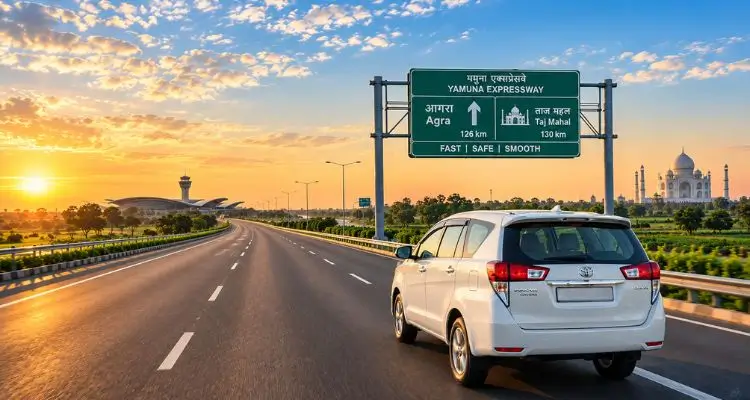
A Delhi Airport to Agra private transfer is one of the most convenient choices for international travellers who want to reach the Taj Mahal directly after landing in India. Instead of entering central Delhi, checking into a hotel or arranging a train connection, passengers can meet a pre-booked driver at Indira Gandhi International Airport and continue directly to their Agra hotel in the same vehicle.
The road distance from Delhi Airport to Agra is approximately 215–240 kilometres, depending on the terminal, the exact hotel location in Agra and the route used. Current road references place the distance from Delhi Airport to central Agra at roughly 212 kilometres, while private-transfer operators commonly quote approximately 220–240 kilometres once hotel locations and normal airport routing are taken into account.
For practical international-tour scheduling, travellers should allow approximately 3.5–4.5 hours after leaving the airport. Under excellent traffic conditions the drive can be faster, but airport pickup, Delhi traffic, a short comfort stop and the final road into Agra can extend the journey. The majority of the intercity sector is normally completed using the Yamuna Expressway, the approximately 165-kilometre access-controlled road linking Greater Noida with Agra.
For travellers seeking a professionally arranged service rather than the lowest local taxi fare, a realistic higher-side Delhi Airport to Agra taxi cost is approximately $130–$165 for a comfortable sedan, around $155–$195 for a Toyota Innova, and approximately $175–$220 for an Innova Crysta. Premium SUVs can cost around $235–$310+, while a Tempo Traveller for a family or small group can cost approximately $275–$380+. Luxury chauffeur-driven cars can begin at around $350 and rise substantially according to the vehicle.
A private airport transfer should offer more than a car waiting outside the terminal. The booking should clearly explain airport meeting arrangements, flight tracking, included waiting time, luggage capacity, tolls, taxes, fuel and the driver's contact details. These practical elements become particularly important after a long international flight, when the traveller does not want to begin negotiating transportation prices immediately after leaving customs.
The Delhi Airport to Agra distance by road is usually quoted between approximately 215 and 240 kilometres because the exact figure changes according to the terminal and final Agra destination. A central-city route estimate is roughly 212 kilometres, while tourism operators commonly use a broader 220–240-kilometre figure for complete airport-to-hotel journeys.
For most private transfers, the driver leaves the airport area, moves towards the Noida–Greater Noida side of the National Capital Region and then joins the Yamuna Expressway for the main intercity sector. The expressway itself is approximately 165 kilometres long and provides the fastest practical road connection towards Agra for most travellers.
The expressway section is usually the easiest part of the journey. The biggest time variables are reaching it after leaving Delhi Airport and then travelling through Agra traffic to the hotel. An international visitor should therefore avoid calculating the transfer solely by dividing the distance by a highway speed.
A realistic airport-to-hotel travel time of 3.5–4.5 hours works well for budgeting. A traveller leaving the terminal around 9:00 AM may reach an Agra hotel sometime around early afternoon, while somebody leaving during a busier traffic period may arrive later.
The actual clock should begin when the passenger leaves the airport in the car, not when the aircraft touches down. Immigration, baggage collection and customs can easily require an hour or more after landing.
Suppose a flight lands at 7:00 AM. The passenger may not reach the arrivals hall until 8:00 or 8:30 AM. After meeting the driver and loading luggage, the vehicle may leave around 8:45 AM. A realistic Agra arrival could then fall around 12:30–1:30 PM, depending on traffic and stops.
This distinction is important when deciding whether to book Taj Mahal sightseeing on the same day.
A private airport transfer costs more than a basic point-to-point city taxi because the service requires terminal coordination, waiting time, intercity driving and often flight monitoring.
For international travellers looking for dependable private transportation, premium-side budgeting can look like this:
|
Vehicle Category |
Practical Passenger Use |
Approximate One-Way Price |
|---|---|---|
|
Comfortable Sedan |
1–2 travellers |
$130–$165 |
|
Premium Sedan |
1–3 travellers |
$145–$180 |
|
Toyota Innova |
2–4 travellers |
$155–$195 |
|
Toyota Innova Crysta |
2–5 travellers |
$175–$220 |
|
Premium SUV |
2–5 travellers |
$235–$310+ |
|
Tempo Traveller |
Small groups |
$275–$380+ |
|
Luxury Chauffeur Car |
Premium travellers |
$350–$650+ |
These figures are intentionally higher than bargain app-based taxi pricing. They are designed for travellers who value a clean air-conditioned tourist vehicle, confirmed airport pickup, luggage assistance and transparent service.
The quotation should state whether fuel, Yamuna Expressway tolls, airport parking, taxes and driver expenses are included.
Airport waiting time also needs to be clear. Some private services include a defined period after the flight lands and monitor delays, while others begin charging extra waiting after a certain time. One current airport-transfer provider, for example, explicitly advertises flight tracking and complimentary waiting before additional charges apply. Policies vary, so travellers should confirm their own booking terms rather than assume all companies operate identically.
A hotel located far from Agra's central tourist area can also change the final fare slightly. The exact property name should be supplied when the quotation is requested.
The airport pickup should be arranged around the flight number, not simply a clock time.
An aircraft can land early or late. Passengers can also spend considerably longer than expected at immigration or baggage collection. If the operator knows only that the traveller requested a pickup at 8:00 AM, a normal flight delay can create confusion. If the operator has the flight number, the driver can monitor the actual arrival more effectively.
After landing, international passengers normally complete immigration, collect checked baggage and pass through customs before reaching the public arrivals area.
A pre-booked driver should have a defined meeting method. This may involve a name board, a specific arrival gate or direct mobile contact.
Travellers should save the operator and driver details on their phone before boarding the international flight. A screenshot of the booking confirmation is useful in case mobile data is not immediately available.
Once the driver is located, confirm the Agra hotel name before leaving. Many hotels have similar names, and major chains can operate more than one property in the same region.
The passenger should also confirm whether any stop is needed during the journey. After a long flight, some travellers want coffee or breakfast almost immediately, while others prefer to continue towards Agra and stop later.
A well-run Delhi Airport to Agra chauffeur transfer should feel straightforward because these details were agreed before arrival.
Indira Gandhi International Airport operates several terminals. International traffic commonly uses Terminal 3, but terminal assignments can vary according to airline and operational changes.
Travellers should provide the actual flight number and terminal information whenever available.
If one member of a group arrives internationally while another arrives on a domestic service, they may not necessarily emerge from the same terminal. This should be discussed with the operator before the transfer.
A driver waiting at Terminal 3 cannot be expected to know that a passenger changed to another terminal unless the information was supplied.
Airport parking charges can also differ according to how long the vehicle waits. This is another reason a fixed, properly structured transfer quotation is more useful than a vague verbal estimate.
For families or groups, the meeting point should be particularly clear. Several passengers searching independently for the driver while carrying luggage can quickly become confusing in a busy airport.
For many travellers, yes. For others, staying near Delhi Airport first is more sensible.
A visitor arriving after a short regional flight may find the 3.5–4.5-hour Delhi Airport to Agra road journey completely manageable. A traveller who has just completed a ten- or fifteen-hour overnight flight may feel differently.
The advantage of continuing directly is efficiency. If Delhi sightseeing is not part of the itinerary, checking into a Delhi hotel for only one night adds another hotel check-in, luggage movement and departure the following morning.
A private car removes that extra step. The passenger leaves Delhi Airport and reaches Agra in one continuous journey.
However, fatigue should be taken seriously. Senior travellers, families with young children and passengers who sleep poorly on aircraft may be better served by resting first.
A late-night arrival creates the biggest concern. If the passenger leaves Delhi Airport at midnight, an Agra hotel arrival may occur around 4:00 AM. The following sightseeing day can then be almost useless because everybody needs sleep.
Paying for an airport hotel can therefore be better value than forcing an overnight road journey simply to save one hotel night.
A morning airport arrival is particularly convenient.
Passengers can complete immigration, meet the driver and reach Agra in time for hotel check-in or lunch. The afternoon can then be used either for light sightseeing or rest.
An early-afternoon arrival can still work well, although travellers may reach Agra towards evening depending on traffic.
A late-afternoon or evening arrival is better treated as a pure transfer. Travellers should not schedule a timed monument visit after reaching Agra.
A very late-night arrival deserves careful consideration. Private transfers operate at night, but passenger and driver fatigue matter.
Winter conditions can also affect travel. North India can experience dense fog during colder months, especially in early mornings and at night. Visibility can slow road travel substantially. For winter airport arrivals, travellers should leave more buffer in the schedule rather than assuming the normal expressway time will always apply.
Yes, if the flight arrives early enough and the traveller is not exhausted.
The Taj Mahal is generally open from sunrise to sunset and closed to general visitors on Fridays. This Friday closure is one of the most important scheduling rules for an Agra visit.
A traveller landing in Delhi early in the morning could reach Agra around lunchtime and potentially visit the Taj Mahal in the afternoon.
The practical question is whether that is desirable after a long international flight.
Suppose the aircraft lands at 6:00 AM. The traveller may leave Delhi Airport around 7:30 AM and reach Agra around noon. After hotel check-in and lunch, an afternoon Taj Mahal visit could work comfortably.
Now consider a flight landing at 11:00 AM. The traveller may not leave the airport until 12:30 PM and may reach Agra around 4:30 PM. Depending on seasonal sunset time, traffic and ticketing, attempting a substantial Taj Mahal visit could be stressful.
The Taj Mahal should not be reduced to a rushed final-hour stop simply because the traveller wants to use every remaining minute.
If the arrival schedule is uncertain, staying overnight and visiting the Taj Mahal the following morning usually produces a better experience.
One of the strongest arrangements for international visitors is to drive from Delhi Airport to Agra, stay overnight and visit the Taj Mahal at sunrise the following morning.
This gives passengers time to recover from the flight while positioning them close to the monument.
Travellers should select a hotel with convenient access to the Taj Mahal if sunrise is important. A property requiring a long drive through Agra traffic reduces the advantage.
The monument is generally open from sunrise to sunset except Fridays, so the actual opening time varies with daylight.
Passengers should be ready before sunrise rather than leaving the hotel exactly at sunrise.
Security checks and entry queues also require time.
Winter mornings can experience fog or haze, which may reduce the famous long-distance views. Travellers should understand that sunrise does not guarantee perfect photography.
Even so, an early visit can provide cooler temperatures and an attractive atmosphere before the busiest part of the day.
Some travellers have a long Delhi layover or only one free day and want to travel directly from the airport to Agra, see the Taj Mahal and return to Delhi.
This is possible, but it creates a very long day.
The road journey alone can total approximately 7–9 hours round trip, depending on traffic. Add airport formalities, Taj Mahal sightseeing, Agra Fort and meals, and the complete schedule can easily reach twelve or fourteen hours.
For a premium same-day private arrangement beginning and ending at Delhi Airport, a sedan can reasonably cost approximately $220–$280, while an Innova Crysta can cost around $280–$350 depending on waiting time and sightseeing requirements.
Travellers connecting to an international flight should be extremely cautious. Road traffic is not predictable enough to build a tight airport connection after an Agra excursion.
A same-day airport–Agra–airport journey is far more suitable when the traveller has an overnight stay near Delhi Airport afterwards than when a flight departs only a few hours after the expected return.
For one or two passengers with moderate luggage, a sedan is sufficient.
The Delhi Airport–Agra route is relatively smooth because much of the intercity sector uses the Yamuna Expressway.
However, international luggage changes the equation.
Two travellers may arrive with two large check-in suitcases, two cabin bags, backpacks and additional shopping or equipment. A standard sedan can become tight once the boot is fully occupied.
An Innova Crysta Delhi Airport to Agra transfer provides more flexible luggage storage and greater cabin space.
The higher seating position is also comfortable for passengers who have spent several hours sitting on an aircraft.
The upgrade may cost approximately $40–$60 over a sedan. For travellers who value comfort after a long-haul flight, this is often a reasonable difference.
Families should provide the exact number of large bags when booking. Four passengers do not automatically fit comfortably into a vehicle just because it contains four passenger seats.
Groups should select a properly sized Tempo Traveller rather than stacking baggage around passengers.
The expressway journey is short enough that many travellers need only one break.
Passengers arriving early in the morning may want breakfast or coffee before continuing to Agra. Others may prefer to drive for an hour or two and stop later.
The Yamuna Expressway has designated service areas and roadside facilities, although the quality of individual restaurants can change over time.
An experienced airport-transfer driver should know suitable options for clean restrooms and food.
Travellers should ask for a stop rather than waiting until the situation becomes urgent. A private transfer allows this flexibility.
A 30–45-minute meal or coffee break is usually sufficient.
For travellers with sensitive stomachs after a long flight, freshly cooked food and sealed bottled water are sensible choices.
The driver should never pressure passengers to use a particular restaurant or shop if they do not want to.
Mathura and Vrindavan are geographically associated with the broader Delhi–Agra corridor, but adding them to an airport transfer changes the day substantially.
A proper visit to Mathura or Vrindavan is not a quick highway stop. Temple access, local traffic, walking and religious schedules require time.
Adding one or both can extend the Delhi Airport–Agra day by several hours.
For a traveller arriving fresh on a short flight, this may be acceptable. For somebody arriving after an overnight international journey, it can be exhausting.
If Mathura or Vrindavan is important, it is better to build it deliberately into the itinerary rather than casually asking the airport driver to make an unscheduled diversion.
The transportation quotation should also be revised because additional kilometres, parking and waiting time are involved.
A traveller should not assume that a fixed Delhi Airport to Agra fare includes unlimited sightseeing anywhere between the two cities.
Train travel between Delhi and Agra can be fast, but the airport is not located at New Delhi Railway Station.
A traveller landing at Delhi Airport must first complete immigration and baggage collection, travel to the appropriate railway station, arrive with enough time to board, manage luggage and then arrange another transfer after reaching Agra.
Current route comparisons estimate the complete airport-to-Agra train journey at around three hours or more, including the required connection from the airport.
A fast train can therefore be excellent for travellers already staying in Delhi. It is less straightforward for somebody who has just stepped off an international flight.
A private Delhi Airport to Agra car offers terminal-to-hotel transportation with no connection.
The train is cheaper and may be faster in certain circumstances. The private car provides much greater luggage convenience and removes the risk of missing a booked train because the international flight arrived late.
For first-time India visitors with substantial luggage, the car often represents the simpler option.
Bus travel is significantly cheaper but involves more logistics.
Current transport comparisons show airport-to-Agra bus journeys can require around six to seven hours or more once the connection to the bus departure point is included.
A passenger may need to move from the airport to a bus terminal, wait for departure and then arrange another taxi after reaching Agra.
For budget travellers with light luggage, this can be perfectly acceptable.
For couples, families and senior travellers beginning a private North India holiday, the additional cost of a chauffeur-driven vehicle buys direct transportation and significant convenience.
Although Agra has an airport, road travel from Delhi is usually much more practical for ordinary tourists.
The distance is short enough that airport check-in, security, baggage procedures and transfer time eliminate much of the theoretical advantage of flying.
Flight schedules can also be limited compared with road availability.
A private car can depart whenever the passenger leaves customs and drive directly to the hotel.
For this particular sector, road and rail normally make more sense than air travel.
A professional Delhi Airport to Agra private transfer booking should state the passenger name, arrival date, flight number and terminal information where available.
The Agra hotel name and address should be included.
The confirmed vehicle category should appear clearly. If an Innova Crysta has been selected, the booking should not simply say “SUV.”
The quotation should explain whether fuel, Yamuna Expressway tolls, airport parking, vehicle taxes and driver allowance are included.
Waiting-time terms should be stated, including what happens when the flight is delayed.
Passenger and luggage counts should be supplied.
Closer to arrival, travellers should receive a driver contact number and clear meeting instructions.
If an additional stop such as Mathura or Vrindavan is required, it should appear in the route before the final price is accepted.
A premium private transfer should eliminate uncertainty, not simply place an expensive car outside the airport.
Flight delays are one of the main reasons travellers should use the flight number when booking.
A professional driver or operator can monitor the updated arrival and adjust the pickup accordingly.
If the flight is delayed before landing, the passenger should normally not be treated as a no-show simply because the original arrival time has passed. However, exact policies vary.
Immigration delays are slightly different because the aircraft may have landed on time while the passenger remains inside the terminal.
If baggage is lost or the traveller needs to file a report with the airline, they should contact the driver or operator immediately.
Good communication is more important than assuming the driver will automatically know why the passenger has not appeared.
A late-night transfer is possible, but comfort and safety deserve priority.
If a passenger leaves Delhi Airport at 11:30 PM, arrival in Agra may occur around 3:00–4:00 AM.
For travellers who sleep easily in the car and want to wake up in Agra, this may be acceptable.
For most long-haul passengers, however, an airport hotel followed by a morning transfer provides a far better first day.
Travellers should also make sure the Agra hotel knows about the overnight arrival and keeps the reservation active.
The driver assigned to a night transfer should be appropriately rested. Saving one hotel night is not worth encouraging unsafe overnight driving.
Tipping is voluntary.
For a straightforward Delhi Airport to Agra private transfer, international travellers can consider approximately $10–$15 equivalent for good service.
If the driver waits patiently through a complicated arrival, assists with substantial luggage and provides professional service throughout the road journey, approximately $15–$25 equivalent can be appropriate.
Prices in this guide are expressed in USD for budgeting, but gratuities are generally more convenient in local currency.
If the same driver continues with the travellers through Agra, Jaipur and Rajasthan, a single tip at the end of the complete driving service is usually preferable.
Safe driving, punctuality and professional conduct should matter more than reaching Agra a few minutes earlier.
Find the answers to all of our most frequently asked questions
The road distance is approximately 215–240 kilometres, depending on the terminal, route and Agra hotel location. Current central-city road estimates are close to 212 kilometres, while private-transfer routes commonly fall within the broader range.
Travellers should normally allow approximately 3.5–4.5 hours after leaving the airport. Delhi traffic, rest stops, fog and the final approach into Agra can affect the actual time.
A premium sedan can reasonably cost around $130–$165 one way, while an Innova Crysta may cost approximately $175–$220. Larger and luxury vehicles cost more.
Yes. The Yamuna Expressway is normally the preferred fast road corridor for Delhi Airport–Agra transfers and covers roughly 165 kilometres between Greater Noida and Agra.
Professional airport services commonly track flights, but waiting policies differ. Confirm how flight delays and extended immigration or baggage delays are handled before booking.
Yes, when the flight arrives early enough. A morning landing can allow an afternoon Taj Mahal visit, but passengers should consider fatigue and remember that the Taj Mahal is closed to general visitors on Fridays.
A sedan is sufficient for two travellers with moderate luggage. An Innova Crysta is more comfortable when passengers have several large international suitcases or want additional cabin space after a long flight.
A fast train between central Delhi and Agra can be quick, but airport passengers first need to reach the railway station. A private car provides direct terminal-to-hotel transportation and removes the risk of missing a train because of a flight delay.
Yes, but they should be treated as genuine sightseeing stops rather than short diversions. They can add several hours to the day and should be agreed with the operator before the transfer price is finalized.
They can be included in a complete quotation, but travellers should specifically confirm fuel, Yamuna Expressway tolls, airport parking, road taxes, driver expenses, waiting time and any sightseeing diversions before paying.