Your Travel Partner
SINCE 1989
Your Travel Partner
SINCE 1989
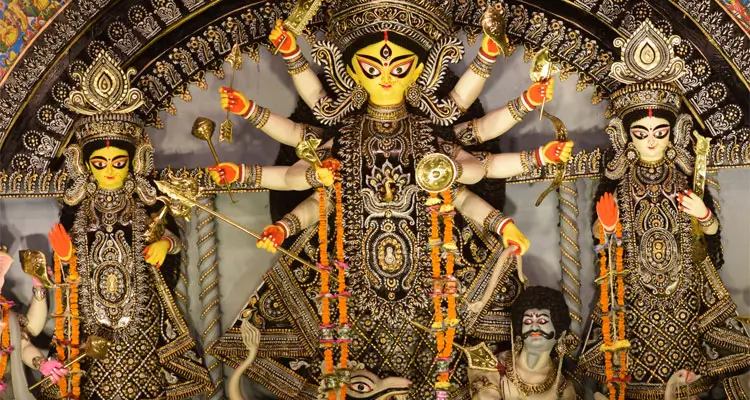
Durga Puja is one of the most important religious and cultural celebrations associated with eastern India, and Kolkata gives the festival its most spectacular public expression. For several days, ordinary streets become corridors of illuminated art, temporary structures rise in neighbourhoods across the city, sculpted images of Goddess Durga become the centre of worship, families gather for prayers and meals, and millions of people move from one pandal to another late into the night. Yet Durga Puja in Kolkata is much more than large crowds and elaborate decorations. At its heart is the worship of Goddess Durga, her victory over Mahishasura, her symbolic arrival at her maternal home, and her emotional departure on Vijayadashami.
The festival is closely connected with the larger autumn period of worship dedicated to the Goddess, but the Bengali Durga Puja tradition has its own sequence, character and rituals. The most important public days are associated with Shashthi, Saptami, Ashtami, Navami and Dashami. Preparations, however, begin much earlier. Artisans spend months shaping the images of Durga and the deities traditionally displayed with her, designers and craftspeople construct theme-based pandals, organisers arrange lighting and crowd management, and families prepare new clothing and festive meals.
Kolkata's Durga Puja was inscribed by UNESCO on the Representative List of the Intangible Cultural Heritage of Humanity in 2021. UNESCO describes the celebration as an annual festival centred on the worship of Goddess Durga in Kolkata and notes the importance of clay image-making and community participation to the tradition. This recognition is significant because it acknowledges not only the religious observance but also the craftsmanship, artistic production and social participation that surround the festival.
For an international traveller, Kolkata Durga Puja can be one of the most absorbing cultural experiences in India. A visitor may see an enormous contemporary pandal based on architecture, social themes or traditional art, then walk a few streets and enter a neighbourhood celebration that has been organised by the same community for generations. The next morning can involve temple worship, while the evening may include aarti, drumming, Dhunuchi dance and a completely different atmosphere.
The experience is most rewarding when the festival is treated as a living religious tradition rather than a collection of tourist attractions. Pandals are artistic spaces, but they are also sacred spaces. Idols are visually extraordinary, but they are worshipped. Processions are dramatic, but they mark a genuine farewell. Understanding this distinction makes every ritual, sound and gesture more meaningful.
Magnificent pandals, intricate idols, devotional ceremonies and illuminated streets come together to create an atmosphere found nowhere else. Explore Durga Puja through the artistry and traditions behind the celebration.
The Durga Puja dates change because the festival follows the Hindu lunar calendar. In the 2026-27 festival cycle, the major Durga Puja observances fall in October. The principal sequence begins with Shashthi rituals, continues through Saptami, Ashtami and Navami, and reaches Vijayadashami and the major Bengal immersion observances on Dashami. Current Panchang calculations place the main sequence around October 16 to October 21, 2026, although exact ritual timings should always be checked for Kolkata or the specific city where the puja is being attended.
Shashthi marks the ceremonial awakening and invocation of the Goddess through important rituals such as Kalparambha, Akal Bodhan, Amantran and Adhivas. Saptami brings the bathing and worship associated with Nabapatrika, commonly referred to in popular Bengali usage as Kolabou. Ashtami is one of the most sacred and crowded days and includes major worship, Kumari Puja at certain institutions and the exceptionally important Sandhi Puja around the transition between Ashtami and Navami. Navami includes the closing phase of major worship and sacred fire ceremonies in many traditions. Dashami brings farewell rituals, Sindoor Khela in many communities, processions and idol immersion.
A date calendar gives only part of the picture because many important rituals are tied to precise lunar transitions rather than to a general morning or evening slot. Sandhi Puja timing, for example, is calculated around the final portion of Ashtami and the opening portion of Navami. The ritual traditionally spans a short and highly significant period around that transition. This means a visitor who wants to witness Sandhi Puja at a particular temple or community pandal should verify the exact local schedule instead of assuming it begins at a standard hour every year.
The same principle applies to Saptami bathing rituals, Ashtami worship and Vijayadashami ceremonies. Festival organisers often display puja schedules at individual pandals, while established temples publish their own timings. A large public pandal may remain accessible around the clock or for very long hours during the peak festival period, but the Durga Puja ritual timings within it are much more specific.
The main days should also be understood in terms of crowd intensity. Shashthi already sees heavy attendance as pandals formally open and devotees begin visiting in large numbers. Saptami becomes busier, while Ashtami and Navami can bring some of the largest crowds. Dashami feels different: the atmosphere gradually shifts from celebration to farewell as idols prepare to leave their pandals.
In practical terms, a traveller who wants a rich festival experience should not arrive only on the final day. Several nights allow time to see the progression. One evening may be devoted to North Kolkata's traditional celebrations, another to major contemporary theme pandals, while daytime can be used for temple visits or quieter neighbourhood pujas. This approach also reduces the pressure to cross the entire city during a single night.
West Bengal Tourism describes Durga Puja as the state's biggest festival and emphasises the elaborate pandals, innovative themes, lighting, cultural programmes, feasting and immersion processions that define the celebration. The official tourism description also highlights the idea of Goddess Durga returning to her maternal home before returning after the festival, a theme that explains much of the emotion surrounding Dashami.
The central religious story behind Durga Puja concerns Goddess Durga's defeat of the demon Mahishasura. According to Hindu tradition, Mahishasura was a powerful being capable of changing form and was especially associated with the form of a buffalo. Through severe austerities he obtained a boon that made him extremely difficult to defeat. Empowered by this protection, he challenged the gods and disrupted cosmic order.
Unable to defeat him individually, the gods combined their divine energies. From this concentrated power emerged Goddess Durga, a supreme warrior manifestation of Shakti, or divine feminine energy. Different deities presented her with weapons and powers. Traditional images therefore show Durga carrying multiple weapons while riding a lion or tiger, representing overwhelming courage and divine authority.
A prolonged battle followed between Durga and Mahishasura. The demon changed forms in an attempt to escape defeat, but Durga ultimately destroyed him. The familiar Durga idol in Kolkata captures this decisive moment: the Goddess stands above Mahishasura while striking him with her weapon, presenting the victory of order over chaos and good over destructive power.
This is why Durga Puja is commonly described as a celebration of the victory of good over evil. Yet the Bengali tradition adds another deeply emotional narrative. Goddess Durga is also regarded as a daughter returning to her maternal home with her children for a brief annual visit. Lakshmi, Saraswati, Ganesha and Kartikeya are traditionally represented around her in the complete tableau.
This domestic interpretation changes the emotional character of the festival. The Goddess is not only a distant warrior deity. She is welcomed like a beloved daughter returning home. Families dress in new clothes, gather together and share meals as they might during a major family reunion. On Dashami, when Durga departs, the mood becomes emotional because the daughter is symbolically leaving her maternal home and returning to her husband Shiva's abode.
The story gives Vijayadashami a remarkable mixture of celebration and sadness. The victory over Mahishasura has already established the triumph of the Goddess, but devotees must now say farewell. This is why people may smile, dance and celebrate during the procession while simultaneously treating immersion as an emotional departure.
Another important tradition concerns Akal Bodhan, the untimely invocation of Goddess Durga associated with the autumn festival. A popular religious tradition connects this worship with Lord Rama invoking Durga before his battle with Ravana. The word Bodhan refers to awakening or invocation, and the ritual has an important place in the Shashthi sequence of Bengali Durga Puja.
Mahalaya is also closely associated with the approach of the festival. It marks an important transition leading toward the period of Goddess worship. For many Bengali families, the cultural atmosphere of Durga Puja begins well before the major pandal days. Traditional recitations and devotional broadcasts associated with Mahalaya remain deeply embedded in public memory.
The festival therefore operates on several levels simultaneously. It is a story of a warrior Goddess defeating a demon, a celebration of divine feminine power, a family narrative about a daughter returning home, a major artistic event and a vast community gathering. That combination is one reason Durga Puja celebrations in Kolkata have such a distinctive identity.
One of the most remarkable parts of the festival occurs long before the main public days begin. In Kolkata, artisans work for months to create the clay images that will eventually become the centre of worship. UNESCO specifically highlights the tradition of sculpting images of Durga and her family from unfired clay, underlining the craftsmanship that supports the festival.
Kumartuli in Kolkata is particularly famous for its community of traditional image-makers. Narrow lanes contain workshops where sculptors build frameworks, apply layers of material and gradually create the faces, bodies and elaborate decorative details of the deities. The transformation from raw structure into a complete image requires considerable skill and is often carried out by families whose craft traditions have continued over generations.
A typical Durga tableau shows the Goddess in the centre, Mahishasura below her, and associated deities around her. The precise artistic style can vary from extremely traditional representations to highly experimental contemporary interpretations. Facial features, clothing, weapons, jewellery and the overall composition are carefully developed before the image is transported to the pandal.
For visitors arriving before the festival, Kumartuli can provide an unusual perspective because it shows the work behind the finished celebration. During the final preparation period, however, the lanes become intensely busy. Travellers should remember that these are active workshops, not staged museum displays. Photography should be respectful, pathways should not be blocked and artisans should not be interrupted while carrying or finishing delicate images.
The Durga Puja pandal has developed into an art form in its own right. At a basic level, a pandal is a temporary structure established for the worship of the Goddess. In Kolkata, however, many committees build extraordinary installations that can resemble palaces, temples, historical monuments, villages, abstract art spaces or structures based on contemporary social and environmental ideas.
Some pandals rely heavily on traditional Bengali craft, while others use recycled material, bamboo, textiles, metal, wood, clay, paper or unconventional materials. Lighting design is often equally important. Entire streets may be converted into coordinated visual environments leading visitors toward the central shrine.
The scale of the work is easy to underestimate. Major pandals can require months of construction and significant budgets. Designers, carpenters, electricians, sculptors, craftspeople, painters, fabricators, organisers, security workers and volunteers may all contribute.
There is generally no standard sightseeing ticket for ordinary community pandals. Most are open to the public, although visitors may encounter separate queue systems, controlled entry points or special access arrangements depending on the organiser. The major cost for tourists is therefore not usually admission but transportation, accommodation, food and the time needed to navigate crowds.
Pandal hopping is a central part of the Kolkata experience, but trying to see every famous pandal is unrealistic. Hundreds of community pujas operate across the metropolitan area, and major installations can have very long queues. A better approach is to select clusters in particular districts and experience each area properly.
North Kolkata is known for numerous traditional and historically important community pujas. South Kolkata offers many highly prominent theme-based celebrations. Central areas add further possibilities. Travellers should group nearby pandals rather than repeatedly crossing the city, especially in the evening.
A visitor should also resist treating every pandal purely as an Instagram location. The central idol is the object of active worship. Devotees may be waiting for darshan while photographers attempt to secure a clear angle. Remaining to one side, moving with the queue and avoiding prolonged posed photography directly in front of the deity is both respectful and practical.
Durga Puja is more than a festival of rituals—it transforms neighbourhoods into extraordinary spaces of art, devotion and community. Be there for the pandals.
The most rewarding way to understand Durga Puja rituals is to follow how worship changes through the main festival days. Each stage has its own religious meaning, atmosphere and ceremonial practices.
Shashthi marks the formal opening of the major worship period. Important rituals include Kalparambha, Bodhan, Amantran and Adhivas. Bodhan represents the ceremonial awakening or invocation of the Goddess. In popular tradition, the autumn invocation is connected with Lord Rama's worship of Durga before his battle with Ravana.
The atmosphere on Shashthi is one of arrival. The Goddess has symbolically come home, pandals are fully active and families begin their main round of visits. For travellers, this is an excellent day to become familiar with the city before the heaviest peak crowds.
Saptami begins with one of the most visually distinctive rituals, Nabapatrika Puja. Nabapatrika consists of nine plants bound together and worshipped as a sacred representation connected with the Goddess. A banana plant forms the most visually prominent part, which is why the arrangement is popularly called Kolabou.
Early in the morning, the Nabapatrika is ceremonially bathed, traditionally in a river or sacred water setting, dressed and brought to the puja space. The ritual can be particularly atmospheric when performed near the Ganges in Kolkata. Visitors hoping to witness it need to be prepared for an early start and should avoid obstructing the religious procession.
Ashtami is among the most sacred days of the festival. Maha Ashtami Puja attracts large numbers of devotees, many of whom offer flowers during Pushpanjali. Worshippers stand together while sacred mantras are recited and flowers are offered to the Goddess.
A visitor who does not know the ritual can simply watch rather than copying others. Where organisers allow non-Hindu visitors to participate, following the priest's or host's instructions is appropriate. There is no requirement to participate in every act in order to show respect.
Some institutions conduct Kumari Puja, in which a young girl is worshipped as a living representation of the divine feminine. The best-known public observance is associated with Belur Math, although crowd controls and access arrangements can be strict during major festival worship. The ceremony expresses the belief that divine feminine energy can be honoured in living human form.
One of the most significant rituals is Sandhi Puja, performed at the transition between Ashtami and Navami. The sacred period traditionally covers the final twenty-four minutes of Ashtami and the first twenty-four minutes of Navami, creating a forty-eight-minute ritual window.
Sandhi Puja commemorates a particularly powerful moment in the Goddess tradition associated with the destruction of demonic forces. Many pujas traditionally use 108 lamps and 108 lotus flowers during the ceremony. The atmosphere can become exceptionally intense as bells, sacred chants, incense and lamps fill the worship space.
Because the ritual depends on the lunar transition, its timing changes. Travellers who specifically want to witness Sandhi Puja in Kolkata should identify one or two accessible pujas in advance and verify that venue's exact schedule. Attempting to cross the city immediately before the forty-eight-minute window is risky because festival traffic and pedestrian restrictions can make travel unpredictable.
Navami carries another major round of worship. Maha Navami Puja and Homa, or sacred fire ritual, may form part of the ceremony. By this stage the festival is approaching its end, and the atmosphere combines continued celebration with the knowledge that farewell is close.
Throughout these days, Durga Puja Aarti can be accompanied by Dhak, the traditional drum strongly associated with the festival. The deep rhythm of the Dhak is one of the defining sounds of Durga Puja. Hearing it inside a crowded pandal while lamps move before the idol creates a sensory experience that cannot be understood through photographs alone.
Another famous cultural expression is Dhunuchi dance, in which participants dance while carrying incense burners containing burning material that produces aromatic smoke. The performance is commonly associated with evening aarti. Skilled participants move rhythmically while balancing the vessels, often to the accompaniment of Dhak.
Tourists should never attempt to pick up a burning Dhunuchi casually. It involves hot material and active religious ceremony. Watching from an appropriate position provides a better and safer experience unless organisers specifically invite trained participants.
Food offerings also form an important part of worship. Many community pujas distribute bhog, a vegetarian meal first offered to the Goddess and then served to devotees. Khichuri, vegetable preparations and sweets are commonly associated with community bhog, although menus differ.
Receiving bhog is not simply the same as buying lunch from a food stall. It is sacred food connected with worship. Visitors who are offered bhog should accept it respectfully and avoid unnecessary waste.
For a foreign traveller, the size of Durga Puja in Kolkata can make the first evening confusing. There are too many major pandals to cover, roads are redirected, crowds move in different directions, and journeys that appear short on a map can take much longer than expected. A successful visit depends more on selecting the right areas and time periods than on trying to accumulate the highest number of pandals.
North Kolkata deserves dedicated time. This part of the city contains many older neighbourhoods where the architecture, narrow streets and long-standing community pujas produce a more traditional atmosphere. Several famous household and community celebrations are associated with northern districts.
South Kolkata provides a different experience. Many of the city's best-known large theme pandals are located in the south and attract enormous crowds. Artistic concepts can be highly elaborate, with visitors sometimes walking through a long thematic installation before reaching the deity.
The best time for photography and easier movement is often daytime or early in the festival period, while the most atmospheric lighting is naturally after dark. Serious festival visitors commonly use both. A morning or afternoon session allows closer appreciation of idol craftsmanship, followed by an evening visit to see how the same pandal changes under illumination.
Late-night pandal hopping in Kolkata is common during peak Durga Puja. Some visitors remain out until very late or begin moving after the heaviest evening crowds start to thin. International travellers interested in this approach should arrange reliable transport and remain aware that some roads become pedestrian-only.
The city's Metro can be extremely valuable when operating convenient services during the festival period, while walking is unavoidable around major clusters. Taxis and app-based vehicles may be useful away from road closures but cannot always reach a pandal entrance.
A private car with driver in Kolkata can still be useful for broader movement, particularly during daytime or for transferring between distant festival zones, but visitors should expect to leave the vehicle and walk considerable distances. Road restrictions apply to private vehicles just as they do to taxis.
Comfortable footwear is essential. A single evening can involve several kilometres of walking and long periods standing in queues. Lightweight clothing is appropriate for Kolkata's warm and humid conditions, while modest dress remains preferable when entering religious areas.
Large backpacks should be avoided. A small secure bag containing a phone, limited cash, water where permitted and basic essentials is much easier to manage. Some high-profile pandals operate security screening, and carrying excessive equipment slows movement.
The festival is also a major food occasion. Kolkata's restaurants and street-food areas become extremely busy, and families use the holiday period for extensive social eating. Durga Puja food in Kolkata can range from traditional Bengali meals to rolls, biryani, sweets, snacks and elaborate restaurant menus.
Visitors interested in Bengali cuisine can use the festival as an opportunity to try rice dishes, fish preparations, vegetable dishes and sweets at reputable restaurants. Community bhog provides a completely different religious food experience.
International travellers should follow normal food and water precautions, especially during long days outdoors. Choose busy, hygienic establishments, drink safely treated water and avoid eating continuously simply because food is available at every street corner.
Accommodation location has a major impact on the experience. Central or well-connected areas can reduce travel difficulties, although there is no single perfect hotel location because major celebrations are distributed across the city. Premium hotels can command higher rates during important festival periods, so early booking is sensible for travellers who want specific properties.
Kolkata is generally accustomed to very large festival crowds, but visitors should remain alert in congested areas. Phones, passports and wallets should be secured, and original passports are better left in a hotel safe unless required. Families with young children should establish clear meeting arrangements before entering extremely busy pandals.
Photography is usually welcomed in many public spaces, but rules vary. Flash should be avoided during active puja where it distracts worshippers. Close portraits require permission. Tripods can be impractical or restricted in dense queues. Drone photography should never be assumed to be permitted in a city environment containing huge public gatherings.
For travellers with sufficient time, Kumartuli, a major temple, traditional North Kolkata pujas, contemporary South Kolkata pandals and an evening aarti create a strong combination. The visitor then sees craft, ritual, neighbourhood tradition and contemporary public art rather than only famous installations.
The final stage of the festival is emotionally distinct from the days before it. Vijayadashami celebrates victory, yet in Bengali tradition it also marks the departure of Goddess Durga from her maternal home.
Morning worship and farewell ceremonies are followed by social rituals. One of the best-known is Sindoor Khela, traditionally associated with married women applying vermilion to the Goddess and then to one another. The sight of red vermilion against white-and-red traditional clothing has become one of the most widely photographed images of Durga Puja.
Visitors should recognise that Sindoor Khela is not a public costume event. It is a ritual with specific cultural associations. An international visitor should not enter the central space or begin applying vermilion without an invitation from the organising community. Observing respectfully is entirely appropriate.
The mood then shifts toward immersion. The idol is prepared to leave the pandal and crowds gather for the farewell. Devotees offer final prayers, and the Goddess begins her symbolic journey away from her maternal home.
Durga Visarjan involves carrying the idol in procession toward an authorised immersion point. Drums, chanting and dancing can accompany the journey. Large vehicles transport major idols, while crowds move alongside them.
West Bengal Tourism describes the immersion as symbolising the Goddess returning to her Himalayan abode after the festival. This explains why the farewell is emotionally comparable to seeing a beloved family member depart after a brief visit.
At designated ghats, the idol is immersed in water according to ritual tradition and official arrangements. The government and city authorities manage crowd movement and environmental procedures around major immersion locations.
International travellers who want to witness Durga idol immersion in Kolkata should not simply arrive at a crowded riverside point without local guidance. Access may be controlled, road traffic can be restricted and the safest observation areas may change. Hotel staff, a knowledgeable guide or official visitor information can help identify practical viewing arrangements.
The procession can continue for a considerable period, and different pujas reach immersion points at different times. A traveller should carry minimal belongings and avoid positioning themselves directly in front of moving vehicles or idol platforms simply to obtain photographs.
After Vijayadashami, people traditionally exchange greetings associated with Bijoya. Families and friends visit one another, elders receive respect and sweets are shared. This social period shows that Durga Puja does not simply stop the moment the idol enters the water.
The artistic structure may disappear, the idol may be immersed and the lights may gradually come down, but the festival closes with a strong sense of continuity. The Goddess has departed, yet the community anticipates her return.
For a traveller, this final stage brings together everything seen during the preceding days. The clay idol that began in an artisan's workshop was installed in a temporary sacred environment, worshipped through an elaborate ritual sequence, visited by enormous crowds and eventually returned to water. The temporary nature of the physical structure is part of the festival's power rather than a contradiction to it.
Durga Puja is celebrated during the autumn festival period, usually in September or October. The dates change according to the Hindu lunar calendar. In the 2026-27 cycle, the principal Bengali Durga Puja days fall in October.
The main public sequence includes Shashthi, Saptami, Maha Ashtami, Maha Navami and Vijayadashami. Each stage has specific rituals, with Ashtami and the Ashtami-Navami transition being particularly important.
Sandhi Puja is performed at the sacred transition between Ashtami and Navami. Traditionally, the ritual spans forty-eight minutes covering the final twenty-four minutes of Ashtami and the first twenty-four minutes of Navami. Exact timing changes according to lunar calculations.
Nabapatrika Puja is an important Saptami ritual involving nine sacred plants bound together, ceremonially bathed and worshipped in connection with Goddess Durga. The banana plant is visually prominent, which is why the arrangement is popularly called Kolabou.
Kolkata combines religious worship with extraordinary public art, community participation, traditional image-making, elaborate pandals, lighting, food and cultural activity. Durga Puja in Kolkata was inscribed on UNESCO's Representative List of the Intangible Cultural Heritage of Humanity in 2021.
Most community Durga Puja pandals do not operate with a standard sightseeing ticket. Public access is usually free, although queue systems, controlled entrances or organiser-specific arrangements may apply at major installations.
Yes. International visitors can attend public pandals and many festival events. Modest behaviour, respect for active worship, appropriate photography and compliance with security or queue instructions are expected.
Sindoor Khela is a Vijayadashami tradition commonly associated with married women offering vermilion to Goddess Durga and applying it to one another before the farewell. Visitors should observe respectfully unless directly invited to participate.
During Durga Visarjan, the idol is carried from the pandal in a farewell procession and immersed at an authorised water location. The ritual symbolises Goddess Durga's departure after her annual visit and her return to her divine abode.
A stay of at least three to four nights gives an international visitor a much better experience than a single evening. It allows time for traditional North Kolkata pujas, large theme pandals, aarti, local food, Kumartuli and the changing atmosphere across different festival days.