Your Travel Partner
SINCE 1989
Your Travel Partner
SINCE 1989
Navratri is one of the most significant Hindu festivals, observed through nine nights of devotion dedicated to the divine feminine power represented by Goddess Durga and her different forms. The festival combines prayer, fasting, temple ceremonies, sacred recitations, community gatherings, music and regional traditions that can look remarkably different from one part of India to another. In Gujarat, nights are famous for energetic Garba and Dandiya celebrations attended by thousands of people. In northern India, devotees commonly observe fasting, visit temples and attend religious ceremonies, while the closing period is closely connected with Dussehra and the story of Lord Rama's victory over Ravana.
The word Navratri refers to nine nights. The festival represents the worship of Shakti, the divine feminine energy, and the triumph of positive forces over destructive ones. The nine nights are traditionally associated with nine manifestations of Goddess Durga, collectively known as Navadurga. Each form has its own symbolism, iconography and devotional significance.
Several Navratri observances occur within the Hindu calendar, but Sharad Navratri, celebrated during the lunar month of Ashwin, is the major autumn festival most international visitors are likely to encounter. It normally falls during September or October and concludes around Vijayadashami or Dussehra.
The festival is especially interesting for a foreign visitor because there is no single Navratri experience. Spending an evening at a large Garba ground in Ahmedabad or Vadodara feels completely different from witnessing devotional ceremonies at a temple in Rajasthan or seeing Dussehra celebrations in northern India. The underlying religious theme remains connected to divine feminine power and victory over evil, yet local communities express it through distinct traditions.
For travellers, this regional diversity makes Navratri celebrations in India much more than a single-night cultural performance. The festival develops across several days. Temples become busier, families alter their diets, worshippers observe different forms of fasting, markets sell festival clothing and religious items, and evenings become increasingly lively in areas known for Garba.
From the auspicious Ghatasthapana Muhurat to the nine forms of Goddess Durga, Navratri unfolds through rituals rich in meaning.
The dates of Sharad Navratri are determined according to the Hindu lunar calendar, which means the Gregorian dates change. The festival begins on Pratipada during the bright lunar fortnight of the month of Ashwin and proceeds through the worship of the different forms of Goddess Durga before reaching the important closing observances associated with Ashtami, Navami and Vijayadashami.
For the 2026-27 festival cycle, Sharad Navratri begins on Sunday, October 11, 2026. The opening day is especially important because it includes Ghatasthapana, the ritual installation that formally marks the beginning of Navratri worship.
The Pratipada Tithi begins at approximately 9:19 PM on October 10 and ends at approximately 9:30 PM on October 11. The exact Ghatasthapana Muhurat varies according to the city because local sunrise and astronomical calculations affect the auspicious period.
In New Delhi, the calculated Ghatasthapana Muhurat is approximately 6:19 AM to 10:12 AM, with an Abhijit Muhurat of approximately 11:44 AM to 12:31 PM. In Jodhpur, the principal period is approximately 6:35 AM to 10:28 AM, followed by an Abhijit period of approximately 12:01 PM to 12:48 PM. Bengaluru has a calculated window of approximately 6:09 AM to 10:07 AM, while Varanasi is approximately 5:54 AM to 9:48 AM.
The variation is important. There is no single Ghatasthapana clock time that should be copied for every destination in India. Families usually follow their local Panchang or the instructions of their priest. Visitors invited to a household ceremony should therefore rely on the timing provided by their host.
Traditional rules place considerable importance on performing Ghatasthapana Puja during the appropriate part of Pratipada. It is generally performed during the first portion of the day while Pratipada prevails, with the Abhijit Muhurat serving as another important period where applicable.
The later stages of Navratri include the particularly significant worship associated with Durga Ashtami and Maha Navami. In the 2026-27 cycle, major closing observances fall around October 19 and October 20, with Vijayadashami occurring on October 20. Regional calendars and ritual traditions can create differences in how particular observances are described or assigned, so visitors attending a specific temple ceremony should check the local schedule.
The religious meaning of Navratri festival is closely connected with the story of Goddess Durga and the buffalo demon Mahishasura. Understanding this traditional narrative makes the nine days of worship considerably easier to appreciate.
According to Hindu tradition, Mahishasura obtained great power through austerities and received a boon that made him extraordinarily difficult for the gods to defeat. Empowered by this protection, he became increasingly destructive and challenged the divine order.
The gods were unable to overcome him individually. Their combined divine energies consequently manifested as the powerful Goddess Durga. She was equipped with weapons and powers associated with different deities and is traditionally depicted riding a lion or tiger.
A fierce battle between Durga and Mahishasura followed. Traditional accounts describe the conflict continuing over an extended period before the Goddess finally defeated him. Her victory came to represent the triumph of divine power, righteousness and courage over arrogance, chaos and destructive forces.
This is one reason the festival is not simply a sequence of prayers. Each successive day represents another stage of spiritual devotion to Shakti. The nine forms of Durga worshipped through Navratri are associated with different qualities, allowing devotees to approach divine feminine power through several aspects rather than one single representation.
The culmination of the period in Vijayadashami reinforces the broader theme of victory. In different regions, this victory is interpreted through traditions connected with Goddess Durga or through the Ramayana narrative of Lord Rama defeating Ravana.
This regional layering is particularly important for overseas visitors. A traveller attending Navratri in Gujarat may spend the evening among circles of Garba dancers, while someone in northern India may see Ramlila performances and eventually enormous Ravana effigies burned at Dussehra. Both experiences belong to the same broad festive period but arise from different traditions.
Ghatasthapana, also known as Kalash Sthapana in many households, is one of the most important opening rituals of Sharad Navratri. It marks the invocation of Goddess Shakti and establishes the sacred focus for the days of worship that follow.
Before the ceremony begins, the worship area is cleaned and prepared. Families may establish a small altar in a dedicated prayer room or another clean section of the home. The exact materials and ritual sequence differ according to family and regional tradition, but a sacred vessel or Kalash forms the centre of the ceremony.
A traditional Kalash is commonly made of metal or earthenware. Water is placed inside, and other sacred materials may be added according to the custom being followed. The vessel can be decorated with a sacred thread and accompanied by leaves. A coconut is commonly positioned at the top, often wrapped or decorated according to household tradition.
Another important element is the sowing of barley or other grains in prepared soil. A shallow earthen container is filled with clean soil and seeds are planted. The Kalash is then installed in association with this sacred arrangement.
The growing shoots are observed throughout Navratri and carry symbolic associations with fertility, life, prosperity and divine blessing. By the end of the festival, the green growth around the sacred installation gives the household altar a distinctive appearance.
The Goddess is invoked through prayers, and a lamp may be lit as part of the ceremony. Some households maintain an Akhand Jyoti, a continuously burning sacred lamp, during Navratri. Such a lamp requires careful supervision and is not something a visitor should touch or move.
Ghatasthapana is not simply decorative. It establishes the sacred beginning of the nine-day period and represents the invocation of divine feminine energy within the household.
An international guest invited to observe the ceremony should allow the family to guide them. Removing footwear before entering the worship area, wearing modest clothing and remaining quiet during recitations are generally sufficient. Visitors do not need to reproduce rituals they do not understand.
Each period of Navratri worship is traditionally associated with one of the nine forms of Goddess Durga, collectively called Navadurga. Their individual stories and symbolism give the festival its spiritual progression.
Goddess Shailaputri
The opening worship is dedicated to Shailaputri, whose name refers to the daughter of the mountains. She is associated with Goddess Parvati and represents stability, purity and strength. Traditional iconography shows her riding a bull and carrying a trident and lotus.
Because her worship begins the Navratri cycle, Shailaputri represents a spiritual starting point. Devotees offer prayers seeking strength and steadiness for the period of worship ahead.
Goddess Brahmacharini
Brahmacharini represents devotion, discipline, austerity and spiritual determination. She is often depicted walking barefoot, carrying prayer beads and a water vessel.
Her story is connected with the intense penance undertaken by Goddess Parvati in her determination to unite with Lord Shiva. Her worship therefore emphasises patience, perseverance and commitment.
Goddess Chandraghanta
The third form, Chandraghanta, takes her name from the crescent moon depicted like a bell upon her forehead. She presents a more martial aspect of the Goddess and is associated with courage and protection.
She is often shown with multiple arms carrying weapons while riding a tiger or lion. Her image communicates readiness to confront destructive forces while remaining a source of protection for devotees.
Goddess Kushmanda
Kushmanda is associated with creative cosmic energy and is traditionally linked with the creation and illumination of the universe. Her radiant form represents life, energy and the power from which creation emerges.
Devotees worship her while seeking health, vitality and prosperity. Her position within Navadurga highlights Shakti not only as a warrior force but also as creative energy.
Goddess Skandamata
Skandamata is the mother of Skanda, also known as Kartikeya. She represents motherhood, compassion and protective care and is commonly depicted holding the young Skanda.
Her worship emphasises the nurturing aspect of divine feminine power. This provides an important contrast to the warrior imagery associated with several other forms of Durga.
Goddess Katyayani
Katyayani is a powerful warrior manifestation of the Goddess and is closely connected with the destruction of evil. She is commonly portrayed riding a lion and carrying weapons.
Her worship is associated with courage, strength and determination. In the larger story of Navratri, her warrior character connects strongly with the conflict against Mahishasura.
Goddess Kalaratri
Kalaratri presents one of the most formidable forms of the Goddess. Her dark and fierce appearance symbolises the destruction of ignorance, fear and negative forces.
Although her imagery can appear intimidating to someone unfamiliar with Hindu iconography, her role is protective. Her fierce form is directed against evil rather than against devotees.
Goddess Mahagauri
Mahagauri represents purity, serenity and spiritual clarity. Her appearance is traditionally calm and luminous, contrasting with the fierce imagery of Kalaratri.
Her worship is associated with purification, peace and the removal of suffering. The transition from Kalaratri to Mahagauri also illustrates the festival's movement from confrontation with darkness toward clarity.
Goddess Siddhidatri
The Navadurga sequence reaches completion with Siddhidatri, associated with spiritual accomplishment and divine blessings. She represents fulfilment and completion after the preceding stages of devotion.
Together, these nine forms give Navratri a structure extending beyond a single representation of Goddess Durga. The Goddess appears as daughter, ascetic, warrior, creator, mother, protector and giver of spiritual fulfilment.
There is a deeper story behind every Navratri ritual—the symbolism of the Kalash, the nine manifestations of Shakti and the traditions of fasting and prayer.
Navratri fasting is one of the most widely observed personal practices during the festival. Not every devotee follows the same fasting rules. Some observe a strict fast, some eat once during the day, while others follow a special vegetarian diet throughout the period.
Common restrictions can include avoidance of meat, eggs and alcohol, while many devotees also avoid ordinary grains and certain other ingredients. Foods prepared specifically for fasting may use alternatives such as buckwheat flour, water chestnut flour, potatoes, dairy products, fruits and other permitted ingredients according to family tradition.
Because practices differ considerably, it is better for a foreign visitor not to assume that every Hindu follows exactly the same dietary rules. If invited to a household during Navratri, following the host's guidance is the most respectful approach.
Restaurants in major cities often introduce Navratri special menus during the festival. These can provide travellers with an accessible way to taste foods associated with fasting traditions without needing to prepare them independently.
Daily household worship can include lighting a lamp, offering flowers and food, reciting prayers and performing aarti. Devotees may visit temples dedicated to Durga and other forms of the Goddess. Major temples can become exceptionally crowded during the closing days of the festival.
Fasting is not intended simply as dietary restriction. For many devotees, it is linked with discipline, purification, prayer and concentration on spiritual practice.
For international travellers, Navratri in Gujarat offers one of the most visually distinctive festival experiences. After evening prayers, cities such as Ahmedabad and Vadodara become centres for enormous Garba gatherings.
Garba traditionally involves dancers moving in circular formations, often around a lamp or representation connected with the Goddess. The circle carries symbolic associations with continuity and the cycle of life, while the central light represents divine presence.
Traditional Garba is devotional as well as social. Music, clapping patterns and coordinated movements build gradually as participants circle the central space. Modern large-scale events can involve sophisticated sound systems, live performers and thousands of dancers, but the underlying connection with Navratri remains important.
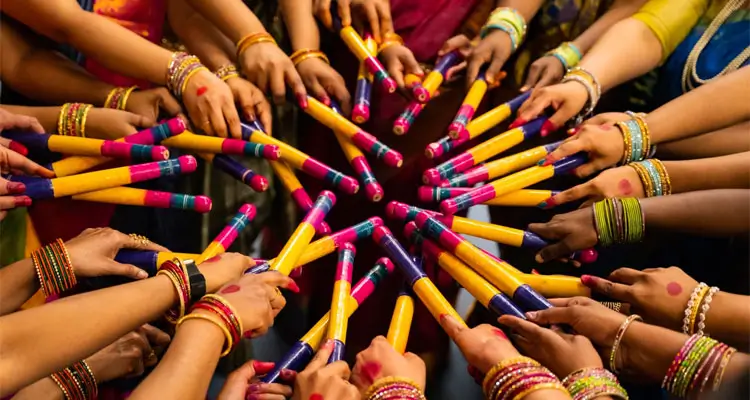
Dandiya Raas uses decorated sticks held by dancers who strike them rhythmically as part of coordinated movements. Visitors sometimes use the terms Garba and Dandiya interchangeably, but they are not identical dance forms.
Traditional clothing adds significantly to the visual character of the evenings. Women often wear colourful, heavily decorated outfits with embroidery and mirror work, while men may wear traditional festive garments suited to energetic dancing.
Visitors do not necessarily need previous Garba experience. Smaller community events can be easier for beginners, while major commercial grounds can be enormous and highly organised. Some large events require paid passes or advance registration, and prices vary substantially according to venue, performer, day and access category. Travellers should purchase entry only through official organisers or recognised ticketing channels.
Ahmedabad provides numerous large celebrations and convenient international-standard accommodation, while Vadodara Navratri is especially famous for mass Garba participation. Anyone travelling primarily for Garba should consider spending several nights rather than attending only one evening.
Navratri has a different character in Rajasthan and much of northern India. Temples receive increased numbers of devotees, families conduct household worship and fasting becomes highly visible in everyday food culture.
Rajasthan can be particularly interesting because visitors can combine religious observances with the state's historic cities. Jaipur has numerous temples and community celebrations, while smaller towns provide a more local atmosphere.
In northern India, the closing period is also strongly connected with Ramlila and Dussehra. Ramlila is a dramatic performance of episodes from the Ramayana, culminating in the defeat of Ravana.
On Dussehra, large effigies of Ravana and sometimes other figures associated with his kingdom are burned at public grounds. The spectacle represents Lord Rama's victory over Ravana and reinforces the wider theme of good triumphing over evil.
For a traveller moving through Delhi, Agra, Jaipur and other northern destinations during this period, Navratri and Dussehra can therefore become part of an existing itinerary without requiring an entirely separate festival journey.
The later part of Navratri carries particular religious importance. Durga Ashtami and Maha Navami are among the most significant periods of worship, although exact household practices differ by region.
One widely observed tradition is Kanya Puja, in which young girls are honoured as representations of the divine feminine. Families invite girls into the home, respectfully wash or honour their feet according to custom, offer food and give gifts or tokens.
A traditional meal associated with the ceremony in many northern households can include puri, a chickpea preparation and a sweet dish. Customs vary considerably, and visitors should understand Kanya Puja as a religious act of honour rather than a staged festival activity.
Temple crowds generally increase during Ashtami and Navami. Travellers wishing to observe worship should expect longer queues and should avoid scheduling several tightly timed sightseeing visits on the same morning.
The festival period culminates with Vijayadashami, also widely known as Dussehra. Its meaning varies regionally but consistently centres on victory over destructive forces.
In northern India, the day is strongly associated with Lord Rama's victory over Ravana. Large public grounds host effigy-burning ceremonies, often accompanied by fairs, food stalls and crowds.
In traditions centred on Goddess Durga, Vijayadashami marks her victory over Mahishasura. The same date can therefore carry distinct narratives while expressing a common principle: righteousness ultimately overcoming destructive power.
For travellers, Dussehra events can attract extremely large crowds. Public transport, roads around celebration grounds and central market districts can become congested. Allowing additional travel time is essential.
A foreign traveller can attend Navratri celebrations without being Hindu, provided the religious nature of the event is respected. Temples, public Garba grounds and community celebrations each have different expectations.
Modest clothing is appropriate for temples. Shoes normally need to be removed before entering sacred spaces. Photography may be permitted in some locations and prohibited in others, so visitors should check before photographing ceremonies.
Garba nights are more festive in dress. Visitors who want to participate can wear Indian festive clothing, but it is not compulsory unless an event specifies a dress code. Comfortable footwear matters because Garba can continue for hours.
Large events may have security checks and restrictions on bags, cameras, food or outside beverages. Carrying minimal belongings makes entry and movement considerably easier.
Women travelling independently commonly attend major organised Garba events, but the normal precautions applicable to crowded nightlife environments remain sensible. Use established transport, keep valuables secure and arrange a reliable return to the hotel before leaving for the event.
Travellers using a private car with driver should agree on a collection point because vehicles may not be able to reach the entrance of large celebration grounds. Mobile traffic and road closures can make last-minute collection arrangements difficult.
Ahmedabad and Vadodara are the strongest choices for travellers primarily interested in Garba, while Delhi, Jaipur and other northern cities provide a combination of Navratri worship and Dussehra traditions. A visitor with sufficient time can experience both regional styles during one journey.
The best festival experience comes from seeing more than a large evening performance. Visiting a temple in the morning, seeing household or community worship, tasting festival food and then attending Garba after sunset provides a much fuller sense of Sharad Navratri traditions and their place in everyday life.
Sharad Navratri begins on Pratipada during the bright fortnight of the Hindu month of Ashwin. The Gregorian date changes according to the lunar calendar. In the 2026-27 cycle, the opening falls on October 11.
Ghatasthapana is the sacred installation performed at the beginning of Navratri. A Kalash and associated ritual arrangement are established while Goddess Shakti is invoked for the period of worship.
The Ghatasthapana Muhurat is city-specific. In New Delhi during the 2026-27 cycle, the calculated principal window is approximately 6:19 AM to 10:12 AM, while the Abhijit Muhurat is approximately 11:44 AM to 12:31 PM.
The nine nights are associated with worship of the nine forms of Goddess Durga, collectively called Navadurga. Each manifestation represents different aspects of divine feminine power, including strength, discipline, protection, motherhood, purity and spiritual fulfilment.
Garba generally involves rhythmic circular dancing traditionally centred around a sacred light or representation of the Goddess. Dandiya Raas involves dancers using decorated sticks in coordinated rhythmic patterns. Both are strongly associated with Navratri celebrations in Gujarat.
Ahmedabad and Vadodara are among the strongest destinations for large-scale Navratri Garba in Gujarat. Both cities host community and organised celebrations ranging from traditional gatherings to enormous ticketed events.
Yes. International visitors can participate in many public and organised Garba events. Beginners should observe the movement pattern before joining a circle and follow the direction and rhythm of other dancers rather than interrupting an established formation.
Food varies according to personal and regional practice. Common Navratri fasting food can include fruit, dairy products, potatoes and preparations made with ingredients such as buckwheat or water chestnut flour. Many devotees avoid meat, eggs, alcohol and ordinary grains.
These are important closing stages of Navratri worship. Special temple ceremonies take place, and many households perform Kanya Puja, honouring young girls as manifestations of divine feminine energy. Practices vary according to region and family tradition.
Yes. Navratri can be particularly rewarding for international travellers because it combines active religious traditions with music, food, dance and regional culture. Respectful temple behaviour, reliable transport, advance arrangements for major Garba events and sufficient time in one destination make the experience considerably easier.