Your Travel Partner
SINCE 1989
Your Travel Partner
SINCE 1989
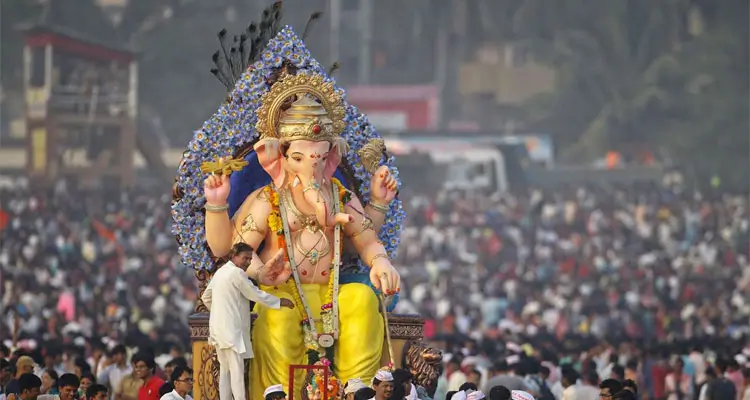
Ganesh Chaturthi is one of India's most deeply rooted religious celebrations, bringing together family worship, centuries-old traditions, public festivities, music, food and enormous farewell processions. Dedicated to Lord Ganesha, the elephant-headed deity revered as the remover of obstacles and a symbol of wisdom, prosperity and auspicious beginnings, the festival is observed in homes and temples across the country. Its most spectacular public celebrations are associated with Maharashtra, particularly Mumbai and Pune, where neighbourhoods install elaborate idols and thousands of devotees visit community shrines throughout the festival.
For someone seeing Ganesh Chaturthi celebrations for the first time, the scale can initially appear to be the defining feature: giant idols, decorated streets, drummers, flowers, lights and immense crowds. The real story, however, begins inside homes and temporary shrines. An idol is respectfully brought in, ceremonially installed, treated as the honoured presence of Lord Ganesha, worshipped with flowers, lamps and food, and finally given an emotional farewell before immersion. Each major ritual marks a different stage in this journey.
The festival follows the Hindu lunar calendar and falls on Shukla Paksha Chaturthi in the month of Bhadrapada, usually during August or September. While the largest public festivities extend over several days and culminate around Anant Chaturdashi, not every family keeps a Ganesha idol for the same duration. Some complete the immersion after one and a half days, while others keep the deity for three, five, seven or more days. Large community installations frequently remain until the major final immersion.
This difference is important for travellers. Ganesh Visarjan is not limited to one single evening. A visitor staying in Mumbai for several days can see smaller family immersions as well as enormous public processions. The atmosphere also changes as the festival progresses, from the anticipation surrounding the deity's arrival to the emotion of the final farewell.
Understand and experience the complete rhythm of Ganesh Chaturthi, from the auspicious beginning of the celebrations to the emotional farewell of visarjan.
The Ganesh Chaturthi date changes every year because it is calculated according to the Hindu lunar calendar rather than being fixed to the Gregorian calendar. Ganesh Chaturthi falls on the fourth lunar day of the waxing phase of Bhadrapada. For travellers arranging flights and hotels specifically around the festival, checking the correct calendar is essential.
For the 2026-27 festival cycle, Ganesh Chaturthi in 2026 falls on Monday, September 14. The Chaturthi Tithi begins at approximately 7:06 AM on September 14 and concludes at approximately 7:44 AM on September 15. Panchang calculations can vary slightly according to geographical location, so a household following a local priest or regional calendar may work with city-specific timings.
The main Ganesh Chaturthi Puja timing falls during Madhyahna, the midday period traditionally associated with Lord Ganesha's worship on this festival. This is an important distinction because visitors sometimes assume that the main ceremony necessarily occurs early in the morning.
In Mumbai, the calculated Madhyahna Ganesh Puja window is approximately 11:20 AM to 1:48 PM. Pune is approximately 11:16 AM to 1:44 PM, Jaipur approximately 11:08 AM to 1:36 PM, New Delhi approximately 11:02 AM to 1:31 PM, Ahmedabad approximately 11:21 AM to 1:49 PM, Bengaluru approximately 11:02 AM to 1:28 PM, Chennai approximately 10:51 AM to 1:18 PM, and Kolkata approximately 10:18 AM to 12:46 PM.
These variations exist because auspicious timings are calculated according to local astronomical conditions. Anyone invited to attend a private family puja should therefore follow the time provided by the host rather than relying on the timing published for another city.
The major final Ganesh Visarjan date in 2026 falls on Friday, September 25, corresponding with Anant Chaturdashi. Smaller immersions occur before this date according to the period for which a family or community has installed its idol.
Understanding the traditional story associated with Lord Ganesha makes the rituals considerably more meaningful. One of the best-known narratives concerns Goddess Parvati creating Ganesha and appointing him to guard her privacy. According to the traditional account, Parvati formed a boy and instructed him not to allow anyone to enter while she was bathing.
Lord Shiva returned and attempted to enter. Ganesha, following the instructions given by Parvati and not recognising Shiva, refused him entry. A confrontation followed. Shiva ultimately severed the boy's head.
When Parvati discovered what had happened, she was overcome with grief and anger and demanded that the child be restored. Shiva instructed his attendants to bring the head of the first suitable living being they encountered, traditionally described as an elephant. The elephant's head was placed upon the child's body, restoring him to life.
Ganesha was subsequently given an honoured position among the deities and came to be revered as Vighnaharta, the remover of obstacles, as well as a deity connected with wisdom, learning, prosperity and new beginnings. This is why Lord Ganesha is commonly worshipped before starting an important ceremony, business venture, journey or major personal undertaking.
Another traditional story explains the custom concerning the moon on Ganesh Chaturthi. According to the narrative, the moon laughed at Ganesha's appearance after an incident involving his vehicle, the mouse. Ganesha became angry and pronounced a curse associated with seeing the moon on Chaturthi. Different versions of the story exist, but the tradition of avoiding sight of the moon during a specified period remains part of festival observance for many devotees.
Ganesh Chaturthi also carries an important public and historical dimension in Maharashtra. Household worship existed long before the modern public festival, but the large community celebration became particularly significant during the late nineteenth century. Bal Gangadhar Tilak played an important role in encouraging public Ganesh festivities as a means of bringing communities together during British colonial rule. Public gatherings around worship, music and cultural activities created a socially important shared space.
The modern festival therefore contains several layers at once: private devotion, family tradition, community participation and a significant history of public celebration.
The festival often begins emotionally before the formal Ganesh Chaturthi Puja itself. Families decide where the idol will be installed and prepare a clean, decorated space within the home. Public community organisations undertake preparations on a much larger scale, constructing temporary structures and elaborate decorative settings.
The idol is traditionally treated with reverence from the moment it is brought home. Families may accompany its arrival with devotional chants and music. In Maharashtra, the arrival is commonly greeted with the famous call “Ganpati Bappa Morya,” expressing devotion and affection toward Lord Ganesha.
Idols vary greatly in size. A household idol may be small enough to carry comfortably, while public idols can reach monumental proportions and require specialised vehicles and teams to transport them safely.
Environmental awareness has increasingly influenced idol selection. Traditional natural clay idols dissolve more readily in water, whereas certain synthetic materials and chemical paints can create environmental problems. Consequently, eco-friendly Ganesh idols made with natural clay and safer decorative materials have become an important part of contemporary celebrations.
The installation area may be decorated with flowers, leaves, lamps, fabrics and other ornamental elements. Families often prepare sweets and other offerings before the formal ceremony. The aim is not simply decorative beauty; the space is being prepared to receive the deity as an honoured guest.
One of the most important Ganesh Chaturthi rituals is Prana Pratishtha. In religious terms, the idol is not treated merely as an artistic object. Through prescribed prayers and ritual actions, the divine presence is ceremonially invoked into the image.
The idol is positioned at the prepared altar or public shrine. The ceremony may be performed by a priest, particularly in large community installations, while families may conduct household worship according to traditions passed through generations.
The ritual involves sacred recitations, gestures and offerings. The precise procedure can vary according to regional tradition and the form of worship followed by the family. Once Prana Pratishtha has been completed, the idol becomes the focus of daily devotion for the duration of its stay.
This idea is central to understanding the entire festival. Lord Ganesha is symbolically welcomed into the household or community, cared for through daily worship, offered food and prayers, and eventually bid farewell. The emotional character of visarjan makes much more sense when viewed as the departure of an honoured divine guest rather than simply the disposal of an idol.
Experience the beauty of Ganesh Chaturthi through authentic rituals, temple visits and local celebrations. We curate seamless Rajasthan journeys for travellers who want to experience India beyond its monuments.
The principal worship can include Shodashopachara Puja, a traditional form of worship involving sixteen forms of honour or service offered to the deity. The exact ceremony may differ among households, temples and priests, but its broader meaning is that the deity is received and honoured with the respect given to an exceptionally important guest.
The ritual begins with invocation and preparation. Offerings symbolically associated with welcoming, seating, cleansing and honouring the deity are made through the course of worship. Water, flowers, sandalwood paste, incense, lamps and food may all form part of the ceremony.
Flowers are important offerings, and devotees may also present sacred leaves associated with Ganesha worship. Durva grass is particularly connected with Lord Ganesha and is frequently included among the offerings. Devotees may offer it in prescribed groupings according to family or priestly tradition.
Incense is lit, followed by a lamp, representing fragrance, purity and divine illumination. Devotional recitations and prayers accompany the offerings. Aarti is performed by moving a lit lamp before the deity, usually accompanied by devotional songs.
Food is then presented as naivedya before being distributed as blessed food. Modak is the sweet most famously associated with Lord Ganesha. The classic Maharashtrian version often has a soft outer layer and a filling containing coconut and jaggery. Steamed modak is particularly traditional, although fried and modern flavoured varieties are widely available.
Other sweets, fruits and foods may also be offered. Once the offering has been ceremonially presented, it becomes prasad and is shared among family members and visitors.
For a foreign guest invited to attend the ceremony, receiving prasad is an easy and respectful way to participate. The visitor does not need to imitate every religious gesture. Quiet observation, following the host's instructions and accepting the offering respectfully are entirely appropriate.
Worship continues every day while the idol remains installed. Families generally conduct regular prayers and aarti, often in the morning and evening. Relatives, neighbours and friends visit one another's homes to receive darshan, offer prayers and share sweets.
The atmosphere at a public Ganesh pandal is considerably larger. Community installations may receive visitors throughout the day and late into the evening. Volunteers manage queues, distribute offerings, coordinate security and organise cultural programs.
Aarti can be one of the most memorable moments for a visitor. Bells, lamps, devotional singing and the concentration of worshippers create an atmosphere very different from simply walking through a decorated venue.
Famous public idols can attract extremely large crowds. Visitors interested in seeing a major installation should allow considerably more time than they would for a conventional tourist attraction. Queues may become very long during evenings, weekends and the later days of the festival.
Public mandals generally do not charge a normal sightseeing admission ticket. Donations may be accepted, and individual venues can have their own systems for managing large crowds. Visitors should rely on official arrangements rather than paying unknown individuals who promise unofficial access.
The question why Ganesh idols are immersed is central to understanding the festival. Visarjan represents the ceremonial farewell of the deity after the period of worship.
The idol, traditionally created from earth or clay, is returned to water. On a symbolic level, this reflects the cycle through which physical forms arise and eventually return to the elements. The divine presence is not believed to disappear with the physical idol. Rather, the temporary form through which devotees worshipped is released.
This explains why the farewell can be joyful and emotional simultaneously. Families may have prayed before the idol every morning and evening for several days. Children may have participated in decorating the altar and preparing offerings. Relatives may have gathered specifically for the festival. When the time for immersion arrives, the household is saying goodbye to a presence that has become part of daily family life.
The familiar chant “Ganpati Bappa Morya, Pudhchya Varshi Lavkar Ya” expresses this emotional combination of farewell and anticipation, asking the beloved deity to return again.
Before the idol leaves the home or public shrine, a final ceremony commonly known as Uttar Puja is performed. The family offers prayers and expresses gratitude before preparing for the deity's departure.
Flowers and offerings may be presented one final time. Aarti is performed, and family members seek blessings. The idol is then carefully moved from its installed position.
For a small household Ganesha, relatives may carry the idol themselves. Larger idols require coordinated teams and specialised platforms or vehicles. Devotees accompany the idol toward an authorised immersion site while singing, chanting and sometimes dancing.
Small family processions can be surprisingly intimate. Large Ganesh Visarjan processions, particularly in Mumbai, are completely different in scale. Streets fill with devotees, drums and decorated vehicles carrying enormous idols toward the waterfront.
At the designated site, final prayers are offered before immersion. Increasing environmental awareness has led many cities and communities to encourage artificial immersion tanks and other controlled arrangements, particularly for smaller idols.
Different families choose different immersion days. A household may perform visarjan after one and a half days or after several days of worship. The large final immersion associated with Anant Chaturdashi attracts the greatest public attention.
Ganesh Chaturthi in Mumbai is unlike an ordinary festival event held at one venue. Celebrations are distributed throughout the city. Residential buildings install idols, neighbourhood groups construct pandals, temples conduct special worship and major public organisations create enormous installations.
Lalbaugcha Raja is among the most famous Ganesh idols in Mumbai and attracts immense numbers of devotees. Its popularity also means visitors should expect significant queues rather than treating it as a quick photography stop.
Other areas provide equally valuable cultural experiences without necessarily requiring the same waiting time. Traditional neighbourhoods allow visitors to see numerous installations within a relatively compact area.
The immersion processions are another major element of Mumbai's festival identity. Girgaon Chowpatty is closely associated with major immersions and can become extremely crowded. Road closures and police-controlled routes are normal on important visarjan days.
International visitors should avoid scheduling an airport departure, long-distance train or other inflexible connection immediately after attending a major procession. Mumbai traffic can already be unpredictable, and festival road restrictions add another variable.
Pune has a particularly important place in the history of Maharashtra's public Ganesh celebrations. The city's established mandals, traditional processions and cultural associations make Ganesh Chaturthi in Pune a strong alternative or addition to Mumbai.
The Pune experience can be especially rewarding for visitors interested in the historical development of public Ganesh celebrations. Traditional music, community organisations and established idols give the festival a character distinct from Mumbai's enormous metropolitan scale.
Goa and parts of Karnataka also observe the festival with strong regional traditions. Celebrations take place in many other Indian cities as well, although their scale and character vary.
A visitor travelling through Rajasthan or North India may still encounter Ganesh worship and local celebrations, but someone travelling primarily for the most prominent public festival experience should consider Maharashtra the central destination.
Food plays an important part in household hospitality during the festival. Modak during Ganesh Chaturthi is the most famous association and should be tried by visitors interested in regional cuisine.
The traditional steamed version commonly uses a rice-flour outer covering with a filling based on coconut and jaggery. The finished sweet has a distinctive pleated shape. Fried versions are also popular, and contemporary sweet shops sell variations using chocolate, nuts and other fillings.
For visitors, established sweet shops and reputable restaurants are sensible places to sample festival foods. Anyone invited to a family home may be offered homemade prasad, providing a more personal connection with the celebration.
International visitors are generally able to attend many public Ganesh Chaturthi celebrations, but respectful behaviour is essential because these are active religious events rather than performances created for tourism.
Modest clothing is appropriate, particularly when entering temples or sacred sections of pandals. Shoes may need to be removed, so footwear that is easy to take off is useful. Late-monsoon humidity and occasional rain can make lightweight clothing and simple rain protection practical.
Photography is often possible in public areas, but permission should be requested before taking close photographs of priests or individual worshippers. Visitors should never block a prayer line, stand directly between devotees and the idol for an extended photograph or enter a restricted ceremonial area.
Large visarjan crowds require additional care. Carry minimal valuables, keep phones and wallets secure and avoid bringing bulky bags. Families travelling with very young children or elderly relatives may find smaller neighbourhood processions more comfortable than the largest waterfront gatherings.
A private car with driver in India can be valuable for travelling between the hotel and festival neighbourhoods, but road closures mean vehicles cannot always reach the immediate procession area. An experienced local driver can arrange sensible drop-off and collection locations.
Travellers combining Mumbai with a longer private India tour can connect the festival with Delhi, Agra, Jaipur, Udaipur, Jodhpur or other destinations. Allowing at least two or three nights in Mumbai gives considerably more flexibility than trying to fit a festival visit into a short transit stop.
The most rewarding experience comes from seeing several stages rather than only the final immersion. Watching an idol arrive, attending an evening aarti, tasting modak, visiting neighbourhood pandals and later seeing a farewell procession provides a much richer view of what Ganesh Chaturthi means to the communities celebrating it.
Ganesh Chaturthi falls on Shukla Paksha Chaturthi during the Hindu month of Bhadrapada, usually in August or September. Because the date follows the lunar calendar, it changes on the Gregorian calendar from year to year.
Major Ganesh Chaturthi rituals include bringing the idol home, Prana Pratishtha, formal puja, offerings of flowers and food, aarti, daily worship, distribution of prasad, Uttar Puja and finally Ganesh Visarjan.
Prana Pratishtha is the ceremonial invocation of the divine presence into the installed idol. It marks the beginning of the period during which Lord Ganesha is formally worshipped in the home, temple or public pandal.
Modak is traditionally regarded as a favourite food of Lord Ganesha and has become the festival's signature sweet. It is offered during worship and later distributed as prasad.
Ganesh Visarjan marks the ceremonial farewell to Lord Ganesha. The physical idol is returned to water, symbolising the temporary nature of physical form and its return to the natural elements.
There is no single duration followed by every household. Some perform immersion after one and a half days, while others keep the idol for three, five, seven or more days. Major community idols often remain until the principal final immersion.
Mumbai offers the largest and most internationally recognised public celebration. Pune is also highly significant and has deep historical associations with community Ganesh festivities. Maharashtra is therefore particularly suitable for travellers whose trip is centred on the festival.
Yes. International visitors can enter many public Ganesh pandals. Appropriate dress, respect for queues, footwear rules and photography restrictions are expected. Visitors do not need to be Hindu to observe the public celebrations respectfully.
Most community pandals do not operate with a standard tourist admission ticket. Donations may be accepted, while security procedures and queue arrangements vary according to the popularity of the installation.
Yes, but visitors should be prepared for noise, dense crowds, road closures and long periods on foot. Smaller local immersions are suitable for travellers who want a calmer introduction, while Mumbai's major Ganesh Visarjan procession offers an extraordinary but much more intense experience.