Your Travel Partner
SINCE 1989
Your Travel Partner
SINCE 1989
An India multi-city private tour with driver is one of the most comfortable ways for international travelers to move through destinations that are naturally connected by road. Instead of changing taxis in every city, carrying luggage through repeated transport connections or following a fixed coach itinerary, travelers can use a private chauffeur-driven vehicle for the road portion of their journey and travel at a pace suited to them.
This style of travel works particularly well across North India and Rajasthan. Delhi, Agra, Jaipur, Ranthambore, Pushkar, Jodhpur and Udaipur can be combined in several sensible sequences. The chauffeur can remain with the travelers across multiple destinations, while professional local guides join for sightseeing in cities where historical interpretation is valuable. Hotels can range from comfortable premium properties to five-star resorts, former royal residences and palace hotels.
The important point is that a private car does not make India's geographical distances disappear. An itinerary can still become exhausting when too many cities are fitted into too few days. The value of private travel comes from combining sensible routing with a comfortable vehicle, realistic departure times, carefully selected hotels and enough nights in important destinations.
For example, Delhi, Agra and Jaipur can form a relatively compact first-time route. Extending deeper into Rajasthan requires more time. Adding Jodhpur and Udaipur can create an excellent journey, but adding Jaisalmer as well introduces another significant western detour. Varanasi does not naturally belong to the same continuous road circuit and is often better connected by air when time is limited.
Travel Plan can coordinate a multi-city India tour with private driver, accommodation, local guides and airport transfers according to the destinations selected. Travelers considering this style of journey should first understand which routes work well by road, how chauffeur services are priced, which vehicle is suitable and when a flight is more sensible than another long drive.
The most important decision in a private driver tour of India is the sequence of destinations. A route should be based on geography and actual road time rather than a list of famous places copied from a map.
Delhi, Agra and Jaipur remain one of the easiest combinations for first-time visitors. Delhi provides the major international gateway and enough heritage sightseeing to justify multiple nights. Agra lies southeast of Delhi and is commonly reached by road, while Jaipur can follow as the journey moves toward Rajasthan.
A comfortable version might give Delhi two or three nights, Agra one or two nights and Jaipur two or three nights. Travelers with more time can continue from Jaipur toward Jodhpur and Udaipur rather than returning immediately to Delhi.
Ranthambore can be introduced when wildlife is a priority. The reserve can fit into a broader North India route, but travelers should allow enough time for more than one safari opportunity if wildlife is genuinely important. A single rushed safari creates unnecessary pressure and still cannot guarantee a tiger sighting.
Jodhpur and Udaipur work well together for travelers continuing deeper into Rajasthan. Jodhpur's Mehrangarh Fort, old-city areas and surrounding desert landscape differ considerably from Udaipur's lakes and palace architecture. The road journey between the two can also be combined with a visit to the Ranakpur Jain temple complex when appropriate to the itinerary and opening arrangements.
Jaisalmer needs more careful consideration because of its western location. It can be a worthwhile destination for travelers interested in desert landscapes, sandstone architecture and the historic fort, but including it generally requires additional road time. A traveler with only eight or nine nights should not force Jaisalmer into an already crowded Delhi–Agra–Jaipur–Jodhpur–Udaipur route.
A longer journey of approximately two weeks provides much more freedom. The travelers can remain two or three nights in key cities instead of spending almost every afternoon on the road.
Varanasi requires another strategy. It is one of India's most significant cultural destinations, but connecting it entirely by private road from Rajasthan is rarely the most efficient use of a luxury traveler's time. A domestic flight can bridge the long distance, after which another private vehicle can handle local transfers and sightseeing.
The same principle applies to Mumbai and South India. There is no benefit in keeping one chauffeur merely for the sake of saying the entire country was crossed by car when a flight saves an enormous amount of time.
A well-structured India road trip with private chauffeur therefore uses road travel where it is comfortable and logical, then changes transportation mode where geography demands it.
The number of hotel changes deserves equal attention. Every additional city means packing, checking out, loading luggage, driving, checking in and unpacking again. Two travelers may tolerate this better than a family, but even experienced travelers can become tired after several consecutive one-night stops.
A stronger multi-city journey often contains deliberate pauses. Three nights in Jaipur or Udaipur can provide time for both sightseeing and leisure. A two-night stay in Jodhpur allows Mehrangarh Fort and the old city to be experienced without rushing immediately onward.
Private transportation is most valuable when it supports this comfortable rhythm rather than encouraging travelers to add endless destinations.
Travel across India's most captivating destinations with a dedicated chauffeur, comfortable private transport and a tailor-made itinerary. From city discoveries to scenic intercity journeys, enjoy a seamless travel experience designed around your pace and preferences.
The chauffeur is the operational constant during a road-based journey. On a route such as Delhi–Agra–Jaipur–Jodhpur–Udaipur, travelers may use the same vehicle and driver for several consecutive days, depending on the confirmed service.
The chauffeur handles hotel-to-hotel transportation, local driving where included, luggage movement associated with the vehicle and practical road logistics. The driver should know the principal route, understand the location of the confirmed hotels and select sensible stops during longer drives.
For international travelers, consistency can be particularly valuable. By the second or third day, the chauffeur already knows whether the guests prefer early departures, how much luggage they have and whether they generally want a lunch stop during long road sectors.
A professional private chauffeur in India should be punctual, appropriately presented, courteous and focused on safe driving. The vehicle should be clean and mechanically suitable for the journey. Air conditioning is essential for much of the year, and sufficient luggage space should be confirmed before the tour begins.
The chauffeur's role should not be confused with that of a professional guide.
Drivers may know the routes extremely well and often have useful practical knowledge, but formal sightseeing interpretation should be provided by professional guides where required. Delhi, Agra and Jaipur in particular contain enough historical complexity to justify specialist guiding for first-time visitors.
The guide can meet the guests at their hotel, travel with them during the sightseeing session and finish after the agreed service. The chauffeur remains responsible for transportation before, during and after that guiding period.
This system allows travelers to receive detailed local expertise without paying for a full-time escort to travel between every city.
A chauffeur can also make long road journeys more comfortable by allowing sensible breaks. Unlike a scheduled coach, a private vehicle does not require twenty or thirty passengers to agree on when to stop. Guests can pause for a washroom, coffee or meal at an appropriate location.
However, flexibility should not become unsafe working hours.
A driver who has completed a long road sector needs adequate rest. Travelers should not expect an unlimited chauffeur service that continues late into the night after an entire day of driving and then restarts before dawn.
This is particularly important on multi-city journeys because fatigue accumulates over several days.
A professionally arranged chauffeur-driven India tour should therefore use realistic driving schedules and avoid treating the vehicle as available around the clock.
The best vehicle for a multi-city journey is not necessarily the smallest vehicle that can physically hold the passengers.
Two adults with light luggage may be comfortable in a sedan for shorter road sectors. Two international travelers carrying large suitcases and cabin baggage may find a larger vehicle significantly more comfortable during a ten-day journey.
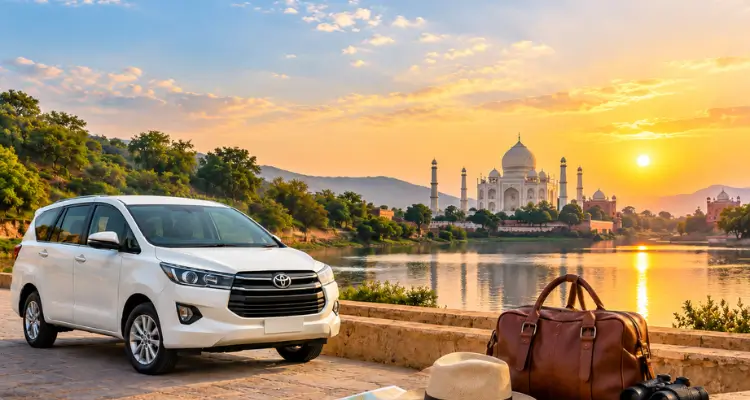
For this reason, an Innova-class vehicle is frequently suitable for a private India road tour for two people. The higher seating position, cabin space and luggage practicality can make long road journeys easier.
Families need even more careful vehicle selection.
A family of four may technically fit into a vehicle advertised for that passenger count, but luggage can create the real problem. Four large suitcases plus cabin bags require significant storage space.
Larger families and small private groups may require a Tempo Traveller or another suitable passenger vehicle. The quotation should identify the category rather than using the vague phrase “suitable vehicle.”
Travelers seeking a higher-end service can request premium sedans or SUVs where available. Mercedes and BMW vehicles may be available for selected services, particularly in major cities, although availability and suitability vary by destination.
The price difference can become substantial on a multi-day journey because the premium vehicle is required not only for one airport transfer but for repeated days and intercity kilometres.
Travelers should therefore decide what they value most. If prestige is important, a luxury-brand vehicle may be worth the additional cost. If space and long-distance comfort are more important, a premium MPV or SUV may provide better practical value.
The vehicle should also be inspected through the quotation details before booking. Travelers can ask for the proposed vehicle category, passenger capacity and luggage suitability.
A private car with driver in India normally involves more than a basic rental fee. Depending on the contract, the price can account for fuel, chauffeur allowance, tolls, parking and relevant interstate or road charges. Travelers should verify whether these costs are included.
If they are not, the likely additional expenses should be explained before the journey begins.
The cost of an India multi-city private tour with driver has several layers. Transportation is one component, but hotels can easily become the largest part of the total once travelers move into the five-star and palace-hotel categories.
For two travelers, a private multi-city journey using comfortable upscale hotels, a chauffeur-driven vehicle and selected professional guides can reasonably be budgeted at approximately US$300 to US$500 per person per day on a higher-side basis.
A strong five-star itinerary can move toward approximately US$500 to US$850 per person per day. Premium palace properties, luxury resorts and expensive room categories can raise the cost toward approximately US$850 to US$1,500+ per person per day.
A 14-night journey for two travelers can therefore range from roughly US$9,000 to US$14,000 for an upscale private trip to approximately US$14,000 to US$24,000 for a stronger five-star experience. A journey using leading palace hotels, luxury suites and premium services can move substantially beyond this level.
These figures are broad budgeting references rather than fixed package rates.
Travelers who want only a chauffeur-driven vehicle without hotels will naturally pay far less. Vehicle-only pricing depends on the vehicle category, total route, number of days and kilometres involved. A short Golden Triangle circuit has a different operating cost from a two-week journey extending across Rajasthan.
Guide services add another layer. English-speaking professional guides can be arranged in major destinations, while foreign-language specialists may cost more depending on availability.
Monument admission can either be incorporated into the package or left for the guests to pay directly. The same is true of domestic flights, train tickets and many special activities.
Wildlife increases the cost in another way. Ranthambore requires safari arrangements, and premium wilderness accommodation can be expensive. Travelers should confirm the number of safari drives included instead of assuming that a stay near the national park automatically includes wildlife excursions.
Hotel seasonality can create the largest price swings. The same property and room category may be much more expensive during high-demand travel dates than during quieter periods.
Room type matters as well. A standard room and signature suite at the same luxury hotel cannot reasonably be compared as though they are the same product.
The most useful quotation therefore separates the major service elements clearly enough for the traveler to understand why the trip costs what it does.
Make every mile part of your holiday with private chauffeur-driven travel, thoughtfully planned routes and handpicked experiences. Whether you prefer heritage cities or an extended journey across India, your itinerary can be tailored to your travel style.
Hotel selection should follow the rhythm of the route. Travelers do not need the most expensive hotel in every city, and using a different style of accommodation in different destinations can make the journey more interesting.
Delhi can suit a polished five-star city hotel with strong dining and a convenient location. Agra may justify a larger hotel budget for travelers who place a premium on proximity or views toward the Taj Mahal.
Jaipur is a natural destination for palace accommodation. Travelers can choose between modern five-star hotels, luxury resorts and historic properties depending on budget and personal taste.
Jodhpur also offers heritage and luxury accommodation, while Udaipur can justify additional spending on a lakeside hotel or resort.
The length of stay should reflect the hotel investment. Paying for an exceptional property but arriving after dark and leaving at dawn provides little opportunity to enjoy what made the room expensive.
Professional guides should be selected with similar logic.
A private guide in Delhi can provide context across the city's different historical periods. An Agra specialist can focus on Mughal heritage and the Taj Mahal. A Jaipur guide can interpret Amber Fort, City Palace and Jantar Mantar. Jodhpur and Udaipur can have their own local experts where detailed sightseeing is desired.
The travelers do not need guides on pure road-transfer days unless an en-route attraction warrants one.
This arrangement can also preserve privacy. The chauffeur remains the consistent transportation professional while guides join only for the parts of the journey where they add value.
Travel Plan can coordinate the road vehicle, hotels and local guides within one itinerary, reducing the need for international guests to negotiate each service separately after arrival.
Before confirming an India private tour with driver, travelers should read the itinerary carefully enough to understand the actual amount of time spent on the road.
Driving times should be realistic. Estimates can change because of traffic, road conditions, weather, local events and stops, so they should never be treated like guaranteed flight schedules.
The vehicle category should be named. If travelers require a particular premium category, that request should be written into the quotation.
Hotel names, number of nights and room categories should be confirmed where relevant. Breakfast or other meal arrangements should also be stated.
Professional guide services should identify the cities in which guides are provided.
The quotation should explain whether monument admissions are included, along with any domestic flights, railway tickets or safari services.
Transportation inclusions should address fuel, parking, tolls and driver-related expenses so guests know whether additional road payments will arise.
Cancellation and payment terms deserve close attention, particularly when expensive hotels or wildlife services are involved.
Travelers should also confirm the process for contacting the operator during the trip. A delayed flight, hotel issue or unavoidable road disruption is easier to handle when there is a clear local point of contact.
Finally, avoid evaluating a quotation solely by its headline price. Two itineraries with identical city names may contain completely different hotels, vehicles and services.
The better comparison is between like-for-like inclusions.
For two travelers including upscale accommodation, a private chauffeur and selected guides, approximately US$300–US$500 per person per day is a useful higher-side starting range. Five-star travel can reach US$500–US$850 per person per day, with luxury palace travel costing considerably more.
On continuous road routes such as Delhi, Agra and Rajasthan, the same chauffeur can often remain with travelers for multiple destinations. Flights to geographically distant cities may require a different driver at the next location.
Delhi, Agra, Jaipur, Ranthambore, Jodhpur and Udaipur can be combined in several logical road sequences. Jaisalmer can also be added when sufficient time is available.
For travelers with limited holiday time, a domestic flight is often more practical for geographically distant destinations such as Varanasi. A new private vehicle can then handle local services after arrival.
An Innova-class vehicle can be particularly practical for two international travelers carrying large luggage and completing long road sectors. A sedan may be sufficient for shorter journeys or lighter baggage.
They often can be included in a complete chauffeur quotation, but this should never be assumed. The written inclusion list should state how fuel, tolls, parking and driver expenses are handled.
A driver handles transportation, while a professional guide provides historical and cultural interpretation. Local guides are particularly useful in Delhi, Agra, Jaipur and other heritage destinations.
Yes. Travelers can mix modern five-star properties, heritage hotels and palace stays according to destination and budget. Using different hotel styles can also help control the total cost.
The answer depends on distance, but a two-week trip should avoid excessive one-night stops. Spending two or three nights in major destinations generally creates a more comfortable journey than trying to include every possible city.
Yes. Travel Plan can coordinate an India multi-city private tour with driver, selected hotels, professional local guides, airport transfers and additional transportation where required. The route, vehicle category and major inclusions can be agreed before confirmation so travelers know exactly how the journey will operate.