Your Travel Partner
SINCE 1989
Your Travel Partner
SINCE 1989
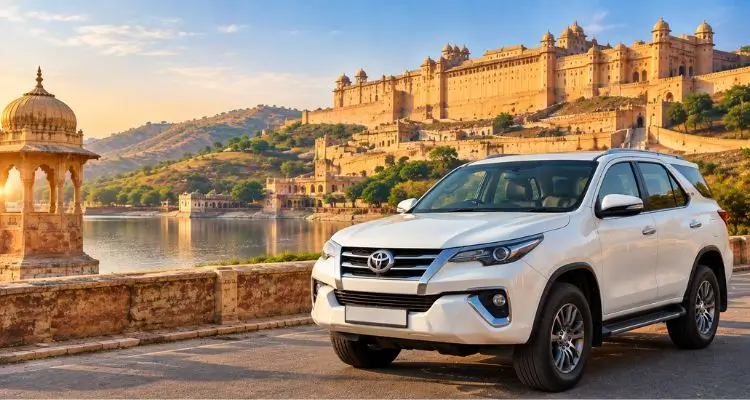
A Rajasthan tour by private car and driver is one of the easiest ways for foreign tourists to travel between Jaipur, Jodhpur, Udaipur, Jaisalmer, Pushkar, Bikaner and other destinations without repeatedly arranging trains, buses, station transfers and separate taxis. Rajasthan is a large state, and many of its most popular tourist cities are separated by five, six or even ten hours of road travel. Having one vehicle and one driver for the main part of the journey removes much of the daily transportation work while allowing travellers to decide how quickly or slowly they want to move.
The system is straightforward. A private vehicle collects the guests from their hotel, airport or railway station at the beginning of the trip. The same car and usually the same driver then remain with them for the agreed route. The driver handles transportation between cities, hotel transfers, scheduled sightseeing transportation, practical road stops and luggage movement. When the travellers reach a hotel, the vehicle normally remains available according to the agreed itinerary and operating schedule. On the final day, the driver completes the specified airport, hotel or railway-station drop.
The driver is not automatically a professional sightseeing guide. This distinction matters. A good private driver in Rajasthan for foreign tourists knows roads, hotel locations, practical stops and the logistics of moving between attractions. A licensed or specialist local guide has a different role: explaining the history, architecture, religion and cultural significance of places such as Amber Fort, Mehrangarh Fort, City Palace or Jaisalmer Fort. Travellers can therefore use one driver throughout Rajasthan and add local guides only in the cities where they want deeper historical interpretation.
Cost depends on the vehicle, route and number of days. For premium private transportation aimed at international visitors, a comfortable sedan can reasonably be budgeted around $85–$110 per active travel day, an Innova Crysta around $110–$140 per day, and a Tempo Traveller approximately $160–$220 per day. These are useful higher-side budgeting figures rather than the cheapest local taxi rates. Long routes, unusually high mileage, airport pickups, extra nights and vehicle repositioning can increase the total.
A seven-day Rajasthan private car tour can therefore cost roughly $750–$1,000 in a sedan or approximately $850–$1,100 in an Innova Crysta. A ten-day journey can cost around $1,000–$1,350 in a sedan or approximately $1,150–$1,500 in an Innova Crysta. For fourteen days, travellers can budget around $1,350–$1,800 for a sedan and approximately $1,550–$2,100 for an Innova Crysta, depending on the complete route.
These figures are for transportation. Hotels, monument tickets, local guides, meals, safari permits and personal expenses are normally separate unless a complete tour package has been purchased.
The biggest advantage of a private Rajasthan tour with driver becomes clear on the first travel morning. Instead of packing bags, taking a taxi to a station, finding the correct platform, boarding with luggage and arranging another taxi after arrival, travellers leave their hotel and place their bags in one vehicle. At the next destination, the driver takes them directly to the new hotel. The same process repeats throughout the trip.
For example, consider a traveller beginning in Jaipur and continuing to Pushkar, Jodhpur, Udaipur and Jaisalmer. The driver may collect the guests from Jaipur Airport or their Jaipur hotel and remain assigned to them until the final drop. During Jaipur sightseeing, the vehicle transports them between the hotel, Amber Fort, the historic centre and other scheduled places. On the departure morning, the luggage goes into the same car and the travellers continue to Pushkar.
After Pushkar, the driver takes them to Jodhpur. The travellers do not need to compare taxis again or negotiate with a new driver. The following sector continues to Udaipur, perhaps with a scheduled stop at Ranakpur when the route and temple visit are suitable. The journey then continues according to the agreed itinerary.
This arrangement is especially valuable for foreign tourists carrying large suitcases. Moving a 20–25 kilogram suitcase through railway stations every second day can become tiring. With a chauffeur-driven Rajasthan tour, luggage generally moves from the hotel room to the vehicle and from the vehicle to the next hotel.
Private transportation also allows practical stops. If passengers need a restroom, coffee or lunch, the driver can stop at a suitable location. If somebody feels unwell, the schedule can be adjusted. If travellers want to spend another thirty minutes photographing a landscape, there is no bus departure forcing them to leave.
There are still limits. A private car should not be treated as an unlimited twenty-four-hour taxi. Drivers need adequate rest, particularly before long intercity sectors. If a driver completes an eight-hour road journey and reaches the hotel at 7:00 PM, passengers should not automatically expect another five hours of late-night driving unless this has been arranged appropriately.
A well-built private Rajasthan journey therefore combines flexibility with realistic daily operating times.
The Rajasthan private driver cost should be viewed as a combination of vehicle, fuel, professional driving time and road expenses rather than simply the driver's salary. When a company quotes a car-and-driver service, the price usually covers the commercial vehicle itself, fuel and driver service, while tolls, parking, taxes or driver overnight expenses may either be included or listed separately.
For international travellers wanting a dependable service, these higher-side ranges provide a practical starting point:
|
Vehicle |
Approximate Daily Touring Cost |
Best Practical Use |
|---|---|---|
|
Comfortable Sedan |
$85–$110 |
1–2 travellers |
|
Premium Sedan |
$95–$125 |
1–2 travellers |
|
Toyota Innova |
$100–$130 |
2–4 travellers |
|
Toyota Innova Crysta |
$110–$140 |
2–4 travellers with luggage |
|
Premium SUV |
$160–$230+ |
Premium private touring |
|
Tempo Traveller |
$160–$220+ |
Families and small groups |
|
Luxury Chauffeur Vehicle |
$300–$600+ |
High-end private travel |
These rates should not be multiplied blindly by the number of calendar days. A ten-day route with several short local days can price differently from ten consecutive long-distance sectors. A vehicle beginning in Jaipur and ending in Jaipur can also have a different cost structure from one beginning in Delhi and finishing in Jaisalmer because the operator may need to reposition the car.
For a seven-day trip, an Innova Crysta can reasonably cost approximately $850–$1,100. Ten days may cost around $1,150–$1,500, while two weeks can cost roughly $1,550–$2,100. A high-mileage route involving Jaisalmer, Bikaner and several long transfers may sit above these ranges.
Travellers should ask whether fuel, tolls, parking, state taxes and driver allowance are included. A quote of $900 plus multiple daily additions is not necessarily cheaper than a complete $1,100 quotation.
A private car price also does not automatically include hotel accommodation for passengers. If a company offers a complete Rajasthan tour package with car, driver and hotels, that is a different product and should specify hotel category, room type, breakfast, guides and other inclusions separately.
The correct vehicle is determined by passengers and luggage rather than budget alone.
For one traveller or a couple carrying moderate luggage, a sedan can be sufficient. Rajasthan's major intercity routes are regularly travelled by sedans, and choosing a larger vehicle is not compulsory.
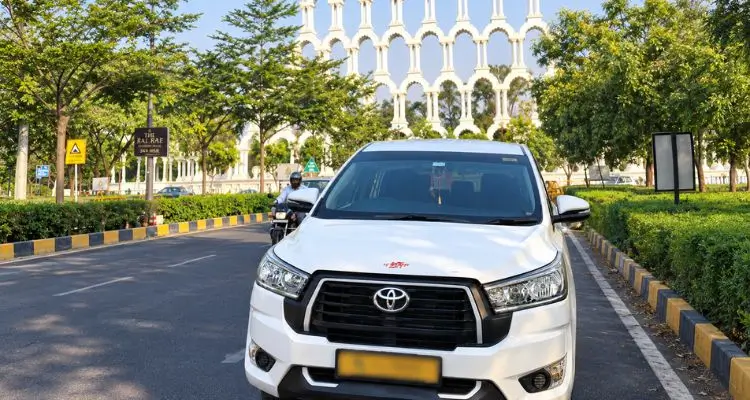
For a couple completing ten or fourteen days on the road, however, an Innova Crysta with driver in Rajasthan can provide noticeably more comfort. The additional cabin space becomes valuable on sectors such as Jaipur to Jodhpur, Jaipur to Jaisalmer or Udaipur to Jaisalmer, where passengers can spend most of the day inside the vehicle.
Three adults with full luggage are also generally better served by an Innova-type vehicle than a sedan.
Four adults require careful baggage consideration. Four passengers may fit easily enough, but four large check-in suitcases plus cabin bags can create storage problems. The transport company should receive the approximate luggage quantity before assigning the car.
Groups of five, six or more adults with substantial baggage should consider a Tempo Traveller for Rajasthan tour. A larger vehicle costs more but prevents the journey from becoming uncomfortable. Seat count should never be confused with touring capacity.
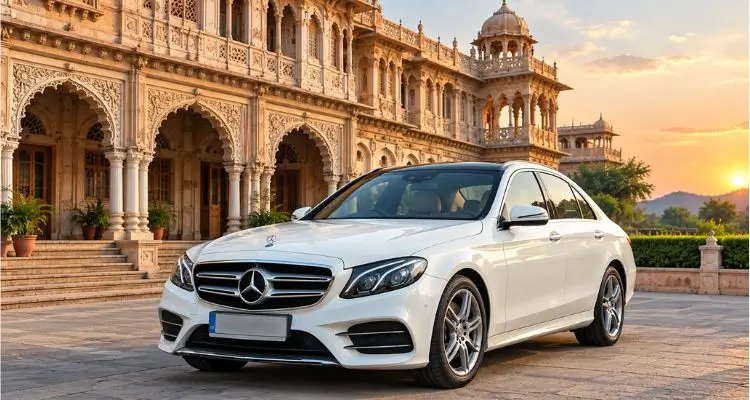
For premium travellers, a luxury sedan or SUV can be arranged, but practicality should still be considered. A Mercedes sedan may be excellent for a Jaipur airport pickup but less convenient than an Innova Crysta when a couple carries several large bags across fourteen days.
The best Rajasthan vehicle is therefore not necessarily the most expensive one. It is the vehicle that provides enough space for the actual passengers, luggage and daily driving distances.
Foreign visitors often underestimate Rajasthan's size when looking at a map. Jaipur, Jodhpur, Udaipur and Jaisalmer may all appear relatively close because they are in the same state, but road travel between them consumes a meaningful portion of the itinerary.
A Jaipur to Jodhpur private car journey generally requires approximately 5.5–6.5 hours, depending on traffic and stops. Jaipur to Udaipur commonly requires around 7–8 hours. Jaipur to Jaisalmer is considerably longer and can take approximately 9–11 hours.
Jodhpur to Udaipur normally takes around 5–6 hours when driven directly, but many travellers make the journey longer by visiting Ranakpur. This is one of the better sightseeing transfers because Ranakpur lies naturally within the broader route and provides a worthwhile break.
Jodhpur to Jaisalmer generally requires around 5–6 hours. Udaipur to Jaisalmer can require approximately 9–10.5 hours, making it one of the longer common Rajasthan sectors.
Jaipur to Ranthambore generally requires around 3.5–4.5 hours, while Jaipur to Pushkar can usually be completed in around 2.5–3.5 hours.
These times are deliberately realistic rather than based on the fastest possible map estimate. Hotel pickup, city traffic, road works and comfort stops affect the day.
A good Rajasthan road trip itinerary should avoid stacking long drives one after another. A traveller who spends nine hours driving to Jaisalmer should have enough time there to make the journey worthwhile.
Seven days is enough for a useful Rajasthan journey, but it is not enough for every major city.
A practical route can begin with Jaipur, where travellers should spend approximately two nights. Jaipur requires enough time for Amber Fort, City Palace, Jantar Mantar, Hawa Mahal and the old city without compressing everything into a few rushed hours.
The route can then continue to Pushkar. The drive is manageable, and travellers can spend time around Pushkar Lake and the town before staying overnight or continuing according to the schedule.
From Pushkar, the private car can continue to Jodhpur, where Mehrangarh Fort deserves a substantial visit. Jodhpur's old city and Jaswant Thada can also be included.
The journey can then continue towards Udaipur, ideally with a Ranakpur stop when timings permit. Udaipur deserves at least two nights because City Palace, Lake Pichola and the old-city environment are better experienced without constant road travel.
A seven-day route should generally avoid forcing Jaisalmer into the same schedule unless another city is removed. Adding Jaisalmer creates several additional hours of driving and can turn the holiday into a sequence of hotel arrivals and departures.
The advantage of a 7-day Rajasthan tour by private car is that the route can be adjusted. A traveller interested in wildlife might replace Pushkar with Ranthambore. Someone focused on heritage might prioritize Jaipur, Jodhpur and Udaipur.
Ten days provide much better flexibility.
A strong route can include Jaipur – Pushkar – Jodhpur – Jaisalmer – Jodhpur region – Udaipur, although the exact order should be arranged to minimize unnecessary backtracking.
Jaipur can receive two nights, followed by a shorter Pushkar stay. Jodhpur deserves at least one or preferably two nights. Jaisalmer should receive at least two nights because of the driving required to reach it.
Udaipur can then receive two or three nights depending on flight or onward travel arrangements.
Another ten-day option can replace Jaisalmer with Ranthambore, producing a slower journey with less extreme road mileage.
A traveller should decide whether desert scenery or wildlife matters more rather than attempting to include both while also keeping every major heritage city.
The 10-day Rajasthan private tour cost for transportation can reasonably fall around $1,000–$1,350 for a sedan and approximately $1,150–$1,500 for an Innova Crysta, depending on mileage and final drop.
Hotels are additional unless a package price has been requested.
Two weeks allow Rajasthan to be experienced with far less pressure.
A fourteen-day route can combine Jaipur, Pushkar, Jodhpur, Jaisalmer and Udaipur while giving the traveller enough time to stay more than one night in major destinations.
Ranthambore can also be incorporated when wildlife is important, although the route should be structured carefully to avoid unnecessary backtracking.
A two-week Rajasthan private driver itinerary also allows smaller places to be added. Ranakpur can become more than a rushed roadside stop. Bundi can be included for travellers who prefer a quieter heritage town. Bikaner can make sense on certain northern Rajasthan routes.
The biggest improvement at fourteen days is not the number of attractions. It is the reduction in pressure.
Instead of arriving in Jodhpur in the afternoon and leaving the next morning, travellers can actually spend a complete day in the city. Instead of driving to Udaipur and immediately beginning sightseeing, they can check in and enjoy the evening.
A premium transportation budget of approximately $1,550–$2,100 for an Innova Crysta is reasonable for many fourteen-day routes, with higher-mileage journeys costing more.
This is one of the most important distinctions for foreign tourists.
A private driver in Rajasthan is primarily responsible for transportation. The driver takes passengers between hotels, cities, attractions, airports and railway stations. An experienced tourism driver can also suggest practical lunch stops, help coordinate pickup points and explain basic logistical information.
A professional local guide provides historical and cultural interpretation.
At Amber Fort, for example, the driver brings the traveller to the appropriate arrival point and waits. The guide accompanies the traveller through the monument and explains architecture, history and significant areas.
The same structure applies at Mehrangarh Fort, City Palace, Jaisalmer Fort and other major attractions.
Some drivers know a great deal about Rajasthan after years of working with tourists, but travellers should not automatically expect a driver's commentary to replace professional guiding.
Local guides can be hired only where required. A traveller who prefers independent sightseeing may not need one every day.
For visitors particularly interested in architecture, history, photography or religion, adding guides in Jaipur, Jodhpur, Udaipur and Jaisalmer can significantly improve the trip.
This depends entirely on the quotation.
Professional Rajasthan transport companies frequently structure the driver's daily allowance or overnight expenses into the package. In other arrangements, a separate daily allowance is charged.
The traveller should ask before booking.
Passenger hotels do not usually need to provide a room for the driver. Drivers on tourism routes often use designated driver accommodation, budget properties or arrangements made by their employer.
Some hotels have separate driver facilities.
Travellers should not discover halfway through the journey that they are expected to find and pay for a driver's room every night if this was never mentioned.
The same principle applies to meals. The driver normally handles his own food when an allowance is included.
Guests may occasionally invite the driver for tea or a meal, but this is optional.
A complete Rajasthan car and driver quotation should make these expenses clear from the beginning.
Can You Change the Itinerary During the Tour?
One of the strongest reasons to hire a private car is flexibility.
If travellers decide they want an additional hour in Jodhpur or an earlier departure from Jaipur, small adjustments can usually be made easily.
Larger changes require discussion.
Adding a completely new city can alter the mileage, number of driving hours and driver accommodation requirements. Changing a Jaipur–Jodhpur journey into Jaipur–Bikaner–Jaisalmer is not a minor adjustment.
Additional kilometres may therefore increase the cost.
Hotel reservations also limit flexibility. A driver may be able to change direction immediately, but a prepaid hotel booking may not be refundable.
Foreign visitors should think of the itinerary as flexible within a structure rather than completely open-ended.
On a normal sightseeing day, the driver collects passengers from the hotel at the agreed time.
The vehicle takes them to the first attraction and waits at a designated parking or pickup area.
After sightseeing, passengers meet the driver and continue to the next place.
In Jaipur, this can involve Amber Fort, Jal Mahal, City Palace and the historic centre.
In Jodhpur, the day can include Mehrangarh Fort, Jaswant Thada and local areas.
In Udaipur, transportation can cover City Palace, Saheliyon Ki Bari and other sites, while boat rides require separate tickets and are not provided by the driver.
The vehicle is available according to the booked operating schedule.
Passengers should keep the driver's mobile number because some monuments have multiple gates or parking areas.
The private car is particularly convenient for purchases, jackets, bottled water and other belongings that travellers do not want to carry all day. Passports, money and high-value electronics should still remain with the passenger.
Foreign tourists should know that shopping commissions exist within the tourism industry.
Drivers, guides and tour representatives may sometimes receive commissions when guests purchase jewellery, carpets, textiles, handicrafts or other products from particular shops.
This does not automatically mean every recommended shop is bad. Some are reputable businesses with good-quality products.
The problem occurs when passengers feel pressured to shop or are repeatedly taken to commercial stops they did not request.
Travellers who are not interested in shopping should say so clearly.
A professional private Rajasthan driver should respect this.
If travellers do want to shop, they should compare quality and prices rather than assuming a recommendation guarantees the best deal.
High-value jewellery, carpets and antiques deserve particularly careful consideration.
A sightseeing day should not quietly become a sequence of commission-based shops at the expense of monuments the traveller actually wanted to see.
Rajasthan road travel is routine, but road conditions and traffic behaviour can differ significantly from what many foreign visitors are accustomed to.
A good driver should prioritize safe speeds and defensive driving.
Travellers should not encourage the driver to “go faster” because a map application predicts an earlier arrival.
Night driving should be minimized when there is no practical reason for it, particularly after a full day on the road.
Long transfers should begin early enough to reach the destination at a reasonable hour.
Seat belts should be used whenever available.
Passengers should also keep valuable belongings with them during restaurant stops rather than leaving passports, cash and expensive electronics in an unattended vehicle.
Driver fatigue deserves particular attention. If the itinerary repeatedly requires early departures, long drives and late-night returns, it has been designed badly.
Private travel should create a more comfortable holiday, not simply make an unrealistic schedule technically possible.
Tipping is voluntary, but many international travellers choose to tip a good driver at the end of a multi-day journey.
For satisfactory professional service, approximately $10–$15 per day can be a reasonable guideline.
For consistently excellent service involving careful driving, luggage assistance, punctual pickups, useful practical help and good vehicle care, approximately $15–$20 per day can be appropriate.
A couple travelling with the same driver for ten days might therefore consider approximately $120–$180 equivalent as a total gratuity when genuinely satisfied.
For two weeks, a good-service gratuity can fall around $175–$250 equivalent, depending on the quality of service.
These figures are shown in USD for budgeting consistency, although local currency is generally more convenient for the driver.
Travellers do not need to tip every evening. Giving the gratuity at the end of the complete journey is simpler.
Before paying for a private Rajasthan car and driver, travellers should have the complete route in writing.
The pickup city, date and location should be stated.
The final drop location should be stated.
Every overnight city should appear in the itinerary.
The vehicle category should be specified.
Passenger and luggage numbers should be provided.
The total transportation cost should state whether fuel, tolls, parking, road taxes, driver allowance and driver accommodation are included.
The approximate daily operating arrangement should be understood.
Airport flight details should be supplied when airport collection is involved.
Cancellation conditions and deposit requirements should be clear.
If a particular vehicle such as an Innova Crysta has been requested, the booking should identify it rather than promising only a generic SUV.
If local guides are included, the cities where they are provided should be listed.
If hotels are included, the actual hotel names and room category should appear separately.
These details turn a verbal promise into a usable travel arrangement.
Find the answers to all of our most frequently asked questions
A premium sedan can reasonably cost around $85–$110 per active travel day, while an Innova Crysta can cost approximately $110–$140 per day. Total pricing depends on route, kilometres, vehicle and final drop location.
A seven-day transportation budget can be around $750–$1,000 for a sedan or approximately $850–$1,100 for an Innova Crysta, depending on mileage and inclusions.
For fourteen days, travellers can budget approximately $1,350–$1,800 for a sedan and around $1,550–$2,100 for an Innova Crysta on a premium service basis. High-mileage routes can cost more.
Usually, yes. One of the main benefits of a Rajasthan tour by private car and driver is keeping the same vehicle and driver through multiple cities. Operational changes can occasionally occur, so this should be confirmed when booking.
Not necessarily. A driver handles transportation and practical road logistics. A professional local guide provides detailed historical and cultural interpretation at monuments.
They can be included in a complete quotation. Travellers should specifically confirm fuel, highway tolls, parking, road taxes, driver allowance and overnight driver expenses before booking.
A sedan is sufficient for many couples, but an Innova Crysta provides more cabin and luggage space and is particularly comfortable for longer Rajasthan journeys.
Minor schedule changes are usually possible. Adding cities or substantially increasing the kilometres can result in additional charges and may also affect hotel bookings.
A private car offers direct hotel-to-hotel transportation, easier luggage handling and flexible stops. Trains can be faster or cheaper on certain routes. The better choice depends on the itinerary and traveller's priorities.
Approximately $10–$15 per day is a useful guideline for good service, while $15–$20 per day can be appropriate for consistently excellent service. Tipping is voluntary and can be given at the end of the journey.