Your Travel Partner
SINCE 1989
Your Travel Partner
SINCE 1989
Hiring a safe private driver in India can make a multi-city holiday far easier, especially for international travellers moving through Delhi, Agra, Jaipur, Jodhpur, Udaipur, Jaisalmer, Pushkar, Ranthambore or other destinations where private road transportation works well. The service removes repeated taxi bookings, reduces luggage handling and gives travellers one consistent vehicle for intercity transfers and scheduled sightseeing.
The quality of the experience, however, depends heavily on the driver and the company supplying the vehicle. A good private driver in India for foreign tourists should be punctual, patient, experienced with long-distance tourism routes and comfortable dealing with hotel pickups, airports, road stops and multi-day schedules. The vehicle should be clean, properly maintained and suitable for the number of passengers and suitcases.
For international travellers, the cheapest quote should not automatically be treated as the best choice. A driver who charges substantially below the normal market may operate an older vehicle, exclude fuel and road charges, rely on excessive commissions from shops or create additional charges after the trip begins. Paying a realistic rate for a professional chauffeur is often more valuable than saving a small amount on transportation that will be used almost every day.
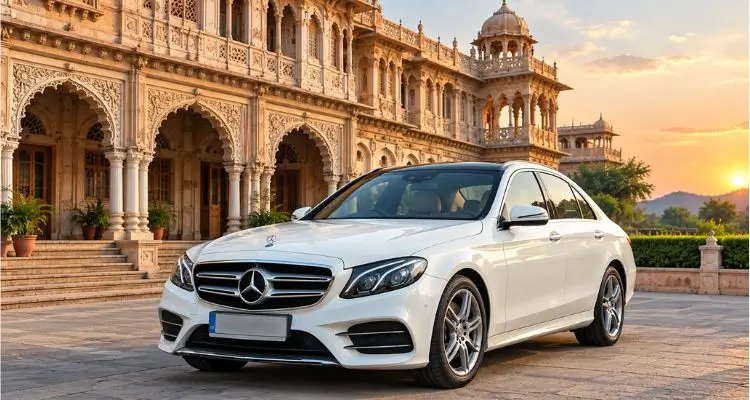
A premium private sedan can reasonably cost approximately $80–$120 per active touring day, while an Innova Crysta can cost around $110–$150 per day. A Tempo Traveller for families and groups can cost approximately $160–$230+ per day, while premium SUVs and luxury chauffeur-driven vehicles can cost substantially more. Long routes, airport waiting, unusually high mileage and one-way final drops can increase the amount.
The quotation should be based on the complete itinerary rather than a vague daily rate. A seven-day Golden Triangle journey is not the same as a seven-day Rajasthan route involving Jaisalmer. One may cover moderate road distances, while the other involves several long driving days and much greater vehicle mileage.
The safest way to hire a reliable car and driver in India is to evaluate the complete service: company reputation, driver experience, vehicle quality, route knowledge, written inclusions, payment conditions, luggage capacity and communication before arrival.
The first step when hiring a private chauffeur in India is to evaluate who is actually providing the service. A professional transport or tour company should be able to explain its business clearly, provide a written quotation and answer practical questions about the vehicle and route without giving vague or evasive replies.
A functioning website is useful, but a website alone does not prove service quality. Travellers should look for consistent company details, a real business location, working telephone numbers and an established online presence. Reviews can provide useful patterns when read carefully. One perfect review proves very little, while repeated comments over time about punctuality, safe driving and clean vehicles provide stronger evidence.
The company should be able to identify the type of vehicle that will be supplied. If the traveller asks for an Innova Crysta, the reply should not simply promise a “big SUV.” If the booking is for a sedan, the operator should explain the vehicle category rather than leave it completely open.
The same applies to the driver. In some cases, the exact driver name may only be assigned shortly before travel, particularly when the booking is made months in advance. That is reasonable. What matters is whether the company can explain how drivers are selected and whether they regularly work with international tourists.
A traveller should be cautious when the person taking the booking refuses to provide written details and insists that every condition will be “managed later.” Multi-day private transportation involves enough money and time that the route and pricing should be clear before the driver arrives.
The company should also be willing to discuss problems. Ask what happens if the vehicle develops a mechanical issue during the journey. A professional operator should have some form of backup arrangement rather than expecting passengers to solve the problem independently.
A private driver India cost cannot be evaluated properly without the route.
The passenger should provide travel dates, starting city, overnight destinations and final drop location before requesting the total transportation price. If airport pickup is involved, the airport and approximate arrival time should also be included.
For example, a ten-day route of Delhi–Agra–Jaipur–Jodhpur–Udaipur has a different operating cost from Delhi–Jaipur–Bikaner–Jaisalmer–Jodhpur–Udaipur, even though both journeys contain the same number of days.
Jaisalmer adds significant mileage. A vehicle ending in Udaipur rather than returning to its home city may also create operational costs after the travellers leave.
A professional quote should therefore be route-specific.
Travellers should avoid comparing operators by asking only, “What is your price per day?” An operator quoting $90 per day may later add kilometre charges, tolls, parking and driver allowance. Another company quoting $120 per day may already include everything required for the confirmed route.
The second quotation can ultimately be better value.
The total amount should preferably be shown in one clear figure, with exclusions identified separately.
One of the most common mistakes foreign tourists make is booking according to passenger seats instead of luggage capacity.
Two people may travel comfortably in a sedan, but two very large suitcases, two cabin bags and backpacks can use most of the luggage space. On a short transfer this may still be manageable. On a two-week Rajasthan journey, an overcrowded vehicle becomes tiring quickly.
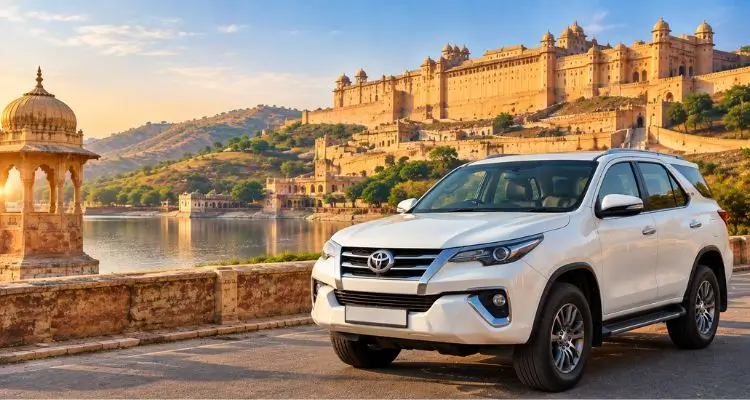
An Innova Crysta with driver in India is particularly popular with international couples because it offers more cabin and baggage room. Travellers do not need all the seats; they use the additional space for comfort.
Three adults with full luggage are also often better suited to an Innova than a sedan.
Four adults should provide exact baggage information. Four large suitcases, four cabin bags and personal backpacks can create problems even in a larger vehicle if the luggage volume has not been considered.
Families and groups should consider a Tempo Traveller when several adults are carrying international luggage.
The booking request should therefore include a sentence such as: “Two adults with two large check-in suitcases and two cabin bags.” That information is more useful than simply saying “two passengers.”
The vehicle should also have effective air conditioning. Much of India can be hot, and long road journeys without reliable cooling can become extremely uncomfortable.
A private car with driver in India can be quoted in several ways, so inclusions matter more than the headline amount.
Fuel should be clearly addressed. For a multi-city tour, fuel is a major operating expense and should normally be included in a complete tourist quotation or explicitly calculated.
Highway tolls should also be clarified. A long road route can pass through multiple toll plazas.
Parking charges at hotels, airports and tourist attractions may be included or paid separately depending on the operator.
Road taxes and state-related commercial vehicle charges should also be discussed when a journey crosses state boundaries.
The driver's overnight expenses require particular attention. On a multi-day tour, the driver needs accommodation and meals. Many professional operators include driver allowance or accommodation arrangements in the transport price.
Foreign travellers should not arrive in Jodhpur and suddenly be told they need to purchase a hotel room for the driver unless that arrangement was agreed before booking.
A written quotation should therefore indicate whether the following are included: vehicle, driver, fuel, normal tolls, ordinary parking, road taxes and driver allowance.
Passenger hotels, monument tickets, local guides, meals and personal expenses are usually separate unless a full tour package has been purchased.
An experienced English-speaking driver in India does not need perfect English. The useful requirement is practical communication.
The driver should be able to discuss pickup time, hotel location, road stops, luggage and ordinary requests without repeated confusion.
Tourism experience is particularly valuable because foreign visitors often have different expectations from local commuters. A driver accustomed to international guests should understand that passengers may need clean restroom stops, regular meal breaks, hotel entrance assistance and realistic explanations of road time.
Long-distance route experience also matters.
A driver who works primarily around Jaipur city may not be the strongest choice for a two-week route involving Jaisalmer, Udaipur and Delhi. Intercity tourism driving requires knowledge of highways, suitable restaurants, road conditions, hotel locations and realistic transfer schedules.
Ask whether the same driver normally handles Rajasthan circuits or Golden Triangle tours.
The driver should also understand the difference between giving practical advice and pressuring passengers into shops or restaurants.
Safe driving should be one of the strongest indicators of a reliable private driver in India.
Foreign tourists sometimes compare navigation-app times and expect every journey to match the fastest estimate. India road travel does not always work that way. Traffic, trucks, motorcycles, animals, road construction and busy town sections can reduce speeds significantly.
A good driver should give realistic travel times rather than promise to cover every route unusually quickly.
Jaipur to Jodhpur generally requires around 5.5–6.5 hours. Jodhpur to Udaipur can require around 5–6 hours direct. Jaipur to Jaisalmer can take approximately 9–11 hours, while Udaipur to Jaisalmer can require roughly 9–10.5 hours.
A driver promising to cut several hours from these journeys should not automatically be considered more efficient.
Aggressive driving is not premium service.
Passengers should never encourage speeding because they left the hotel late. The correct response to a delayed departure is to adjust the arrival schedule, not to ask the driver to take unnecessary risks.
A private driver should not be expected to drive unlimited hours.
On a long Rajasthan tour, the driver may spend six, eight or ten hours on the road during major transfer days. Requiring late-night restaurant transfers after such a journey and then demanding another departure at sunrise creates fatigue.
A professional company should structure the itinerary so the driver receives adequate rest.
Foreign travellers should also examine their own schedule. If every day begins before sunrise, contains eight hours of driving and ends after dinner, the itinerary itself is poor even if the car is comfortable.
Private transportation should create flexibility and comfort, not make an exhausting route technically possible.
When a late-night airport arrival is involved, the company should assign a driver whose working schedule is appropriate for the transfer.
Safety should always take priority over avoiding one additional hotel night.
Shopping commissions are common within many tourism markets, and India is no exception.
A driver or guide may know jewellery shops, textile stores, carpet businesses, handicraft outlets and souvenir shops where they receive a commission if travellers make a purchase.
This does not automatically mean the shops are dishonest. Some can sell excellent products.
The problem begins when travellers who have no interest in shopping repeatedly lose sightseeing time because commercial stops are added without permission.
Before the first sightseeing day, travellers can simply tell the driver: “We do not want shopping stops unless we request them.”
A professional tourist driver in India should respect that preference.
Travellers who do want to shop should still compare prices and quality. A recommendation from a driver should be treated as one option rather than proof that the shop offers the best price.
High-value jewellery, carpets and antiques require particular care.
A private driver is responsible for transportation.
A professional sightseeing guide is responsible for detailed historical, cultural and architectural explanation.
Some experienced drivers have excellent general knowledge and may tell travellers basic facts about cities and routes. This can be helpful, but it should not be confused with a dedicated guided tour.
At places such as Amber Fort, Mehrangarh Fort, Agra Fort, Fatehpur Sikri or City Palace, travellers interested in detailed history can hire a local guide separately.
This distinction also protects the travel day.
The driver remains responsible for the vehicle and luggage while passengers visit the monument with their guide.
Foreign tourists should be cautious when an extremely cheap driver service claims that one person will act simultaneously as driver, professional historian, escort and specialist guide across the entire country.
Specialized knowledge differs by destination.
Airport pickup is one of the moments when a private driver should reduce stress.
The operator should request the flight number rather than only a scheduled pickup time. Flights can arrive early or late, and the driver should know the actual service being monitored.
The passenger should receive clear meeting instructions.
For an international arrival, immigration and luggage collection can require significant time after the aircraft lands. The waiting policy should therefore be explained.
If the driver will wait with a name board, the passenger should know where.
If the meeting occurs at a designated airport pickup area, the instructions should be written clearly.
A private airport driver in India should not require a newly arrived foreign traveller to walk around outside the terminal searching blindly for the car.
The passenger should also save the operator's number before boarding the flight.
A professional company may request a deposit to confirm a vehicle and driver.
This is normal, particularly for multi-day tours, premium vehicles and busy travel periods.
The important issue is whether the terms are clear.
Travellers should know how much is due before arrival, when the remaining balance is payable and what methods are accepted.
A company demanding the full amount months in advance without clear cancellation terms deserves additional scrutiny.
At the same time, travellers should not expect an operator to reserve a premium vehicle and experienced driver for two weeks without any financial commitment.
The booking should include cancellation and amendment conditions.
Foreign visitors should also ask whether card payments, bank transfer or other electronic methods carry additional charges.
Cash should not be the only method available for a significant premium booking unless the traveller has deliberately chosen that arrangement.
A very cheap private driver in India price should raise questions.
Suppose three companies quote $1,200, $1,280 and $650 for the same ten-day Rajasthan route in a comparable vehicle.
The lowest quote may be genuine, but the difference is large enough to investigate.
Ask whether fuel is included.
Ask about tolls, taxes and parking.
Ask whether the driver's allowance is included.
Ask whether the quoted vehicle is genuinely the requested model.
Ask whether the mileage covers the entire route.
A cheap service may depend heavily on shopping commissions. Another may use an older vehicle or add numerous charges during the journey.
The purpose is not to choose the most expensive company automatically. It is to understand why one quotation is dramatically different.
A realistic premium budget for a ten-day private road journey is approximately $1,000–$1,350 for a comfortable sedan and around $1,150–$1,500 for an Innova Crysta, depending on route.
A price far below normal expectations should have a clear explanation.
The exact driver may not always be known when a journey is booked several months ahead.
Closer to the travel date, however, the operator should provide relevant driver and vehicle details.
Travellers should receive the driver's name and contact number.
The vehicle registration or identifying details may also be supplied depending on company practice.
For airport pickup, this becomes particularly useful because passengers know which person and vehicle they are looking for.
The driver should also have the correct passenger information.
Hotel names, flight details and route should already be available to the driver rather than being reconstructed from memory on the morning of pickup.
The first day provides useful evidence about the quality of the service.
The driver should arrive at the agreed time or communicate clearly if a genuine delay occurs.
The vehicle should be clean.
The air conditioning should work.
The driver should not spend the journey using a phone irresponsibly.
Road behaviour should feel controlled rather than aggressive.
The driver should confirm the schedule without trying to redesign the entire itinerary around commission-based stops.
Travellers should also feel comfortable asking for a restroom break or meal stop.
If serious problems appear immediately, contact the operating company rather than waiting several days and hoping everything will improve.
A professional company should address genuine service issues promptly.
Even when the driver is trustworthy, passports, cash, cards and expensive electronics should remain with the traveller.
Large suitcases can stay in the vehicle during a normal sightseeing stop, but valuable personal items should remain in a small day bag.
This is standard travel practice rather than a comment on the driver.
During meal stops, passengers should avoid leaving passports or significant amounts of cash inside any parked vehicle.
Hotel safes can be used when appropriate, but the traveller should retain control of essential documents.
Copies of passport information and important bookings can also be stored securely online or on the traveller's phone.
Foreign travellers often find route pricing easier to understand than generic daily rates.
A Delhi to Agra private sedan can reasonably cost approximately $130–$165, while an Innova Crysta can cost around $175–$220.
An Agra to Jaipur private car can cost around $130–$165 for a sedan or approximately $175–$220 for an Innova Crysta, with additional cost when Fatehpur Sikri is included.
A Jaipur to Jodhpur private car can cost approximately $150–$190 for a sedan and around $200–$250 for an Innova Crysta.
A Jodhpur to Udaipur private transfer can fall around $150–$190 for a sedan or approximately $200–$250 for an Innova Crysta, with Ranakpur increasing the price.
A Jaipur to Jaisalmer private car can cost around $250–$310 for a sedan or approximately $320–$390 for an Innova Crysta because of the much longer distance.
These higher-side estimates help foreign tourists identify quotes that appear unusually low or high.
Tipping is voluntary and should reflect service quality.
For a good full-day private driving service, approximately $10–$15 equivalent is a practical international-traveller guideline.
For excellent multi-day service, approximately $15–$20 per day can be appropriate.
A couple using the same driver for ten days may therefore give approximately $120–$180 equivalent at the end of the journey if the service has been consistently good.
For fourteen days, approximately $175–$250 equivalent can be a reasonable premium gratuity range.
The amounts are expressed in USD for budgeting, although local currency is normally more convenient for the recipient.
Travellers should not feel required to tip highly after unsafe driving or poor service.
A gratuity should reward punctuality, safe driving, vehicle cleanliness, luggage assistance and professional behaviour.
Find the answers to all of our most frequently asked questions
A premium sedan can reasonably cost approximately $80–$120 per active touring day, while an Innova Crysta can cost around $110–$150 per day. Long routes and unusually high mileage can cost more.
Check the company, read review patterns, request a written route and quotation, confirm the vehicle category, ask about driver experience and verify what happens if a vehicle problem occurs.
They can be included in a complete quotation and often are for premium multi-day services. Travellers should confirm fuel, tolls, parking, taxes and driver allowance before paying.
For a couple with large luggage or travellers completing several long road journeys, an Innova Crysta often provides more comfort and baggage space. A sedan remains sufficient for two travellers with lighter luggage.
For a road-based route such as the Golden Triangle or Rajasthan, using the same driver can be very convenient. The passenger avoids repeated vehicle changes and the driver becomes familiar with the route and travel preferences.
A driver can provide practical information, but detailed sightseeing interpretation should normally be handled by a professional local guide. The two roles are different.
Payment structures vary. A reasonable deposit can be normal, but travellers should understand cancellation conditions, remaining balance timing and payment methods before transferring money.
Tell the driver clearly that no shopping stops should be added unless requested. A professional private tourist driver in India should respect this instruction.
Night driving can be necessary in some circumstances, but repeated late-night long-distance travel should be avoided when possible. Driver rest and realistic road schedules are important for safety.
You should have the confirmed route, vehicle category, total price, inclusions, pickup details and company contact information. Closer to travel, the driver's name and phone number should also be provided.