Your Travel Partner
SINCE 1989
Your Travel Partner
SINCE 1989
The first leopard most visitors see in this corner of Rajasthan is not in a forest at all. It is sitting on a bald granite boulder at dusk, tail hanging over the edge, while a herder in a red turban walks his goats home along the road below. Nobody panics. The goats keep moving, the leopard keeps watching, and the jeep engine ticks quietly as it cools. That scene is the reason Jawai and Bera have become the most talked-about leopard safari in Rajasthan. The two names are often used as if they were different destinations, but they share the same landscape of rocky hills, scrub, wheat fields and a large reservoir in Pali district. What changes is the style of stay. Around the reservoir you find the polished tented camps and resorts. Around Bera village you find heritage homes, smaller lodges and family-run safari outfits. This guide compares the luxury leopard lodges on both sides, with realistic rates, how the jeep drives work, the best months, the Rabari herding families who share the hills with the cats, and how long the drive takes from Udaipur and Jodhpur.
It helps to picture the area before choosing a lodge. Jawai Dam is a large reservoir built across the Jawai River, and the countryside around it is broken up by dramatic outcrops of grey and pink granite. These hills are full of caves, ledges and cracks, which make ideal shelter for leopards. Around 20 square kilometres near the dam are protected as the Jawai Bandh Leopard Conservation Reserve, managed by the state forest department. The wider area, including the hills around Bera village a short drive away, is a mix of farmland, grazing land, temple hills and private estates. Local conservationists estimate somewhere between 50 and 70 leopards use the Bera and Jawai hills, although there is no official count for the whole area.
This is very different from a national park such as Ranthambore. There are no zones, no fixed gates, no government booking portal and no queue for shared open-top park buses. Safaris are run by the lodges themselves and by licensed local jeep owners, mostly on village roads and tracks around the hills. That brings real advantages. Drives can start when the light is right rather than at a fixed gate time, and a good tracker can follow a particular cat from one hill to the next. The drawback is that standards vary a great deal from one operator to another, which is why the choice of lodge matters more here than in most wildlife areas.
When people say "Jawai", they usually mean the stays clustered around the reservoir and the villages to the south and east of it. This is where SUJÁN Jawai sits, along with resorts such as Ratan Villas, Amritara Jawai Sagar and the recently opened Sterling Leopard Haven Jawai. The setting is broad and open, with water birds on the reservoir, crocodiles basking on the banks and long views across the hills.
When people say "Bera", they usually mean the village and the cluster of hills around it, a little to the north. Castle Bera, the ancestral home of the former ruling family of the estate, is here, along with Leopard Lair Resort, Bera Safari Lodge, WelcomHeritage Cheetahgarh Resort and Spa, and many smaller homestays and tented places. The feel is more intimate and more village-centred. Several of the most famous leopard hills, including the temple hill near Perwa village, are within a few minutes' drive of Bera itself.
In practice, the leopards do not care which side you sleep on. Jeeps from both sides cover overlapping hills, and many guests at a Jawai camp will spend part of a drive near Bera, and the other way round. The real decision is about budget, privacy, the quality of guiding and how much comfort you expect after the drive. A guest who wants a five-star tented camp with plunge pools and a spa will end up in Jawai. A guest who wants a heritage home, a host who has lived among these hills all his life and a lower bill will usually be happier in Bera.
Experience the thrill of riding through Rajasthan's desert highways, scenic villages and golden landscapes. Plan your Jaisalmer motorcycle adventure with memorable stops and authentic desert experiences.
SUJÁN Jawai is the camp that put this landscape on the international map. It began life as Jawai Leopard Camp, and some travel agents and booking sites still use that name, so do not be confused if you see both. It belongs to the SUJÁN group, which also runs Sher Bagh near Ranthambore and The Serai in Jaisalmer, and it is a member of Relais & Châteaux. The camp has ten tents in total: eight luxury tents, a family tent and the Royal Tented Suite, which is made of two connected tents and comes with its own heated pool, a private jeep and a dedicated butler.
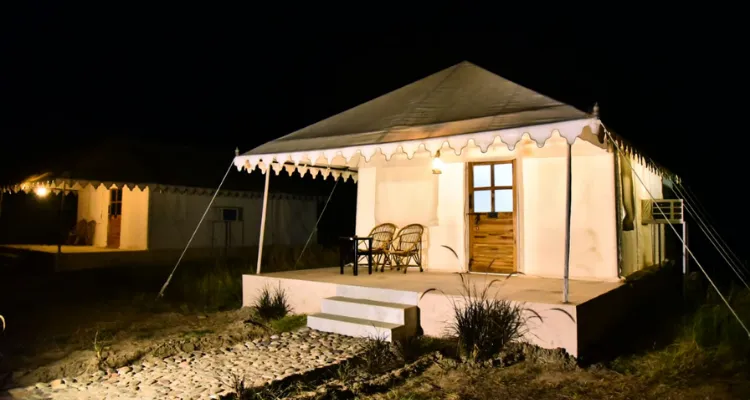
The tents are large, air-conditioned and heated in winter, with king-size beds, freestanding stone or copper bathtubs, hand-embroidered fabrics and private verandahs facing the rocks. Leopards are sometimes seen from the decks themselves, moving across the boulders behind the camp in the late afternoon. Meals are served in a dining tent, at a lantern-lit table in the scrub, or as a bush breakfast on a hilltop after the morning drive. Much of the produce comes from the camp's own kitchen garden. There is a pool, a tented spa and a lounge with a fireplace for the cold winter evenings.
Rates at SUJÁN Jawai are among the highest of any wildlife lodge in India. A luxury tent for two usually costs roughly Rs.105,000 to Rs.135,000 a night, about 1,200 to 1,550 US dollars, in peak season. The Royal Tented Suite generally runs from around Rs.175,000 to Rs.265,000, roughly 2,000 to 3,000 US dollars. These are all-inclusive leopard safari rates. They normally cover all meals, house wines and soft drinks at many times of year, two shared jeep drives a day with a naturalist and tracker, laundry and Wi-Fi. Day trips to Ranakpur and Kumbhalgarh Fort cost extra. Private jeeps are available at an additional charge, and they are worth it for serious photographers.
The camp is seasonal. It usually opens in early September, after the monsoon, and closes in mid-May before the worst of the summer heat. Peak dates around Christmas, New Year and the Diwali week sell out months ahead, and a minimum stay of two or three nights is common at these times.
Several other properties sit in the upper bracket around the reservoir. Ratan Villas is a 28-room resort built around a former family home, set in wheat fields on a large estate. It offers leopard drives, cycling along the dam, walks with Rabari herders and day trips to Ranakpur. Sterling Leopard Haven Jawai opened recently with 19 cottages, suites and villas, some with private plunge pools, plus an infinity pool and a restaurant focused on regional food. Amritara Jawai Sagar has rooms with verandahs facing the lake. These properties typically charge between Rs.15,000 and Rs.40,000 a night for two, depending on room type and inclusions, which makes them a sensible step down from SUJÁN for families or groups who still want comfort and a pool.
The honest comparison is this. SUJÁN gives you the most polished guiding, the most private setting and the best food in the area, and it is priced accordingly. The newer resorts give you a comfortable room and a decent pool, but the quality of the jeep drive depends on which local safari operator they use. Always ask who will be driving and tracking before you confirm.
Bera's appeal is personal. Many of the lodges here are owned by local families who grew up watching leopards from their rooftops, and the guests are often looked after by the owner himself. That gives a warmth and a depth of local knowledge that a larger resort cannot easily match.
Castle Bera is the most characterful stay in the village. It is the ancestral home of the former ruling family of the Bera estate, and the family still lives there and hosts guests personally. There are only five air-conditioned heritage rooms, high-ceilinged and furnished with old family pieces, giving the place a gently faded grandeur that many travellers love. Rates on booking sites usually start around Rs.11,000 to Rs.15,000 a night for a room, with breakfast. Leopard drives, dinners and full board are normally arranged as a package, and a realistic all-in figure for two people with meals and two drives a day is around Rs.25,000 to Rs.35,000 a night, roughly 280 to 400 US dollars. Do not expect a spa or a long room-service menu. Expect conversation on the terrace, home-cooked Rajasthani food and hosts who know the local leopard families by name.
Leopard Lair Resort is one of the better-known lodges built specifically for leopard watchers. It is small, with four cottages and four deluxe rooms, plus indoor and outdoor dining areas. Leopard drives, village drives and short nature walks are offered from the property. Listed prices on booking sites start at around Rs.19,000 per person per night, but rates and inclusions shift through the season, so confirm exactly what is covered before booking.
Bera Safari Lodge, run by a local family closely involved in leopard tracking, is popular with photographers. A double room with three meals and two leopard drives a day usually costs around Rs.25,000 a night. WelcomHeritage Cheetahgarh Resort and Spa is a larger option on a 20-acre estate near Bera, with lake-view rooms, garden chalets, chalets with private plunge pools and two-bedroom luxury tents. It suits families who want more space, a restaurant and a spa, and it is about 125 kilometres from Udaipur.
Beyond these, Bera has many simple homestays, tented camps and small resorts priced from roughly Rs.5,000 to Rs.10,000 a night. Some are excellent. Others have been built quickly on former leopard ground and have little to offer beyond a bed and a jeep. For a luxury traveller, the safest Bera choices are Castle Bera, Leopard Lair, Bera Safari Lodge and Cheetahgarh.
One important point applies across Bera in particular. Because most of the land is outside the protected reserve, rules are loose. Some operators have been reported using live bait, imitating prey calls or running night drives with powerful searchlights to guarantee a sighting. These practices stress the animals and are not something a responsible traveller should pay for. A good lodge will happily tell you how they track: by reading pugmarks on sandy tracks, watching for alarm calls from peafowl and langur monkeys, and scanning familiar ledges at dawn and dusk. If a lodge promises a guaranteed sighting, treat that as a warning sign rather than a selling point.
Take your motorcycle adventure across the magnificent Thar Desert. Discover open highways, sandy landscapes and traditional villages while enjoying an unforgettable journey through western Rajasthan.
A Jawai leopard safari follows a rhythm that is quite different from a national park drive. Most lodges run two drives a day. The morning drive leaves at first light, roughly 6:15 to 6:45 in winter and earlier in spring, and lasts around three hours. The evening drive leaves around 3:30 to 4:00 in the afternoon and returns after dark, often stopping for a sundowner on a quiet ridge. Leopards here are most active at dawn and dusk, when they leave their caves to sun themselves on the rocks or come down to hunt.
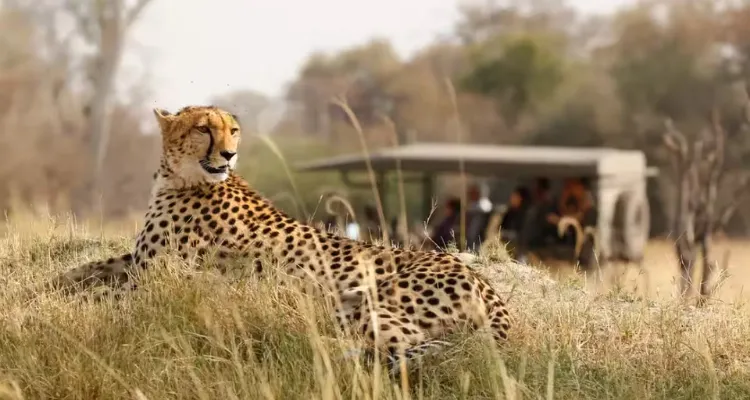
The vehicles are open-sided 4x4 jeeps, usually with a driver, a naturalist and a tracker. Because there are no fixed routes, the team decides where to go based on the previous evening's sightings, fresh pugmarks and reports from herders and other drivers. A drive typically covers several granite hills. The jeep stops on a dirt track or a field edge, and everyone scans the boulders through binoculars. The leopards here are extremely well camouflaged against the rock, and a good tracker can spot an ear or a tail tip at several hundred metres. Once a cat is found, the jeep usually waits at a respectful distance and lets the animal decide whether to move closer, climb higher or disappear into a cave.
Sighting rates are genuinely high. During the cooler months, many guests see leopards on most drives, and two or three nights usually brings several good sightings, including mothers with cubs. That said, it is a wild animal on open land, so some drives will be blank. Three nights is the most comfortable length for a stay, giving six drives and a good chance of close, well-lit views. Two nights works if your itinerary is tight.
Shared drives at the top lodges are normally included in the room rate, with four to six guests per jeep. A private leopard safari jeep for the morning or evening usually costs between Rs.6,000 and Rs.15,000 per drive, depending on the lodge, which is excellent value for photographers who want to stay longer with a sighting or position the vehicle for light. Independent jeep operators in Bera charge roughly Rs.4,000 to Rs.7,000 per jeep for a three-hour drive, but quality and ethics vary, so it is worth booking through your lodge or a trusted operator.
Bring a camera with a long lens of at least 400 millimetres, binoculars, a warm fleece and hat for winter mornings, a scarf against the dust, and neutral-coloured clothing. Open jeeps at dawn in December and January can be properly cold, with temperatures close to freezing on the coldest mornings. Lodges supply blankets and hot water bottles, but layers are still essential.
Many drives also include other wildlife. The reservoir is home to large mugger crocodiles, and in the cooler months it attracts flamingos, bar-headed geese, sarus cranes and many ducks. Striped hyenas, jungle cats, desert foxes and blue bulls (large antelope) are seen in the scrub around the hills. A visit to the reservoir at sunset is a peaceful break between leopard drives.
The thing that makes this landscape unique is not just the number of leopards. It is the way people and cats live side by side. The Rabari herders are a traditional pastoral community who have grazed goats, sheep, cattle and camels across western Rajasthan and Gujarat for centuries. The men are easy to recognise by their white clothing, heavy red turbans and large gold earrings. The women wear black or deep red wool and silver jewellery. Their small settlements and grazing camps are scattered across the farmland between the hills.
Many Rabari families regard the leopard with reverence. Local belief links the cat with the god Shiva, who is often shown seated on a leopard skin, and the temples on many of these granite hills are visited by leopards as well as worshippers. Priests at the hilltop temple near Perwa village have found leopards resting on the temple steps. When a leopard takes a goat, many herders accept it as part of life rather than a reason for revenge, and some believe the loss will be repaid twice over. This tolerance is the main reason leopards are so relaxed here, and it is why attacks on people are extremely rare despite the close contact.
A visit to a Rabari home is offered by most lodges, and it is one of the most memorable parts of a stay. Usually it involves a short drive or walk to a herder's camp, a cup of tea made with goat or buffalo milk, and a conversation with the help of your naturalist. You may see the family milking animals, making butter, or setting out with the flock in the morning. The best lodges arrange these visits with families they know well and pay them fairly for their time. Ask your lodge how this is handled, and avoid anything that feels like a staged performance.
A few courtesies make the visit comfortable for everyone. Ask before photographing people, especially women. Dress modestly, with shoulders and knees covered. Accept tea if offered, even if you only take a sip. Gifts of sweets are welcome, but cash handed directly to children is not a good idea; if you want to contribute, ask your lodge about community projects instead. SUJÁN Jawai and several other properties support local schools, water projects and compensation for livestock lost to leopards, which is a meaningful way to give back.
The Rabari way of life is changing quickly, with younger family members moving to towns and grazing land shrinking as resorts and farms expand. Choosing a lodge that respects this community, uses local staff and does not bait leopards helps keep the balance that makes this place so special.
Both Jawai and Bera are easy to reach from the two main cities of southern and western Rajasthan. Udaipur to Jawai is roughly 125 to 135 kilometres by road and takes about two hours twenty minutes to three hours, depending on which lodge you choose. Jodhpur to Jawai is around 150 to 160 kilometres and takes just under three hours. Udaipur's Maharana Pratap Airport and Jodhpur Airport both have regular flights from Delhi and Mumbai. A private car and driver for the transfer, in a premium sedan or SUV, usually costs Rs.7,000 to Rs.12,000 one way. SUJÁN Jawai can arrange its own airport transfers. The nearest railway station is Jawai Bandh, about 12 to 18 kilometres away, with Falna a little further.
The drive itself is worth building into the trip. From Udaipur, the road passes close to Kumbhalgarh Fort and the marble Ranakpur Jain temple, both of which can be visited on the way. A sensible route for many travellers is Udaipur, then Kumbhalgarh for a night, then Ranakpur and on to Jawai for three nights, then Jodhpur. This breaks the travel into short, easy days and adds two of Rajasthan's finest sights.
The best time for a leopard safari in Jawai is October to early April. October and November are mild and green after the rains, with clear light. December and January are cold at dawn, sometimes close to freezing, but leopards spend long periods sunning on the rocks, which makes for excellent sightings. February and March are warm and dry, and sightings remain very good. From April onwards temperatures rise above 38 degrees, and by May they can reach 42 or more. Leopards are still seen early and late, and birdlife at the reservoir can be good, but comfort drops sharply. July to mid-September is the monsoon, when the hills turn green and the top camps are closed. Many smaller lodges stay open all year.
Here is a quick way to choose:
All hotel rates in India carry GST, usually 18 percent for rooms in this price range, and some lodges add a service charge, so check whether quoted rates are inclusive. Book four to six months ahead for SUJÁN at peak dates, and two to three months ahead for the smaller Bera lodges in winter. A private tour operator in Rajasthan can combine the leopard stay with Udaipur, Jodhpur and the rest of your route, arrange the transfers and check which jeep team the lodge actually uses.
Both cover the same leopard hills, and jeeps from either side often visit the same areas. The real difference is the style of lodge: Jawai has the high-end tented camps and resorts, while Bera has heritage homes and smaller family-run lodges.
A luxury tent for two usually costs roughly ₹105,000 to ₹135,000 a night in peak season, about 1,200 to 1,550 US dollars. Rates normally include all meals and two shared leopard drives a day.
Yes. The camp started under the name Jawai Leopard Camp and is now known as SUJÁN Jawai, although some booking sites still use the older name.
Three nights is ideal, giving six drives and a strong chance of several good sightings. Two nights works on a tight itinerary.
Sighting rates are high, especially from October to March, and most guests on a two or three night stay see leopards several times. It is still a wild animal on open land, so some drives will be blank.
Jawai is roughly 125 to 135 kilometres from Udaipur, about two and a half to three hours by road. From Jodhpur it is around 150 to 160 kilometres, just under three hours.
The camp usually opens in early September and closes in mid-May. October to early April is the most comfortable period for leopard drives.
They are a traditional herding community who graze goats, sheep and cattle across the hills and live peacefully alongside the leopards. Many lodges arrange respectful visits to their homes for tea and conversation.
Yes. Attacks on people are extremely rare, and the lodges have well-established safety routines. Follow your guide's instructions and do not walk alone in the hills after dark.
Yes, and it is the most popular way to reach Jawai from Udaipur. Both Kumbhalgarh Fort and the Ranakpur Jain temple are on or close to the route and fit easily into a relaxed drive.