Your Travel Partner
SINCE 1989
Your Travel Partner
SINCE 1989
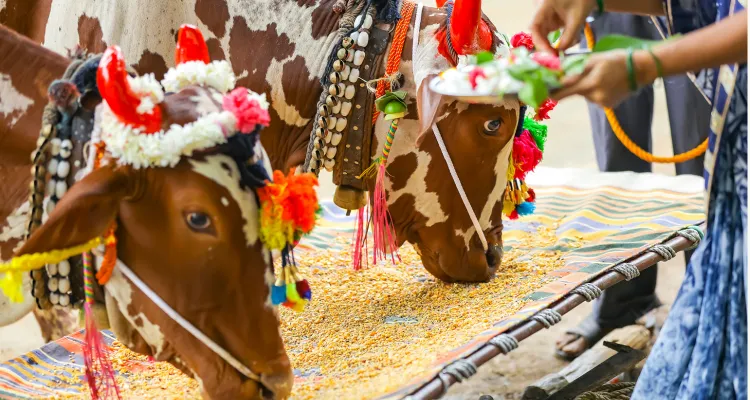
The Nagaur Cattle Fair is Rajasthan's second biggest livestock fair, held in Nagaur between Jodhpur and Bikaner. The official tourism dates are 12 to 15 February 2027, with trading starting several days earlier. The best stay is Ranvas, a heritage hotel inside Ahhichatragarh Fort, and the best photographs come at dawn and in the late afternoon.
At a Glance
|
Detail |
Information |
|---|---|
|
Official dates |
12 to 15 February 2027 (trading starts a few days earlier) |
|
Also known as |
Ramdeoji Pashu Mela |
|
Organised by |
Rajasthan Tourism; cattle contests by the Animal Husbandry Department |
|
Star animals |
Nagauri bulls, Marwari horses, camels |
|
Best stay |
Ranvas, inside Ahhichatragarh Fort |
|
Ranvas rate |
From about Rs.15,000; around Rs.22,000 to Rs.35,000 in fair week |
|
Nearest airport |
Jodhpur |
|
Drive from Jodhpur |
About 2.5 hours |
|
Drive from Bikaner |
About 110 km, around 2 hours |
|
Best photo light |
Dawn to 9 AM, and 4:30 PM to sunset |
Long before the sun clears the horizon at Nagaur, the fairground is already awake. Smoke from cow-dung fires hangs low over thousands of animals. A herder in a bright red turban ties a bell around the neck of a white Nagauri bull, its horns painted and wrapped with tassels. Camels groan as they rise. Somewhere a radio plays a folk song, and a tea seller stirs a huge blackened pot. When the first light finally arrives, it comes in soft and golden through the dust, and every photographer on the ground goes very quiet. This is the Nagaur Cattle Fair, and for a few days each winter it is one of the most honest, raw and beautiful sights in all of Rajasthan.
The Nagaur Cattle Fair runs officially from 12 to 15 February 2027, though trading starts several days earlier. It is worth visiting because it is a real working livestock market, far less touristy than Pushkar, and famous for Nagauri bulls, Marwari horses and camels.
The Nagaur Cattle Fair, also known as the Ramdeoji Pashu Mela, is held every year in the desert town of Nagaur, roughly midway between Jodhpur and Bikaner. The Department of Tourism, Government of Rajasthan, calls it the second biggest cattle fair in India, after Pushkar. The tourism department organises the fair and its cultural events, while the Animal Husbandry Department runs the livestock competitions. In the official Rajasthan fairs and festivals calendar, the main tourism dates are 12 to 15 February 2027.
The trading itself starts several days earlier and continues around the official window, because the fair follows the Hindu lunar calendar in the month of Magh and grows naturally as herders arrive from across Rajasthan and neighbouring states. If you want to see the market at its busiest, with the largest number of animals and the most real trading, arrive a day or two before the tourism programme begins. If you want the organised events such as camel races and the cultural evenings, be there during the four official days.
What makes Nagaur different from Pushkar is the mood. Pushkar has become famous worldwide, and the town fills with travellers, backpackers and hawkers. Nagaur remains a working market first. The men who come here are serious traders. Bulls, bullocks, camels, horses and cows change hands, and prices are negotiated over hours of tea and talk. The Nagauri bull, a breed known for its strength, speed and white colour, is the star of the fair. A well-bred pair can command a striking price, and the pride of the owners is visible in the way the animals are dressed.
Horses are another highlight. The Marwari horse, with its curved inward-turning ears, is bred in this region, and you will see owners showing off their animals with gentle rides and dance steps. Camels arrive in long lines from the desert, decorated with beads, mirrors and coloured woollen tassels. Around them grows a temporary town of tents, stalls and open-air kitchens. Visitors also come for the Mirchi Bazaar, where Nagaur's famous red chillies are sold, as well as iron tools, wooden goods, camel leather items and bridles.
For international travellers interested in rural India, the fair is a rare chance to see a living tradition without a stage set around it. You will not be hassled much. Most people are busy with their animals, and many are delighted to talk, pose, share tea, or simply stare back at the curious foreigner with a camera. A good local guide transforms the visit, because he can translate, explain the trade and introduce you to families.
Ahhichatragarh, the Fort of the Hooded Cobra, is Nagaur's restored royal fort, known for its painted palaces, Mughal-style gardens and water channels. Allow at least two hours with a guide, and stay until sunset on the ramparts.
Above the town rises Ahhichatragarh, the great fort of Nagaur, whose name is usually translated as the Fort of the Hooded Cobra. The site is ancient, with a fort here since early medieval times, and the walls you see today were developed over many centuries by Rajput and Mughal-era rulers. The fort's most celebrated chapter came in the 18th century, when Maharaja Bakhat Singh of Jodhpur ruled Nagaur in the middle of that century and built palaces, gardens and residences for the royal women.
After decades of neglect, the fort was carefully restored by the Mehrangarh Museum Trust, the same team behind the conservation of Mehrangarh Fort in Jodhpur, under the patronage of Maharaja Gaj Singh of Jodhpur. The restoration work has received international recognition, including an award from UNESCO for heritage conservation. Today the fort is a quietly spectacular place to wander, with painted murals, Mughal-style gardens, water channels, fountains, pavilions and the Hadi Rani Mahal and other palaces where wall paintings have been brought back to life.
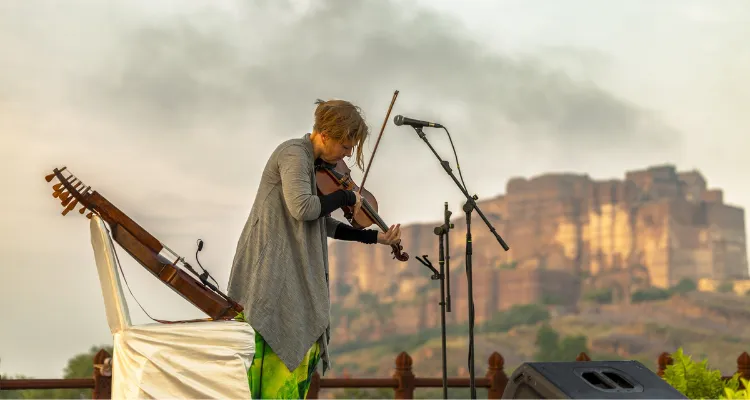
The fort also hosts the World Sacred Spirit Festival, a celebrated music festival of Sufi and spiritual music, which is held in Nagaur and Jodhpur. Its dates vary and do not always fall during the cattle fair, but if you are lucky enough to see a concert inside these walls, it is something you will remember forever. Ask your tour operator to check the festival calendar when you book.
The town below the fort deserves an hour too. Nagaur is an old trading town with busy bazaars, small mosques and temples, and the Sufi shrine of Hamiduddin Nagauri, a disciple of the great saint Khwaja Moinuddin Chishti of Ajmer. The dargah is an important place of pilgrimage, and visiting it in the calm of the late afternoon adds a gentle spiritual layer to a trip that is otherwise full of dust and noise. Dress modestly, cover your head inside the shrine, and remove your shoes at the entrance.
Inside the fort, allow at least two hours with a guide. Start with the main palace complex, walk the ramparts in the late afternoon, and finish at sunset on the walls looking over the town and the fairground in the distance. The fort is especially beautiful in winter light. Entry fees are modest, roughly Rs.50 for Indians and higher for foreign visitors, and the fort typically opens around 9 AM. If you stay at Ranvas, the fort is literally your garden, and you can walk its courtyards in the quiet hours when day visitors have gone.
Ranvas, inside Ahhichatragarh Fort, is the best place to stay, with rooms spread across ten restored 18th century havelis. Seasonal luxury tented camps also appear during the fair, but their operator and availability change each year, so confirm them early.
Nagaur fair stay options and approximate rates
|
Stay |
Type |
Rate per night |
|---|---|---|
|
Ranvas (regular season) |
Heritage havelis inside the fort |
From Rs.15,000 |
|
Ranvas (fair week) |
Heritage havelis inside the fort |
Rs.22,000 to Rs.35,000 |
|
Seasonal luxury tented camp |
Tents with private bathrooms |
Rs.12,000 to Rs.25,000 with meals |
|
RAAS Jodhpur (day-trip base) |
Boutique heritage hotel |
Rs.30,000 to Rs.55,000 |
|
Umaid Bhawan Palace, Jodhpur (day-trip base) |
Palace hotel |
Rs.70,000 and above |
Ranvas is the luxury stay in Nagaur, and for many travellers it is the main reason to come. Its name means the abode of the queens. It occupies ten restored havelis inside Ahhichatragarh Fort that were originally built in the 18th century for the queens of Maharaja Bakhat Singh. Each haveli is named after one of the Ranis, with names such as Shekhawat, Jadechi, Ranawat and Naruki. The property is run by Jodhana Heritage, the hospitality arm of the Jodhpur royal family.
Rooms are spread across these havelis, each holding two or three bedrooms around shaded courtyards with day beds and swings. Room count figures vary slightly between sources, from 27 to 34 rooms, depending on how suites and categories are counted. The rooms are elegant rather than flashy, with four-poster beds, antique furniture, handmade textiles and private courtyards in some categories. There is a swimming pool, a restaurant serving Rajasthani and continental cuisine, and candlelit dinners can be arranged on the terraces. Television is absent, and that is part of the charm. Wi-Fi is available in common areas.
Expect rates from roughly Rs.15,000 per night in a regular season, rising to around Rs.22,000 to Rs.35,000 per night for better rooms during the fair week, with meals and taxes extra. The hotel is small, and fair dates are its busiest time, so reserve three to four months ahead. Many luxury tour companies hold rooms well in advance for their guests.
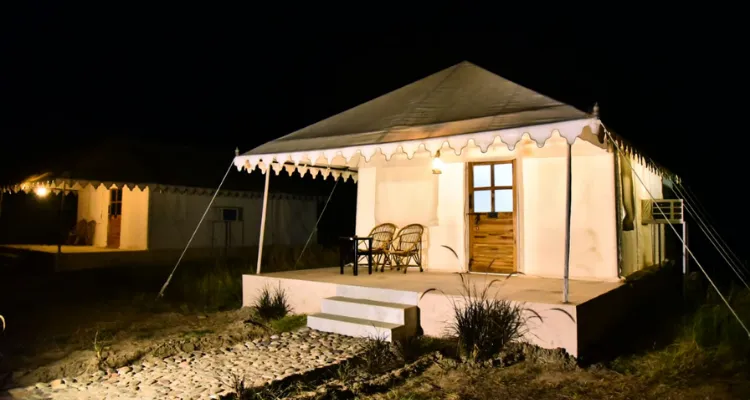
Over the years, the fort has also seen a Royal Tented Camp set up during the fair on the former polo ground inside the walls, with large luxury tents equipped with proper beds and private bathrooms. Seasonal tented camps around Nagaur are pitched for the fair period, but the operator, size and availability change from season to season. If you want the romance of sleeping under canvas with a fort wall above you, ask your tour operator to confirm the camp for your exact dates. Expect luxury tent rates in the range of Rs.12,000 to Rs.25,000 per night with meals, depending on the camp.
There is little else in Nagaur at the luxury level. If Ranvas is full, the best fallback is to stay in Jodhpur at a fine hotel such as Umaid Bhawan Palace, RAAS Jodhpur or Ajit Bhawan, and take a long day trip. Jodhpur to Nagaur is around 135 km by road, about two and a half hours by car. Bikaner is also within reach, around two to two and a half hours away. A day trip works, but you will miss the dawn light at the fairground, which is the soul of the visit.
The official programme usually includes camel races, bull and bullock races, livestock competitions, tug-of-war, rural sports and evening folk performances by Kalbelia dancers and Manganiyar musicians. Mornings are for trading and photographs, afternoons for races and evenings for music.
The fair has a rhythm that rewards early starts. At dawn, herders feed and water their animals, and the ground is at its calmest and most photogenic. By mid-morning, trading picks up and people pour in from nearby villages. Afternoons are hot and dusty, even in February, and that is when many organised competitions take place. Evenings bring fires, cooking, music and long conversations.
During the official tourism days, the programme typically includes camel races, bull and bullock races, livestock beauty contests, tug-of-war matches, rural sports such as turban-tying contests, folk music and dance performances in the evening, and sometimes a rural craft market. Camel races on the open sand are thrilling to watch. The animals are faster than you might expect, and the crowd cheers each rider. Bull contests show the power of the Nagauri breed and are judged by experts from the Animal Husbandry Department.
The cultural evenings feature Rajasthani folk performers: Kalbelia dancers with their swirling black skirts, Manganiyar musicians singing desert ballads, puppeteers, jugglers and fire dancers. These evenings are informal and lively, and you can usually find a good place to stand if you arrive early. The exact programme is published by Rajasthan Tourism a few days ahead, so your guide should check it on arrival.
The opening ceremony on the first official day is worth seeing. District officials, tourism staff and village elders gather, decorated camels and bulls parade around the arena, and folk musicians lead the way. The final evening usually brings a closing cultural programme and prize distribution for the best animals. In between, wander the lanes of the temporary market. You will find saddles, embroidered camel blankets, bells, leather whips, ropes, brass tags, colourful woollen tassels and pots of the pungent red chilli powder that Nagaur is famous for. Bargaining is normal and part of the fun, but keep it friendly. These traders have travelled a long way and work on thin margins.
Food at the fair is simple and filling. Bajra rotis, ker sangri, kadhi, freshly fried kachoris, mirchi vadas and sweet jalebis are cooked in open kitchens. If you want to taste them, ask your guide to choose a busy stall where food is cooked fresh in front of you, and eat it hot. For full meals, return to Ranvas, where the kitchen can prepare a traditional Marwari thali with the same flavours in a more comfortable setting.
Weather is comfortable but variable. February mornings in Nagaur can be close to 8 to 10 degrees Celsius, while afternoons reach the mid to high twenties. Dust is the biggest challenge. Bring a scarf or a soft mask, sunglasses, sunscreen and closed shoes. Long cotton clothes protect you from the sun and also show respect in a conservative rural setting. Women travellers should dress modestly, with shoulders and knees covered.
Shoot from first light until about 9 AM and from 4:30 PM until sunset, carry a 24-70mm and a 70-200mm lens, protect your camera from dust, and always ask before photographing people up close.
Nagaur is one of the most rewarding places in India for travel photography. The light, the faces, the animals and the colour all come together in a way that feels timeless. A little preparation makes the difference between snapshots and a real portfolio.
The golden hours are from first light until about 9 AM, and from 4:30 PM until sunset. At dawn, smoke and dust create layers of backlight. Shoot into the sun with the animals and the men silhouetted, and let the haze become your frame. In the evening, the light warms and is ideal for portraits. Midday light is harsh and flat, so use it to rest, edit, or visit the fort.
Lenses: a 24-70mm covers most scenes, and a 70-200mm is valuable for candid portraits and races without crowding your subject. A wide 16-35mm works well for the tented camp and the fort. Dust is the enemy of sensors, so avoid changing lenses in the open on windy afternoons, and carry a blower, lens cloths and a rain cover to protect your camera from dust.
Respect is the best photography tool. Ask before you photograph someone close up. A smile, a gesture to the camera, and a nod is usually enough. Many herders are happy to be photographed, and some will ask to see the image on your screen. Showing it is a lovely way to connect. Some will ask for a small tip. A modest Rs.50 to Rs.100 is reasonable if someone poses for you for a while, but never offer money in a way that embarrasses people. With women, be especially careful and always ask first, ideally through your guide.
Give animals space. Bulls and camels are calm in general, but they can kick or swing their heads suddenly. Never walk directly behind an animal. Stay out of the path of races, and listen to the volunteers and police who manage the arenas. Drones generally need official permission in India, and you should not fly one at the fair without written approval.
If you want a deeper photographic visit, a private photography guide from the region, booked through your tour operator, can take you into the camps at dawn, introduce you to families, and position you well for races. For serious photographers, two full days at the fair are ideal: one to learn the ground, and one to shoot with intention.
Fly into Jodhpur, the nearest airport, and drive about two and a half hours to Nagaur with a private chauffeur. A well-paced private route is Jodhpur, two nights at Ranvas for the fair, and then Bikaner.
Nagaur sits in central Rajasthan. The nearest major airport is Jodhpur, with daily flights from Delhi and Mumbai. Jaipur to Nagaur is about 200 km, roughly a five-hour drive, while Bikaner is about 110 km away. Jodhpur to Nagaur takes about two and a half hours. Nagaur also has a railway station, but for comfort and flexibility, a private car with chauffeur is by far the best way to travel. Roads from Jodhpur and Bikaner are good highways, and the drive passes through desert farmland, small villages and grazing herds that set the mood for the fair.
A well-paced private itinerary might begin in Jodhpur with a visit to Mehrangarh Fort, then drive to Nagaur on the morning of day two, arriving for lunch at Ranvas. Spend the afternoon in the fort and the evening on the ramparts at sunset. Day three is a full fair day, starting at dawn at the fairground, a rest at midday, the races in the afternoon and folk performances at night. Day four can be a second dawn shoot, a relaxed breakfast, and a drive to Bikaner to see Junagarh Fort and the Karni Mata Temple at Deshnok, or back to Jodhpur. From Bikaner, you can continue into the Thar desert toward Jaisalmer.
For photographers and culture lovers who want more time, a five-night version works beautifully: two nights in Jodhpur, two nights at Ranvas covering two full fair days, and a final night in Bikaner. It allows two dawn sessions at the fairground, an unhurried fort visit and a relaxed pace that suits older travellers as well. Families with children also enjoy the fair, especially the camel races and the evening folk shows, but keep young children close in crowded areas.
A luxury private journey of this kind, including Ranvas, a chauffeur-driven Innova Crysta or premium sedan, a private guide, entry fees and most meals, typically costs around Rs.25,000 to Rs.45,000 per person per night of the fair segment, depending on room category and how many people share the vehicle. Travel Plan Raj, a Jaipur-based private travel company with decades of local experience, can arrange the full route with Ranvas, a chauffeur and a photographer-friendly guide.
Thu Nov 2026
Wed Nov 2026
The fair is held every year in January or February according to the Hindu lunar calendar. For 2027, the official tourism dates are 12 to 15 February 2027. Trading begins several days before, so arrive a day or two early to see the market at its busiest.
Nagaur is more of a working livestock market and far less touristy. It is known for the Nagauri bull, Marwari horses and serious trading, and it has fewer hawkers and crowds. Pushkar is larger in fame and has a strong religious side with the Pushkar Lake and Brahma Temple.
Ranvas, inside Ahhichatragarh Fort, is the finest choice. It occupies ten restored 18th century havelis built for the queens of Maharaja Bakhat Singh. Seasonal luxury tented camps also appear during the fair, but availability changes every season, so confirm in advance.
Ranvas rooms start from around ₹15,000 per night in regular season. During the fair week, expect around ₹22,000 to ₹35,000 per night for better rooms, with meals and taxes extra. Book three to four months ahead.
Dawn until about 9 AM and late afternoon from 4:30 PM until sunset. Early mornings bring smoke, dust and soft backlight that create dramatic images. Midday light is harsh, so use it for rest or a fort visit.
Yes, it is generally safe and welcoming. Dress modestly, keep a respectful distance from animals, follow the instructions of volunteers during races, and travel with a local guide who can translate and introduce you to herders and families.
The tourism programme usually includes camel races, bull and bullock races, livestock competitions, tug-of-war, rural sports and evening folk performances by Kalbelia dancers, Manganiyar musicians and puppeteers. The Mirchi Bazaar for Nagaur red chillies is also a highlight.
Nagaur is about two and a half hours by road from Jodhpur, around 110 km from Bikaner (about two hours), and around 200 km from Jaipur (about five hours). Jodhpur is the nearest airport with daily flights.
Yes, it is possible from Jodhpur or Bikaner. However, you will miss the dawn light and the calm early-morning atmosphere at the fairground, which are the most special part of the visit. One or two nights at Ranvas is far more rewarding.
Wear long, light cotton clothing, closed shoes and a hat. Carry a scarf or soft mask for dust, sunglasses, sunscreen, a warm layer for cold mornings, cash in small notes and plenty of bottled water. Photographers should bring a blower and protective cover for their cameras.