Your Travel Partner
SINCE 1989
Your Travel Partner
SINCE 1989
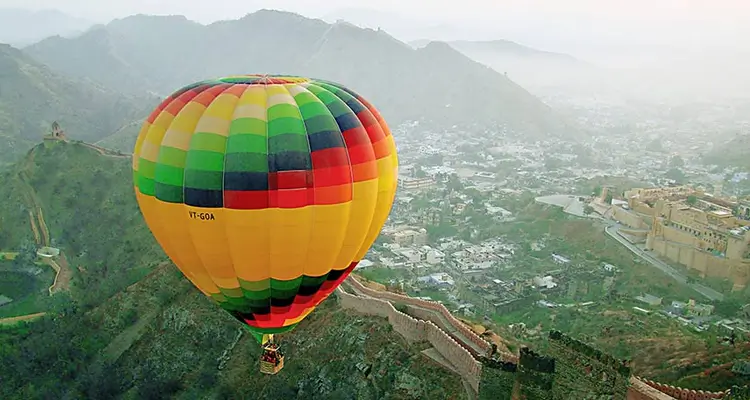
The burner roars, the basket gives a small lurch, and suddenly the ground just lets go. There is no engine noise after that, only the occasional blast of flame overhead and the sound of dogs barking in a village far below. A hot air balloon ride in Jaipur is one of the calmest hours you can spend in Rajasthan, and also one of the most surprising. From a few hundred metres up, the Aravalli hills fold away in brown and green ridges, the walls of Amber Fort trace the hilltops, and mustard fields glow yellow in winter. Further west, a Pushkar hot air balloon flight drifts over sand dunes, temple spires and the small holy lake, and in November over thousands of camels gathered for the annual fair. This guide covers who actually flies in Rajasthan, where the balloons launch, when the season runs, what a private basket costs compared with a shared seat, and what happens when the wind decides otherwise. It is written for travellers who want the flight to fit neatly into a well-run itinerary rather than become a stressful early-morning gamble.
Commercial ballooning in India is a small world, and in Rajasthan it is dominated by one name. Sky Waltz has operated passenger balloon flights in India for well over a decade and describes itself as the country's first fully licensed commercial balloon operator, working under the approval of the Directorate General of Civil Aviation. Its Rajasthan bases are Jaipur and Pushkar, with seasonal flights near Ranthambore and special flights around the Pushkar and Nagaur cattle fairs. Most of the balloon rides sold by hotels, travel websites and tour operators in Jaipur are flown by Sky Waltz, even when the booking page carries another company's name. That is worth knowing, because it means the price differences you see online are usually differences in commission and inclusions, not in the balloon, the pilot or the flight itself.
The pilots are a mix of Indian and international commercial balloon pilots, many from the UK, Europe and Australia, who spend the winter season flying in India. The baskets and envelopes are imported from established European manufacturers such as Cameron and Ultramagic. A standard passenger basket is divided into compartments, with the pilot standing in the centre beside the burners and passengers in sections around the edge. Smaller balloons are used for private flights.
In Jaipur, there is no single fixed launch field. The pilots choose the site each morning after checking wind speed and direction, because a balloon can only travel where the wind carries it. The usual launch areas sit on the northern and north-eastern side of the city, in the open farmland and low valleys around Amber, Kukas and towards Samode, along the Delhi highway side of Jaipur. On a good morning the balloon lifts off from a field near the Aravalli foothills and drifts past the ramparts of Amber Fort and the long walls of Jaigarh, over villages, small lakes and farms. On another morning the wind may push the flight in a different direction altogether, and you might see more fields and villages than forts. Good pilots will tell you this honestly at the briefing.
Pushkar is a different landscape. The town sits in a bowl of hills about two and a half hours from Jaipur by road, with sand dunes spreading out on its western edge. Balloon flights over Pushkar usually launch from open ground on the edge of town near the dunes, and on a calm morning they float over the desert, the temple rooftops and sometimes the lake itself. During the camel fair in November, the fairground and the camel camps on the dunes become the main attraction from the air. Outside the fair period, flights from Pushkar run on a more limited schedule and are best confirmed directly before you build them into a trip.
Landing is part of the charm. The balloon comes down in whatever open field suits the wind, and the chase crew follows by road to meet it. Children from the nearest village almost always come running across the fields, and the farmer whose land you have landed on often stands nearby, curious and amused. The crew pack the envelope away, and a vehicle takes you back to your hotel.
The balloon season in Jaipur generally runs from September or October until March, with some operators continuing into April and occasionally beyond when the weather allows. The heart of the season is November to February. Mornings are cool and still, visibility is usually good, and the farmland is green or bright with mustard flowers. From May to August, heat and monsoon storms make flying uncomfortable or unsafe, and regular flights are usually suspended.
Almost every flight is a sunrise balloon flight, and the reason is physics rather than romance. Balloons need calm, stable air. The hours just after dawn, before the sun heats the ground and the breeze picks up, give the steadiest conditions of the day. In winter, some operators also run late-afternoon flights on calm days, usually starting around 4 in the afternoon. These are less common and more likely to be called off, because afternoon winds are harder to predict.
The morning starts very early. Hotel pickup in Jaipur is usually somewhere between 5 and 6 in the morning, depending on the month and the launch site chosen that day. Hotels in the walled city or close to the Amber road are the quickest to collect from. After a drive to the launch field, you are given tea, coffee or juice and a safety briefing while the crew lays out the envelope and fills it with cold air from a large fan. Then the burners heat the air, the balloon rises to standing, and passengers climb in. This part is worth watching closely. Seeing a flat pile of fabric turn into a tall, glowing balloon in a few minutes is half the fun.
The flight itself is usually around 45 minutes to an hour in the air. Flight time depends on the wind and on finding a safe landing field, so the pilot may land a little earlier or later than expected. The balloon typically cruises at a few hundred metres, and sometimes drops low enough to skim a treetop or float just above a village rooftop. The total experience, from hotel pickup to drop-off, normally takes three to four hours. Most guests are back at the hotel for a late breakfast by about 9 or 10 in the morning.
The time of year changes the experience more than people expect. In October and early November, the land is still green after the monsoon and the mornings are mild. December and January bring cold starts, often around 6 to 9 degrees Celsius, and occasionally mist or haze that softens the view. Warm layers matter, because the air at launch is cold, even if the burners throw out heat overhead. February and March bring clearer skies, golden wheat and mustard fields, and slightly warmer mornings.
For Pushkar, the busiest period is the Pushkar Camel Fair, held around the full moon of the Hindu month of Kartik, usually in November. Flights during the fair sell out first and are often priced higher than the rest of the season. Outside the fair, the Pushkar season broadly follows the Jaipur pattern, but scheduled flights are less frequent, so confirm well in advance.
A practical tip: put the balloon flight on the second or third morning of your Jaipur stay, not the last one. If the flight is cancelled because of weather, there is still a morning left to try again.
The single biggest choice is whether to share a basket or book a private balloon flight. Both use the same pilots and safety standards. The difference lies in space, privacy and what surrounds the flight.
A shared balloon flight puts you in a larger basket with other passengers. Depending on the balloon, there may be four to eight people in total, and the largest baskets take more. The basket is divided into compartments, so you stand in your own section with two to four others, usually strangers. It is perfectly comfortable, the views are the same, and the pilot talks to everyone. The downsides are smaller. Photographs tend to include other people's elbows and phones, and the morning runs on a fixed group schedule. For solo travellers, friends and families on a budget, a shared seat is a sensible way to fly.
A private basket booking means a smaller balloon reserved only for your party, usually two to four people, sometimes up to six or eight in a larger charter. It gives you the whole edge of the basket to lean on and photograph from, and a pilot who speaks only to you. The mood is quieter and more personal. It suits honeymooners, couples celebrating an anniversary, and families who want their children close beside them. Private flights often come with extra touches, such as dedicated transfers in a private vehicle, sparkling wine or a small celebration after landing, and a little more flexibility with pickup time.
The private option is also where proposals and anniversary surprises fit best. A ring in a basket with eight strangers is awkward. A ring in a basket with only your partner and a pilot who has seen it all before is much easier. If you have something like that in mind, tell the operator in advance so the pilot and crew can help with timing and photographs, and maybe set up a small table with flowers at the landing field.
What does not change with a private basket is the weather. A private booking does not give you priority to fly on a windy morning. Every balloon follows the same safety call, and private flights are cancelled or postponed just like shared ones.
There is one more practical difference. Shared flights depend on minimum passenger numbers. On a slow morning in early or late season, a shared flight may be combined or moved to another day. A private charter is confirmed for your group alone, so it is more reliable to fix on a specific date. For a trip with tight timing, that alone can justify the extra cost.
Children are generally accepted from about five years of age, and children under twelve must be accompanied by an adult. Passengers need to stand for an hour, climb in and out of a waist-high basket, and adopt a bent-knee landing position. Balloon flights are not suitable for pregnant travellers, people recovering from recent surgery or serious back or knee injuries, or wheelchair users. If you have any doubt, mention it at the time of booking rather than at the launch field.
Published prices for a hot air balloon ride in Jaipur vary a lot across websites, and older articles quote figures that have long since risen. The ranges below reflect current listings and what travellers typically pay in peak season, on the higher, realistic side.
A shared seat for an adult in Jaipur usually costs Rs.12,000 to Rs.16,000 per person, roughly 135 to 180 US dollars. Children aged about five to twelve are usually charged Rs.7,500 to Rs.9,000. This normally includes hotel pickup and drop-off within central Jaipur, tea or coffee with light snacks at the launch field, about an hour in the air and a flight certificate. Hotels outside the city limits may be charged extra for transfers. Lower prices seen online are often off-season offers or listings that leave out transfers or taxes.
A private basket for two typically costs Rs.65,000 to Rs.90,000, about 740 to 1,020 US dollars, with private transfers and a celebratory drink after landing. Larger private charters for families or small groups of four to eight usually run from roughly Rs.110,000 to Rs.160,000, depending on balloon size, date and inclusions. Some international travel agencies quote in foreign currency, and their prices can be noticeably higher once their margin is added.
Pushkar balloon prices are usually a little higher than Jaipur. Shared seats commonly fall around Rs.15,000 to Rs.20,000 per adult, and fair week can be higher still. Private flights over Pushkar during the camel fair should be booked well ahead and priced individually, because demand is far greater than the number of balloons available.
Here is a typical breakdown for a couple booking a private flight from a luxury hotel in Jaipur:
A shared flight for two people works out around Rs.25,000 to Rs.32,000 in total, roughly 280 to 365 US dollars.
Check exactly what is included before paying. The main points are hotel transfers (and whether your hotel is inside the pickup zone), applicable GST, refreshments, the flight certificate, and the cancellation terms. If you are booking as part of a private Rajasthan tour, your tour operator can reserve the flight directly, coordinate the pickup with your driver and hotel, and rebook quickly if the weather intervenes. That is often the simplest way to avoid paying for a seat you cannot use.
Book at least three to four weeks ahead for peak months, and earlier for Christmas, New Year and the Pushkar fair. The number of balloons is limited, and a full morning in Jaipur may carry only a few dozen passengers in total.
Every balloon flight is provisional until the morning itself. The pilot makes the final decision based on surface wind, the forecast for the flight period, visibility and the chance of fog. Balloons need light winds, generally well under about 12 to 15 kilometres per hour on the ground. A breezy morning that feels perfectly pleasant on a hotel terrace can still be too much for a safe launch and landing. The call is usually made late the previous evening or very early in the morning, sometimes after you have already reached the launch field. It can feel disappointing, but it is the right decision every time.
What happens to your money depends on who you booked with. Operators flying directly generally offer either a full refund or another date when they cancel for weather. Some third-party booking websites follow stricter rules. They may offer only a different slot and no cash refund, or apply heavy charges if you cancel yourself within a week of the flight. Read the cancellation policy before paying, especially on reseller platforms, and keep at least one spare morning in your Jaipur stay. Booking through someone who can rebook you directly with the operator saves a lot of trouble.
Mist and fog are the main seasonal risks. Late December and January can bring hazy or foggy mornings around Jaipur, which reduce visibility and sometimes stop flights completely. October, November, February and March are generally the most reliable months.
On balloon safety in India, the picture is reassuring. Passenger flights are regulated by the DGCA. Pilots hold commercial balloon licences, many from Europe, the UK and Australia, with long experience. The equipment comes from established European manufacturers and is inspected and maintained to a schedule. Balloons carry dual burner systems and fuel reserves. A briefing before every flight covers how to stand, where to hold, and how to brace for landing.
Your part of the safety picture is simple. Listen carefully to the landing briefing, because landings can be bumpy, and the basket occasionally tips onto its side and slides a short way in a breeze. Bend your knees, hold the inside handles, and keep your back against the padded wall of the basket. Keep cameras and phones on a wrist strap, because anything dropped from a balloon is gone for good. Do not lean over the edge to take photographs.
Dress for a cold start. Wear warm layers you can remove, a hat for the heat of the burners overhead, and closed, flat shoes with a good grip, because you will step into fields that may be ploughed, dusty or damp with dew. Leave sandals and heels at the hotel. Sunglasses help once the sun is up. A small bag is fine, but large bags take up space in the basket and are best left in the vehicle.
There are also local considerations. Drones are not allowed near the launch site or during the flight. Flying over private farmland means landing in someone's field, and good operators handle this with care, sometimes leaving a small gift for the farmer. Quietly greeting the villagers who gather around the landing is part of the morning. Many travellers find that this short, unexpected meeting in a mustard field stays in their memory as much as the view from the sky.
Where the balloon flight sits in your trip affects how much you enjoy it. A sunrise flight means a pickup before 6 in the morning, so it is best not to schedule it after a late arrival from Delhi or Agra. Most travellers find the best rhythm is to arrive in Jaipur, settle in with a gentle afternoon visit to the old city, sleep early, and fly on the second or third morning.
In Jaipur, the flight pairs well with a slower day that follows. After you return to the hotel around 9 or 10, have a proper breakfast and rest. Then spend the afternoon at the City Palace, Jantar Mantar or the Albert Hall Museum. Avoid scheduling the Amber Fort visit on the same morning as the flight. The fort is best seen early, and you will have just floated past it in the balloon, so it makes sense to visit it on a different day and compare the view from the ground. If the flight is cancelled, your driver can take you straight to Amber Fort, which opens early and is a pleasant fallback for a morning that has already started.
The location of your hotel matters for pickup. The launch areas lie north of the city towards Amber and Kukas. Hotels on the Amber road or in the old city are the closest, such as the Raj Palace and Samode Haveli, while Alila Fort Bishangarh sits out in the countryside to the north and is close to some launch fields. Central properties such as Rambagh Palace are a slightly longer but still easy drive. Properties on the Tonk road or near the airport mean a longer drive in the dark. Confirm the pickup time with the operator the evening before, and leave a note at reception so breakfast can be packed or held for later.
For Pushkar, the flight usually works as part of an overnight stay. Pushkar is about two and a half hours from Jaipur, so an early flight is only practical if you stay in town the night before. Comfortable options include The Westin Pushkar Resort and Spa, Ananta Spa and Resort and the smaller, quieter heritage-style properties around the edge of town. During the camel fair, many travellers stay in luxury tented camps set up near the fairground, which makes a dawn flight over the camel camps easy to reach. These camps and the fair itself book out months ahead, so the balloon, the stay and transport are best reserved together.
A typical luxury route looks like this. Spend two or three nights in Jaipur with the balloon flight on the second morning. Then take a private car to Pushkar, stay one or two nights, and continue to Udaipur or Jodhpur. During fair week, consider flying in Pushkar rather than Jaipur, because the view of the fairground from above is unlike anything else in Rajasthan.
Finally, think about how much you want to do around it. Balloon mornings are early and the experience is intense in a quiet way, so many travellers enjoy keeping the rest of the day light. A slow lunch, an afternoon nap and an evening dinner on a rooftop terrace overlooking the city is a fine way to round off the day you flew over Rajasthan.
No. The main season runs from roughly September or October to March, sometimes into April. Regular flights are usually suspended in the hot summer and monsoon months from May to August.
A shared seat usually costs ₹12,000 to ₹16,000 per adult, roughly 135 to 180 US dollars, including transfers and refreshments. A private basket for two typically costs ₹65,000 to ₹90,000.
Sky Waltz is the main licensed commercial balloon operator in Rajasthan, flying in Jaipur, Pushkar and on request around the cattle fairs. Many hotels and booking websites resell its flights under their own names.
There is no fixed launch site. Pilots pick a field each morning based on the wind, usually in the farmland north of the city around Amber, Kukas and towards Samode, so the route can pass near Amber Fort.
The flight itself usually lasts around 45 minutes to an hour. With hotel pickup, inflation, landing and the return drive, the whole experience takes about three to four hours.
The pilot cancels if the wind is too strong or fog limits visibility. Operators usually offer a full refund or another date, but some reseller platforms only offer a new slot, so check the terms before you pay.
For couples, honeymooners, proposals and families with young children, usually yes. You get a smaller balloon, the whole basket edge to photograph from and private transfers, though the weather decision is the same for everyone.
Commercial balloon flights are regulated by the DGCA and flown by licensed, experienced pilots using European-built equipment. Following the landing briefing and wearing sensible shoes covers most of the passenger's role.
Children are usually accepted from about five years old and must be accompanied by an adult if under twelve. Flights are not suitable for pregnant travellers or those with recent surgery or serious back or knee problems.
Yes, flights are offered over the fairground and dunes during fair week, usually in November. They sell out early and often cost more than the regular season, so book together with your stay well in advance.