Your Travel Partner
SINCE 1989
Your Travel Partner
SINCE 1989
Most visitors to the City Palace in Jaipur stop at a beautiful doorway and go no further. They stand in the courtyard with the four painted gates, photograph the peacock door, look up at the cream and pink tower of the Chandra Mahal, and then turn back towards the museums. Above them, behind closed doors, are the rooms where the royal family of Jaipur still lives and entertains. A small number of those rooms open to visitors on the City Palace royal apartments tour, sold at the palace as the Royal Tour and once offered in tiers with names such as Royal Grandeur and Royal Splendour. It is one of the few chances in India to walk through a palace that is still a family home, with a personal guide leading the way through mirrored halls, a blue and white monsoon room and a rooftop terrace overlooking the old city. This guide covers what the Chandra Mahal tour actually includes, how it differs from the standard ticket, what it costs, when to go and the slightly old-fashioned way you have to book it.
The City Palace Jaipur sits at the heart of the walled city that Maharaja Sawai Jai Singh II laid out in the early 18th century. It is not a single building but a large complex of courtyards, gateways, gardens and halls built over more than two centuries, each ruler adding his own wing. Today most of the public area is run as the Maharaja Sawai Man Singh II Museum by a trust set up by the royal family. That is why it works differently from government monuments such as Amber Fort or Hawa Mahal, and why it has its own tickets, its own rules and its own booking system.
The tallest building in the complex is the Chandra Mahal, a seven-storey tower that rises at the western end of the palace. It is still the private residence of the Jaipur royal family. The present head of the family lives here, and you can tell when he is in residence by the flag flying from the rooftop pavilion. When the royal standard flies alongside the state flag, he is at home. Floors used privately by the family are never shown to visitors. Several of the historic state rooms on the floors above, however, are opened on the guided Royal Tour.
Each floor of the Chandra Mahal has its own name and character. The ground floor holds Sabha Niwas, a formal hall for receptions. Above it are Sukh Niwas, a drawing room and dining hall that remains private, and Rang Mandir, a room decorated with mirror work. Higher still are Shobha Niwas, a jewel box of a room with gold leaf and mirrors, and Chhavi Niwas, painted in blue and white and used in the hot months and the monsoon. Then come Sri Niwas, another richly mirrored room, and finally Mukut Mandir, the crown-shaped pavilion on the roof that carries the flags.
To reach the Chandra Mahal, you pass through Pritam Niwas Chowk, the inner courtyard famous for its four painted gates. Each gate represents a season and is linked to a Hindu deity. The best known is the Peacock Gate, with three-dimensional birds in brilliant blue and green. A standard ticket takes you into this courtyard and no further, so many visitors photograph the gates and the tower and never realise that there is a whole palace above them that they can see with the right ticket.
That difference is the whole point of the private tour. The museum galleries in the public part of the complex are excellent, with royal costumes, arms and armour, paintings and the huge silver urns used to carry Ganges water to England. The Chandra Mahal, though, is where the palace feels lived in rather than displayed. The rooms are smaller, quieter and more personal, with family portraits, furniture still in use, and views from windows that only a handful of people look through on any given day. For anyone with a real interest in Indian royal life, architecture or decorative arts, it turns a good museum visit into something far more memorable.
It is worth remembering that a family home has its own calendar. On days when the family is hosting guests, attending a festival or holding a private occasion, the Royal Tour can be limited, delayed or unavailable. The palace does not always announce this far ahead, which is one reason to keep some flexibility in the Jaipur part of your itinerary.
The Royal Tour of the Chandra Mahal is a guided visit, typically around 45 minutes to an hour inside the private wing, led by a palace-appointed guide who stays with your group throughout. The official ticket describes it as covering the courtyards and galleries of the museum, plus Pritam Niwas, Shobha Niwas, Chhavi Niwas and Sri Niwas, with a personal guide and refreshments. Rooms on the tour can change slightly with the family's use of the palace, so treat the list as a guide rather than a guarantee.
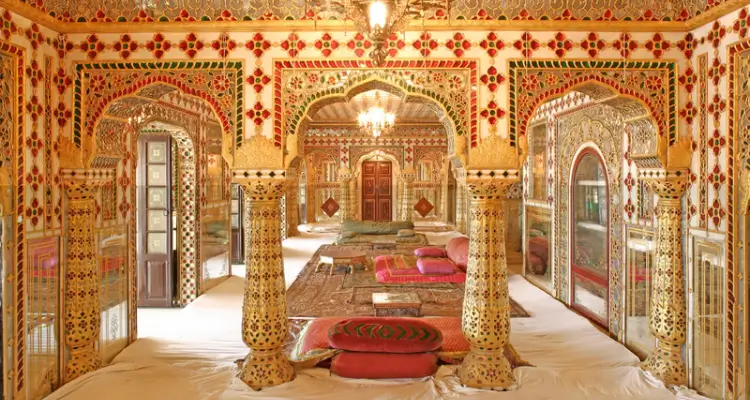
The visit usually begins at the base of the Chandra Mahal, after a short wait in a reception area where the guide meets you. From here a staircase and a small lift lead up through the tower. The first major room is often Shobha Niwas, and it tends to stop people in their tracks. The walls glitter with mirror work, gold leaf and mica, set in floral and geometric patterns that catch every change of light. Shobha Niwas was used for private entertaining, and it shows. Its proportions are intimate, almost like a jewellery box blown up to the size of a room.
Chhavi Niwas is a complete contrast. Painted in cool blue and white, with delicate floral motifs and simple lines, it was designed as a retreat for the hottest months and the monsoon. Standing inside on a warm afternoon, you can feel why. It is often the room people photograph most, because its blue colour scheme is unlike anything else in the palace and comes out beautifully on camera.
Sri Niwas brings back the glitter. It is another heavily mirrored hall, sometimes described as the palace's own mirror palace, with thousands of small pieces of glass set into the walls and ceiling. When the guide closes the curtains and lights a single candle or turns on a soft lamp, the whole room sparkles like a night sky. The guides usually share stories about the rulers who used these rooms, the family's link to Jaipur's polo and cricket history, and the palace's role as a royal residence today.
The tour normally ends on or near the rooftop terraces of the Chandra Mahal, with views that are rare anywhere in the old city. Below are the courtyards of the palace, the instruments of Jantar Mantar and the domes and towers of the walled city. Beyond them are the Aravalli hills, with Nahargarh Fort on the ridge to the north-west and Jaigarh further along. On a clear afternoon the light turns the pink city walls into soft gold, and many visitors say this is the best view in Jaipur.
The tour also covers the front of the palace experience in more detail than a standard visit. Your guide can explain the meaning of the four gates in Pritam Niwas Chowk and the symbolism of the seasons and deities. They can also point out the details in the Sabha Niwas reception hall, with its portraits of past rulers and formal seating. Refreshments are usually served at a set point during or after the tour, often in a reception room or shaded terrace. Typically it is tea, coffee or a cold drink.
Photography rules vary by room and can change. Photography is generally allowed in the open courtyards and on the rooftop. Some interiors, including formal halls and a few galleries, restrict or ban photographs. Your guide will tell you room by room. Flash and tripods are not welcome, and video recording may be stopped altogether. It is best to ask before lifting a camera, and to accept the answer gracefully. This is someone's home.
There are several City Palace tickets, and the price differences between them are larger than many visitors expect. The palace website lists prices separately for Indian and international visitors, and third-party listings often quote outdated figures, so the ranges below are given cautiously. Always confirm at the ticket counter on the day.
The basic City Palace Museum ticket covers the public courtyards and museum galleries, including Mubarak Mahal, the armoury and the painting and photography galleries, as well as Pritam Niwas Chowk with its painted gates. The palace lists this at Rs.400 for an Indian adult. International visitors pay noticeably more, with recent visitor reports putting the City Palace Jaipur ticket for foreigners at around Rs.1,000 to Rs.1,200, roughly 11 to 14 US dollars. Concession tickets are available for students, children under twelve and senior citizens, and international visitors should bring a passport or student card if they want to claim one.
The palace also sells a composite ticket that adds Jaigarh Fort and the royal cenotaphs at Gaitore to the museum. It is listed at Rs.500 for an Indian adult, with international visitors reported to pay around Rs.1,700. This is a separate ticket from the Rajasthan government's composite ticket, which covers sites such as Amber Fort, Hawa Mahal, Jantar Mantar, Nahargarh and the Albert Hall Museum. The government composite ticket does not include the City Palace, because the City Palace is run by the royal family's trust. Many travellers buy the wrong one and end up paying twice.
The Royal Tour of the Chandra Mahal is listed on the official palace website at Rs.4,000 per adult, with a youth concession of Rs.2,000 for students and children under twelve. It includes the courtyards and galleries as well as the private apartments, so you do not need a separate museum ticket. Some international visitors have reported a higher foreign-visitor rate for this tour, around Rs.5,000. Budget for that, and be pleasantly surprised if the counter charges less. At about Rs.88 to the US dollar, the Royal Tour works out at roughly 45 to 57 US dollars per adult.
For a couple on a private tour of Jaipur, a realistic budget for the day at the palace looks something like this:
That brings the total to roughly Rs.15,000 to Rs.23,000, around 170 to 260 US dollars, excluding the car and driver.
A few things affect what you actually pay. Ticket prices at Indian monuments are revised from time to time, and the City Palace has raised its prices several times in recent seasons. Tour companies and booking sites that sell a "private Chandra Mahal tour" often bundle the ticket with a guide, a car, hotel transfers and occasionally a bottle of champagne. These packages are commonly priced from about 250 to 300 US dollars per person. That can be convenient, but it is worth knowing that the palace's own ticket is a fraction of that. A good private tour operator will build the ticket into your day at the real price and arrange the guide and car around it.
The palace also offers golf carts within the complex for those who find the walking difficult, and a separate small ticket for the Jaipur Centre for Art. The Museum at Night ticket, which once allowed evening visits to the courtyards with a light and sound show, has been listed as temporarily closed. Check before you build an evening around it.
This is where the City Palace surprises many travellers. In an age of online booking for almost everything, Royal Tour tickets are sold only at the palace ticket counter. The official palace website states this clearly. There is no official online booking page for the private apartments tour, and websites claiming to sell "skip the line" Royal Tour tickets are generally reselling a guided package that still involves buying the ticket at the counter on the day.
In practice, booking the Chandra Mahal tour works in a few simple ways. The first and most common is to buy the ticket on arrival. Go to the ticket window at either entrance and ask for the Royal Tour. The counter will tell you the next available time, collect payment and hand you a ticket with a slot. The tour runs in small batches, and the guide may wait for a few visitors to gather before starting, so allow some flexibility. On busy days, particularly weekends, Indian holidays and the Christmas and New Year period, slots can fill up and you may have to wait an hour or more for the next tour.
The second option is to call ahead. The palace has a main reception line, and it is sensible to phone in the morning to check whether the Royal Tour is running that day and whether there are any family events or closures. Your hotel concierge can do this for you. Luxury hotels such as Rambagh Palace, which is also linked to the Jaipur royal family's history, often have good contacts with the palace and can advise on the best time.
The third option is to arrange it through a private tour operator. In that case the operator's guide or driver handles the ticket purchase at the counter, often before you arrive, and coordinates the timing with the rest of your day. This is the easiest way for most international travellers, because it removes the uncertainty of waiting and lets the palace visit fit around Amber Fort, lunch and the rest of the city. Ask your operator to confirm the Royal Tour specifically, not just a standard City Palace visit, because the two are very different.
There are two entrances. Gate 1 is near the Jantar Mantar ticket counter on the Jantar Mantar side, and Gate 2 is at Jaleb Chowk, the large forecourt on the Tripolia side. Both have ticket counters. Cars usually drop visitors near Jaleb Chowk, and your driver will know where to wait.
Carry your passport or a clear photocopy, because international visitors may be asked for identification to confirm the ticket category. Card payments are usually accepted, but keep some cash as a backup in case the machines are down. If you want a guide for the wider museum galleries before or after the Royal Tour, you can hire one through the ticketing desk for an additional fee. Alternatively, bring your own licensed guide, who can wait while the palace guide takes you through the Chandra Mahal.
The City Palace Jaipur timings listed on the official website are 9:30 in the morning to 6:30 in the evening, every day of the week, with the last tickets sold at about 6 in the evening. The Royal Tour runs within the same hours. The palace is closed on Dhulandi, the second day of the Holi festival, which usually falls in March. The royal family may also close parts of the complex for private functions, state occasions and festivals, and the Chandra Mahal tour can be suspended at short notice. Some galleries close from time to time for restoration. The textile gallery in Mubarak Mahal, for example, was recently closed for conservation work.
The best time to take the royal apartments tour depends on what you want from it. In the morning, between about 9:30 and 11, the palace is quieter, the light in the courtyards is soft, and you are more likely to get a tour slot without waiting. The late afternoon, from about 3:30 to 5:30, brings warmer light on the rooftop and the walled city below, and is especially beautiful from November to February. Avoid the middle of the day if you can. Coach groups arrive between roughly 11 and 2, and the courtyards become crowded and hot, especially from April onwards.
The most comfortable months for a palace visit are October to March. Days in Jaipur are mild and sunny then, usually 20 to 28 degrees Celsius, with cool evenings. From April to June, temperatures often cross 40 degrees, and the climb through the Chandra Mahal can be tiring. The monsoon months of July to September bring humid days with sudden showers. The courtyards and gardens look fresh and green, but the rooftop can be slippery after rain.
Allow enough time. A good visit to the City Palace with the Royal Tour takes two and a half to three and a half hours. That includes the museum galleries, the courtyards, the waiting time for a tour slot and the private apartments themselves. Many travellers combine it with Jantar Mantar next door, which takes about an hour with a guide, and Hawa Mahal, a short walk away. Together they make a comfortable half day in the old city. Amber Fort is best seen early on another morning, rather than squeezed into the same day.
Dress comfortably and modestly. There is a fair amount of walking on stone floors, and there are stairs within the Chandra Mahal, though a small lift serves some floors. Shoulders and knees covered is respectful in a family home and photographs well in the rooms. Comfortable flat shoes help. Large bags may have to be left at the cloakroom, so a small day bag is best.
For lunch, the palace has its own restaurant, Baradari, set in a courtyard within the complex. It makes a pleasant break between the museum and the Royal Tour. Nearby, the old city has some well-known places for a quieter lunch, and heritage hotels such as Samode Haveli and the Raj Palace serve elegant meals in historic surroundings. Back at your hotel, an evening at Rambagh Palace's terrace bar is a fitting way to finish a day spent in the world of Jaipur's royal family.
Finally, keep the visit in the right spirit. The guides are welcoming, the rooms are beautiful, and the family's willingness to share part of their home is generous. Asking questions, following the photography rules and treating the rooms as private spaces rather than a stage set will make the tour far more rewarding for you, and keep it open for travellers who come after you.
It is a guided Royal Tour of the Chandra Mahal, the seven-storey wing of the City Palace where the royal family still lives. It opens rooms that standard ticket holders cannot enter, such as Shobha Niwas, Chhavi Niwas and Sri Niwas, along with the rooftop terraces.
The official palace website lists the Royal Tour at ₹4,000 per adult and ₹2,000 for students and children under twelve. International visitors have reported a higher rate of around ₹5,000, so confirm at the counter on the day.
No. The palace states that Royal Tour tickets are sold only at the ticket counter. A private tour operator or your hotel can arrange the purchase and check availability on your behalf.
The palace has offered its private apartment visits under different names over the years, including Royal Grandeur and Royal Splendour. The current version is sold as the Chandra Mahal Royal Tour, and it covers the main state rooms open to visitors.
It covers the public courtyards and museum galleries, including Mubarak Mahal, the armoury and Pritam Niwas Chowk with its four painted gates. It does not include entry to the upper floors of the Chandra Mahal.
The palace is open daily from 9:30 in the morning to 6:30 in the evening, with the last tickets sold at about 6. It is closed on Dhulandi, the second day of Holi.
No. The government composite ticket covers sites such as Amber Fort, Hawa Mahal and Jantar Mantar. The City Palace is run by the royal family's trust and sells its own tickets, including a separate palace composite ticket.
The guided part inside the Chandra Mahal usually takes around 45 minutes to an hour. With the museum galleries and waiting time, allow two and a half to three and a half hours at the palace.
Photography is generally allowed in the courtyards and on the rooftop, but some interiors restrict it. The palace guide will tell you room by room, and flash and tripods are not permitted.
Early morning, soon after the 9:30 opening, is quietest and the easiest time to get a slot. Late afternoon from November to February gives the most beautiful light over the walled city from the rooftop.