Your Travel Partner
SINCE 1989
Your Travel Partner
SINCE 1989
The first sound most guests remember from Ranthambore is not a tiger's roar but the alarm call of a spotted deer, sharp and urgent, cutting through the dry forest just after dawn. A good safari lodge is what turns that moment into a whole trip: a warm tent to come back to, a naturalist who knows which valley the tigress used last week, and a bath and a quiet lunch before the afternoon drive. Three lodges sit at the top of the market here: Aman-i-Khas, Suján Sher Bagh and The Oberoi Vanyavilas. All three are superb, but they are not interchangeable. Two of them close completely during the hot months and the monsoon, one stays open all year, and they differ sharply in how meals, drinks and Ranthambore safaris are included in the price. This comparison sets out the seasons, accommodation styles, all-inclusive packages, realistic nightly rates, distances to the park and notes on the Ranthambore safari zones, so you can book the lodge that fits your dates, budget and idea of a perfect wildlife stay.
The single most important fact about these three lodges is when they operate, because it rules some of them out before price or style even come into it. Ranthambore National Park itself follows a fixed rhythm. The core tourism zones open on 1 October after the monsoon and run until the end of June. From July to September, the core zones close for the rains, when the forest regenerates and the animals breed. Some buffer areas on the edges of the reserve may still operate limited drives in that period, but the experience is very different and not what most visitors come for.
Aman-i-Khas is the most clearly seasonal of the three. The camp is closed from 1 June to 30 September every year and reopens on 1 October, in step with the core zones. That means it is closed for the whole of June, even though the park is still open, because daytime temperatures in Ranthambore commonly pass 45 degrees Celsius and staying in tents becomes very uncomfortable. If your heart is set on Aman-i-Khas, your window is October to the end of May.
Suján Sher Bagh is also a seasonal camp, open from early October until around mid-May. The exact closing date can shift a little depending on the heat in a given year, so if you are hoping for a stay in the first half of May, confirm the dates before booking flights. In the hot weeks before closing, Sher Bagh usually offers lower summer rates, which can be good value for keen wildlife watchers who do not mind the heat.
The Oberoi Vanyavilas is the only one of the three that stays open all year. That makes it the obvious choice for anyone travelling in June, when the park is still open and tiger sightings are often at their best, or for travellers who want a luxury stay near the park during the monsoon. In July, August and September, the core zones are closed, so a stay at Vanyavilas in those months is more about the green landscape, the fort, a visit to the Chambal River and the comfort of the resort than about tigers.
Season also changes the safari itself. From October to December, the forest is green and thick after the rains, which is beautiful but means animals can be harder to see. In January and February, mornings are cold, often around 5 to 8 degrees Celsius in an open vehicle, and the light is soft and golden. March to June is the classic tiger sighting season: the grass dies back, water holes shrink and tigers spend more time near the lakes and streams, where they are easier to find. The trade-off is the heat. By May, afternoons are punishing, and the lodges that stay open put real effort into cool rooms, iced towels and shaded lunches.
In short, if you are travelling between October and mid-May, all three lodges are available. From mid-May to the end of May, only Aman-i-Khas and Vanyavilas are open. From June to September, Vanyavilas is your only choice of the three.
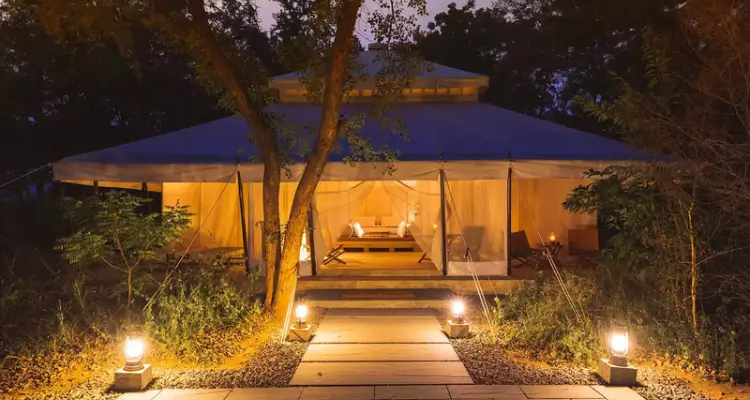
All three properties are built around the idea of luxury canvas, and none of them offers ordinary hotel rooms. The tents, however, are very different in scale and style. Aman-i-Khas is the most intimate, with only around ten main guest tents in a walled compound on the edge of the forest. Each Tented Pavilion covers about 108 square metres and is inspired by the travelling camps of the Mughal emperors, with a soaring canopy around six metres high, separate living, sleeping and dressing areas, and a large bathroom with a free-standing tub. A small number of Tented Pool Pavilions and Grand Tented Pool Pavilions, up to around 256 square metres, add private pools. Every tent has a butler, and the camp has a stepwell-style swimming pool, an outdoor gym, and an organic garden that supplies much of the kitchen. The mood is minimalist, peaceful and almost monastic in the best sense.
Suján Sher Bagh has around a dozen tents and is the most traditionally styled. It recreates the feel of an old colonial hunting camp, with brass bathtubs, stone showers, campaign-style wooden furniture, old photographs and handwoven textiles. The standard Tented Jungle Suites are spacious and very comfortable, with private verandas facing the garden. Above them sit the Royal Sher Suite, set slightly apart with a heated plunge pool and an outdoor fireplace, the family Machhli Suite, and the two-bedroom Imperial Raj Bagh Suite with its own swimming pool and large deck. The camp has an infinity pool, a jungle spa, a bar on the upper floor of the main building and evening campfires. Sher Bagh is family-owned and run with a warmth that many guests find more personal than a large hotel group.
The Oberoi Vanyavilas is the largest and most hotel-like of the three, with about 25 tents spread across some 20 acres of landscaped gardens, orchards and water channels. It is sometimes thought of as a villa resort because of its grand central building, built in the style of a royal hunting lodge, but the guest accommodation is entirely tented. The Luxury Tents have teak floors, raised beds, clawfoot tubs and private gardens enclosed by walls. The Luxury Tents with Private Pool, at around 129 square metres, add a temperature-controlled pool. The top Royal Tent has two tents, a private pool, a courtyard and its own fire pit. The central lodge has a dining room with painted walls, a bar, a swimming pool, a spa, yoga sessions and an observation tower for spotting birds and animals in the evening.
The main difference, then, is not tent against villa but scale and style. Aman-i-Khas is the most private and spare, Sher Bagh the most atmospheric and old-fashioned, and Vanyavilas the most polished and resort-like. All three have air conditioning and heating in every tent, which matters in both May heat and January cold. Couples looking for quiet and seclusion usually prefer Aman-i-Khas or a private-pool tent at Vanyavilas. Families and groups of friends often enjoy the larger suites at Sher Bagh or the gardens and pool at Vanyavilas, where children have room to run around between safaris.
Dining also follows the personality of each lodge. At Aman-i-Khas, meals are served in a dining tent, by the pool or around the fire, with a mix of Indian and Western dishes using produce from the garden. Sher Bagh serves meals at individual tables, outdoors or in the dining tent, and is known for its home-style Rajasthani cooking. Vanyavilas has a formal dining room, an outdoor grill and private dinners by a small lake on the grounds, with musicians from local villages on some evenings.
Comparing prices at these three lodges is not straightforward, because each includes different things in the rate. Aman-i-Khas operates on a full-board basis, so breakfast, lunch, dinner and non-alcoholic drinks are included in the rate, along with laundry and transfers from Sawai Madhopur railway station. Alcohol is extra, and so are safaris. Aman's published rates in peak season start at roughly 2,000 to 2,500 US dollars a night for a Tented Pavilion, which is around Rs.180,000 to Rs.220,000. On top of that come service charges and taxes, which together can add about a third. Park entry and safari passes are charged separately, at roughly 75 US dollars per person per drive plus tax. Aman also offers packages, such as a three-night safari stay that bundles full board, two private jeep safaris, a fort visit and a spa treatment for two, which can make the total more predictable.
Suján Sher Bagh includes all meals in the rate as well. In the high season, a Tented Jungle Suite usually costs around Rs.110,000 to Rs.125,000 a night for two, roughly 1,250 to 1,420 US dollars, before taxes. The Royal Sher Suite runs about Rs.190,000 to Rs.200,000, and the Imperial Raj Bagh Suite about Rs.280,000 to Rs.305,000. Over Christmas and New Year, a higher festive rate applies. Summer rates in April and May are noticeably lower, with the standard tent at around Rs.68,000. Sher Bagh adds a mandatory conservation fee of Rs.2,500 per person per night, which goes towards local wildlife and community projects. Drinks, safaris, spa treatments and excursions are charged separately and settled on departure.
The Oberoi Vanyavilas generally offers room-only, breakfast or meal-inclusive rates, and packages that add jungle drives. In peak season, a Luxury Tent usually costs roughly Rs.75,000 to Rs.120,000 a night, about 850 to 1,360 US dollars, before 18 percent tax. A Luxury Tent with Private Pool usually costs Rs.120,000 to Rs.180,000. The Royal Tent costs far more. Rates in the summer and monsoon months are much lower, which makes Vanyavilas good value in June for travellers chasing summer tiger sightings.
Safari costs add up quickly at all three lodges. The official foreigner rate for a seat in a six-seat open jeep, booked through the Rajasthan forest department, is around Rs.2,500 to Rs.3,000 per person per drive, guide included. A private jeep booked for just two people usually costs Rs.15,000 to Rs.20,000 per drive through official channels, and the lodges charge more because they add their own vehicles, naturalists, blankets and breakfast boxes. For a stay of three nights with four or five drives, safari costs for two people can easily reach Rs.80,000 to Rs.150,000 on top of the room.
It helps to work out the full cost per day before comparing. As a rough guide for two people in peak season, including room, meals, tax and two private safaris a day:
These are approximate and depend on the exact tent, the number of safaris you take and whether you want a private jeep or are happy to share.
All three lodges sit on the outskirts of Sawai Madhopur, the small town at the edge of the reserve, and none is inside the national park itself. The distances to the park entrances are short, but they still affect how early you must wake up for the morning drive. The Oberoi Vanyavilas stands on Ranthambore Road, the main approach to the park, about 9 kilometres from Sawai Madhopur railway station and only a few minutes' drive from the turn-off towards the central zones. Morning departures usually leave the lodge 15 to 20 minutes before the gate opens.
Aman-i-Khas and Suján Sher Bagh are close neighbours in the village of Sherpur, on the quieter edge of the reserve, roughly 11 to 13 kilometres from the railway station. Both lie near the boundary of the park and its buffer area, and the drive to the main entry points for the central zones takes around 15 to 25 minutes. The upside is a more remote, rural feel, with village life all around and wildlife sometimes passing close to the camps at night.
Ranthambore is divided into ten tourism zones. Zones 1 to 5 cover the central part of the reserve and are generally considered the best for tiger sightings. They include the famous lakes near Ranthambore Fort, such as Padam Talao, Raj Bagh Talao and Malik Talao, where tigers have been photographed resting among ruins and old banyan trees. Zones 6 to 10 lie on the outer parts of the reserve. They are usually less crowded, with rocky hills, valleys and grasslands, and tigers are regularly seen there too, especially in the Kundal and Kachida areas. Leopards, sloth bears, marsh crocodiles, wild boar, large forest deer and a rich variety of birds are found throughout.
An important detail is that safari zones are allocated by the forest department, not by the lodge. Bookings open around 90 days ahead on the official Rajasthan forest department website, and zone allocation follows a system that no lodge can override. The lodges book your permits as soon as they open, and their experienced naturalists know how to read the forest in any zone, but none can guarantee a particular zone or a sighting. Booking several drives over two or three days, rather than one or two, gives you a much better chance of seeing a tiger.
Safari timings change with the season. From October to January, morning drives usually run from about 6:30 to 10:00, and afternoon drives from about 2:30 to 6:00. From February to March, mornings start around 6:00 and afternoons run until roughly 6:30. From April to June, mornings begin as early as 5:30 and afternoon drives end around 7:00. Each drive lasts about three and a half hours. The lodges usually provide warm blankets and hot water bottles in winter and cold towels and drinks in summer.
Ranthambore is easy to reach from both Jaipur and Delhi. Sawai Madhopur railway station is on the main line between Delhi and Mumbai, and fast trains from Delhi take roughly four to six hours. From Jaipur, the drive by private car takes about three to three and a half hours through farmland and villages. Jaipur's international airport, about 170 to 180 kilometres away, is the nearest major airport. All three lodges offer transfers from the railway station, and Aman-i-Khas and Sher Bagh include them in the rate. A private car and driver for the whole trip, which many visitors use for the wider Rajasthan circuit, is usually the most comfortable way to arrive.
A stay of three nights is ideal for most travellers. It allows four to six safaris, time for a visit to Ranthambore Fort, and a few lazy hours at the lodge between drives. Two nights is the minimum to give yourself a fair chance of a tiger sighting, while keen wildlife photographers often stay four or five. A trip to the Chambal River, about two hours away, to see gharials, river dolphins and huge flocks of birds, adds variety to longer stays.
Each lodge suits a different kind of traveller. Aman-i-Khas suits couples and private travellers who want the most secluded, quiet and spacious experience, with very personal service and a strong focus on wellness. It is ideal for those who see Ranthambore as a retreat as much as a wildlife trip, and who are happy to pay a premium for that peace.
Suján Sher Bagh suits travellers who love atmosphere and history, and who want their stay to feel like a classic safari camp. Its naturalists are highly respected, and the family behind it has long been involved in conservation in the area. It is a favourite with returning visitors, wildlife enthusiasts and anyone who has enjoyed traditional safari camps in Africa.
The Oberoi Vanyavilas suits travellers who want the comfort and consistency of a luxury hotel, with gardens, a large pool, a spa and polished service. It is the best choice for families with young children, for June visits and for travellers combining Ranthambore with other Oberoi hotels in Jaipur, Udaipur and Agra. Being open all year also makes it the most flexible option.
Whichever you choose, book early. All three lodges have only a small number of tents, and the best dates between late October and April are often taken months in advance. A private tour operator in Rajasthan can match the lodge to your dates, arrange safari permits as soon as bookings open and fit Ranthambore neatly between Jaipur, Agra and Udaipur on a longer route.
No. Aman-i-Khas is closed from 1 June to 30 September every year and reopens on 1 October. It is open during the main safari season from October to the end of May.
Sher Bagh is usually open from early October to around mid-May. It closes during the hottest weeks of summer and the monsoon, so confirm dates for any stay in May.
The Oberoi Vanyavilas is open all year, including June. June is often an excellent month for tiger sightings, although temperatures are very high.
Both lodges include all meals, but safaris are usually charged separately. Some Aman packages bundle private jeep safaris, so check what is included when booking.
A shared seat in a six-seat jeep costs roughly ₹2,500 to ₹3,000 per person per drive. A private jeep for two usually costs ₹15,000 to ₹20,000 per drive, and more when booked through a luxury lodge with its own naturalist.
No. Zones are allocated by the Rajasthan forest department, and no lodge can guarantee a particular zone. Booking several drives gives the best chance of reaching the central zones.
Zones 1 to 5 in the central part of the reserve are generally considered the best, especially around the lakes near Ranthambore Fort. Tigers are also seen regularly in the outer zones.
Yes. All three lodges have air conditioning and heating in every tent, which keeps them comfortable in the cold of January and the heat of April and May.
Three nights is ideal for most travellers, allowing four to six safaris. Two nights is the minimum for a fair chance of a sighting, and photographers often stay longer.
By private car, the drive takes about three to three and a half hours. The lodges are also easy to reach from Sawai Madhopur railway station, which has fast trains from Delhi.