Your Travel Partner
SINCE 1989
Your Travel Partner
SINCE 1989
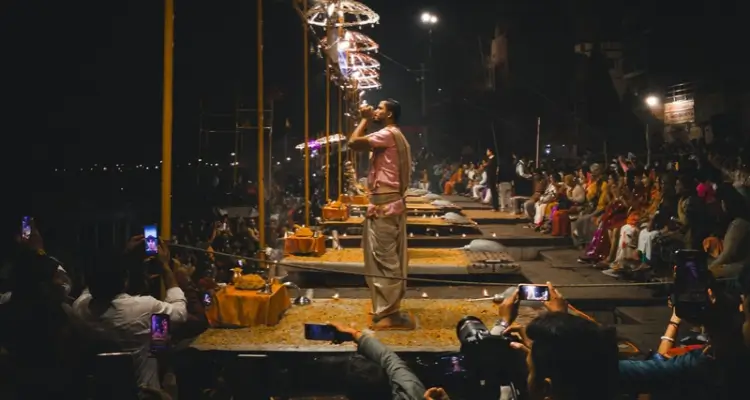
The river is almost black by the time the bells begin. Small leaf boats filled with marigolds and a single flame drift past the hull, and on the steps above, young priests in saffron and gold raise tall brass lamps in slow, perfect circles. Smoke from camphor and incense rises into the evening air, and the chanting rolls out across the water. Watching the Ganga Aarti in Varanasi from a boat is one of the most moving evenings in India, and also one of the most chaotic if it is not arranged properly. Hundreds of boats crowd the river in front of Dashashwamedh, and the difference between a wonderful evening and a frustrating one often comes down to the boat you book, when you board and where your boatman parks. This guide covers the evening ceremony timings through the year, the different types of boat on the river, what a private Ganga Aarti boat costs, how sunrise compares with the evening, where to board and how to keep the crowds at a comfortable distance. Everything here is aimed at travellers who want a calm, private evening on the river rather than a scramble for a seat.
Varanasi holds several riverside ceremonies each evening, but the one most travellers come to see takes place at Dashashwamedh, the city's busiest and best known set of riverside steps. A smaller, older ceremony is held at the neighbouring Rajendra Prasad steps, and another takes place further south at Assi. The Dashashwamedh ceremony is the grandest. A row of young priests, usually five to seven, stand on raised wooden platforms facing the river, each with an identical set of brass lamps, incense, conch shells, yak-tail whisks and peacock-feather fans. They move in near-perfect unison to chanting, bells and drums. It is a ceremony of thanks to the river Ganges, and it is performed every evening of the year, rain or shine.
The Ganga Aarti timing follows sunset, so it shifts through the year. In winter, from roughly November to February, the ceremony usually begins between about 6 and 6:30 in the evening. In summer, from about April to August, it begins later, generally between about 6:45 and 7:15. Spring and autumn fall in between. The main ceremony itself lasts around 45 minutes, though the build-up begins well before that, as the platforms are prepared, the lamps are lit and the crowd gathers on the steps. Because the exact start time can move by a few minutes from day to day, it is wise to confirm with your hotel or boatman on the morning of the visit.
To watch from a boat, you need to be on the water at least an hour before the ceremony begins. Boats take their positions in front of the steps from late afternoon, and the best spots, close to the platforms and roughly in line with the centre of the ceremony, fill up first. On a typical winter evening, aim to board between about 4:30 and 5 in the afternoon. That leaves time for a gentle trip along the riverfront in the soft light of late afternoon before you settle into position for the aarti itself.
The monsoon changes everything. From roughly July to September, the Ganges rises dramatically, sometimes by many metres, and covers the lower steps entirely. In those months the ceremony is moved higher up the steps or onto nearby rooftops. When the current is strong, the local administration can suspend boat services altogether for safety. If your trip falls during the monsoon, treat a boat as a possibility rather than a certainty, and be ready to watch from a rooftop terrace or the upper steps instead.
There are also special nights when the river is busier than ever. The most famous is Dev Deepawali, held on the full moon night about two weeks after Diwali, usually in November. On this night the entire riverfront is lit with hundreds of thousands of small oil lamps. It is extraordinarily beautiful, but boats are booked out weeks in advance, prices multiply several times over, and the river becomes crowded to the point of gridlock. Diwali itself, the Ganga Dussehra festival in early summer and large religious gatherings also bring heavy crowds. If you want a quieter evening, avoid those dates. If you want to be there for them, book very early through someone you trust.
Three types of boat work the river in Varanasi, and each gives a very different evening. Knowing the difference is the most useful thing you can do before booking a Varanasi boat ride.
The traditional choice is a rowing boat, a simple wooden boat with a boatman at the oars. These boats usually seat two to six passengers on low wooden benches or cushions, and they move slowly and quietly along the river. The pace allows you to hear the bells and chanting drift across the water without an engine humming beneath you. For many travellers, a private rowing boat is the most atmospheric way to see the aarti and the riverfront. It does have limits. It cannot easily push into a good position on a crowded evening. It is slow against the current, so the route is shorter. And on a cold winter evening, there is little shelter. For couples and small families who want the most authentic experience, it is still the first choice.
A motor boat is a larger wooden boat fitted with a small diesel engine, usually seating six to twenty passengers or more. Motor boats can cover more of the riverfront in less time, reaching both the burning steps at Manikarnika in the north and Assi in the south before the ceremony. They are also easier to manoeuvre into position in front of Dashashwamedh. The drawback is noise and fumes. The engine is usually switched off once the boat is parked for the ceremony, but on the way the sound can intrude. For families, groups or anyone short on time, a private motor boat is the practical option.
The most comfortable option is a large wooden boat, sometimes with two decks, a flat roof terrace, cushions, low tables and even a small cabin. These are the traditional pleasure boats of the river. They are rowed or motor-assisted, and they move slowly and steadily. The upper deck gives a raised view over the smaller boats in front of the ceremony, which is a real advantage on a busy evening. Some luxury hotels and specialist operators run their own versions with blankets, lanterns, tea, snacks and a guide or musician on board. For a special occasion, a honeymoon or anyone who values comfort and space, a private large wooden boat is the most elegant way to watch the aarti.
There are also shared boats, usually motor boats sold by the seat at the steps, where you join a group of other passengers. They are inexpensive and fine for a quick look. They are often crowded, though, the route and position are fixed, and you have no say over when the boat leaves. For a luxury trip, a private boat of any kind is worth the extra cost.
Whichever boat you choose, check its condition before you board. Look for life jackets, which should be on board and offered to every passenger, a dry, stable deck, and a boatman who seems calm and experienced. The best boats are usually arranged through a hotel or a reputable operator. They know the boatmen, pay them fairly and choose sturdy boats. Avoid boats overloaded with passengers, and never stand up suddenly or lean over the side to take photographs during the ceremony, when boats are packed tightly together.
Boat prices in Varanasi are rarely fixed. They change with the season, the festival calendar, the time of day, the boat type and the person doing the bargaining. Government-notified rates exist for some routes, but in practice most boats are priced by negotiation. The figures below reflect what travellers typically pay for a private evening boat in Varanasi in peak season, on the higher, realistic side for international visitors booking through a hotel or operator.
A private rowing boat for the evening aarti, usually for around one and a half to two hours including the riverfront trip and the ceremony, typically costs Rs.1,500 to Rs.3,000 for the boat, roughly 17 to 34 US dollars. Booked directly with a boatman at the steps, the price can be lower. Booked through a luxury hotel, with a guide and a guaranteed position, it can be higher.
A private motor boat for the evening, seating up to about ten, typically costs Rs.2,500 to Rs.5,000, about 28 to 57 US dollars. Larger motor boats for bigger groups cost more.
A private large wooden boat is the premium choice. Depending on size, decoration, catering and season, it usually costs Rs.6,000 to Rs.15,000 for the evening, roughly 70 to 170 US dollars. Hotel-run versions with a dedicated host, tea and snacks, blankets and a musician can cost more. Shared seats on motor boats, by contrast, usually cost a few hundred rupees per person.
For a couple on a private evening in Varanasi, a typical budget looks like this:
That brings a well-run evening to roughly Rs.6,000 to Rs.12,500, about 70 to 140 US dollars. Choosing a large wooden boat with catering raises the total to around Rs.12,000 to Rs.22,000.
Several things push prices up sharply. On Dev Deepawali, private boats can cost five to ten times the normal rate, and large boats are often sold out weeks ahead. Diwali, Christmas, New Year and long weekends in India also bring higher demand. Boats booked at the last minute on a busy evening are usually more expensive and less well positioned.
Agree the details before you board. Confirm the price for the boat, not per person, the total duration, the route, and whether the boat will stay in position for the whole ceremony. Agree too on whether the guide and any tea or snacks are included. A private tour operator in Varanasi can fix all of this in advance and have the boat waiting at a set time. That is particularly useful on busy evenings, when finding a reliable boat on the spot can be stressful.
Many travellers ask whether to take the boat in the evening for the aarti or at dawn for the famous sunrise boat ride on the Ganges. The honest answer is both, if you have two nights in Varanasi, because they are entirely different experiences.
The evening aarti boat is about ceremony and atmosphere. The light fades, lamps glow on the steps, bells ring, the chanting rises, and the river fills with floating flames and flowers. It is theatrical, emotional and busy. You share it with thousands of people on the steps and hundreds of boats on the water. The noise of drums and loudspeakers can be intense, especially at Dashashwamedh. It is the right choice for travellers who want to see the city's devotion at its most dramatic.
The sunrise boat ride is quieter and more reflective. Boats usually leave between about 5 and 6:30 in the morning, depending on the season, and drift along the riverfront as the sun rises over the far bank. The steps come alive with ordinary morning life. Pilgrims bathe in the river, priests perform small rituals, men practise yoga and exercise, women wash clothes, and boatmen call to one another. At Assi, a dawn ceremony called Subah-e-Banaras is held each morning, with music, chanting and a smaller aarti. It makes a lovely start to a sunrise boat. The light at dawn is soft and golden, the air is cool, and the river is far less crowded. Many photographers prefer this time over the evening.
A private rowing boat at sunrise usually costs about the same as in the evening, or slightly less, typically Rs.1,500 to Rs.2,500 for one to two hours. Motor boats and large wooden boats are also available at dawn, and some hotels serve tea and breakfast on board.
There are a few practical differences. The evening aarti is the more crowded experience, so your choice of boat, positioning and timing matters more. At dawn, there is room to drift wherever you like. In winter, dawn on the river is cold, often around 7 to 10 degrees Celsius, and mist can hang over the water until mid-morning. It is beautiful but chilly, so bring warm layers and a scarf. The evening is usually milder.
On a short stay with only one night, choose the evening aarti if you want the ceremony, and sunrise if you want the city's everyday spiritual life and quieter photographs. With two nights, do the evening ceremony on the first night and sunrise on the second morning. That way you see both faces of the river, and you will have a sense of the city before facing the busiest moment.
Boats can be boarded at almost any point along the riverfront, but a few places make the evening easier. Dashashwamedh is the obvious choice, because the ceremony takes place right there. It is also the most crowded, and getting through the lanes to the water's edge in the late afternoon can be slow and tiring. Many private boats leave instead from Assi in the south, Kedar or Rana Mahal, and then travel north along the river to Dashashwamedh. Others board near the riverside hotels in the old city. That gives a gentler start and a beautiful trip along the riverfront before the ceremony.
Cars cannot enter the narrow lanes of the old city, and in the evening traffic near Dashashwamedh is heavily restricted. Your driver will usually drop you at the Godowlia crossing or a similar point, from where it is a walk of about ten to fifteen minutes through crowded streets to the water. Pedal taxis and small electric carts also run the last stretch. Comfortable shoes, a small bag and a guide who knows the lanes make this much easier. Travellers staying at riverside hotels such as BrijRama Palace, which sits on the Darbhanga steps close to the ceremony, can often board a boat almost from the hotel's own steps, which avoids the crowds entirely. Hotels in the cantonment area, such as Taj Ganges and Taj Nadesar Palace, are more spacious and quieter but sit farther from the river, so the drive and walk need more time.
On the water, positioning matters most. Ask your boatman to arrive early and park in front of the main platforms rather than behind a wall of other boats. A slightly side-on position, a few boats back, often gives a clearer and calmer view than a crush right at the front. Large wooden boats with an upper deck have a natural advantage here. Expect boats to tie up side by side, and accept that other passengers will step across your boat to reach theirs. It is part of the scene.
A few crowd tips make a real difference. Keep your valuables in a zipped bag and your phone on a strap. Pickpocketing is not common on boats, but dropped phones are, and anything that falls into the river is lost. Hawkers selling flowers, lamps, tea and souvenirs often row up alongside. A polite "no, thank you" is usually enough. If you would like to float a leaf-boat lamp on the river, buy one from a vendor, light it carefully and set it gently on the water. It is a small and lovely gesture.
Respect matters on the river. The ceremony is an act of worship, not a performance, so stay seated and quiet during the most solemn parts. Photography of the aarti from a boat is accepted and very common, but turn off the flash. Never photograph cremations at the cremation steps at Manikarnika or Harishchandra. Families are mourning their dead, and photographs are strictly unwelcome there. Your boat may pass these places on the way to the aarti. Look quietly, ask your guide questions softly, and put the camera away. Dress modestly, with shoulders and knees covered, and carry a light shawl for cool evenings and for covering up if needed.
Finally, keep the evening simple. Varanasi can be overwhelming, and a calm, well-arranged private boat with a good boatman and a thoughtful guide turns the aarti from a crowded spectacle into one of the most peaceful and memorable hours of an entire trip to India.
It follows sunset, so the timing changes through the year. It usually begins around 6 to 6:30 in the evening in winter and around 6:45 to 7:15 in summer, and lasts about 45 minutes.
Board at least an hour before the ceremony starts, around 4:30 to 5 in the afternoon in winter. That gives time for a riverfront trip and a good position in front of the platforms at Dashashwamedh.
A private rowing boat usually costs ₹1,500 to ₹3,000 for the evening, a private motor boat ₹2,500 to ₹5,000, and a large wooden boat ₹6,000 to ₹15,000. Prices rise sharply on festival nights.
A private rowing boat is the most atmospheric for couples, a motor boat is practical for groups, and a large wooden boat with an upper deck gives the best raised view and most comfort on busy evenings.
A boat gives a calmer seat and the whole ceremony framed against the lit steps. Watching from the steps puts you closer to the priests but in a dense crowd, so many travellers do both on different evenings.
They are different experiences. The evening is ceremonial, dramatic and crowded, while sunrise is quiet, reflective and full of everyday river life. With two nights in Varanasi, do both.
From roughly July to September, high water and strong currents can lead the administration to suspend boat services. The aarti continues on higher steps or rooftops, so be ready to watch from land instead.
Dashashwamedh is closest but very crowded. Boarding at Assi, Kedar or near a riverside hotel and travelling along the river to the ceremony is usually calmer and more scenic.
Generally yes, with a reputable boatman and a sturdy boat. Ask for life jackets, avoid overloaded boats, stay seated during the ceremony and keep phones and cameras on a strap.
Photography of the ceremony is widely accepted, but turn off the flash and stay seated. Never photograph cremations at Manikarnika or Harishchandra, where families are grieving.